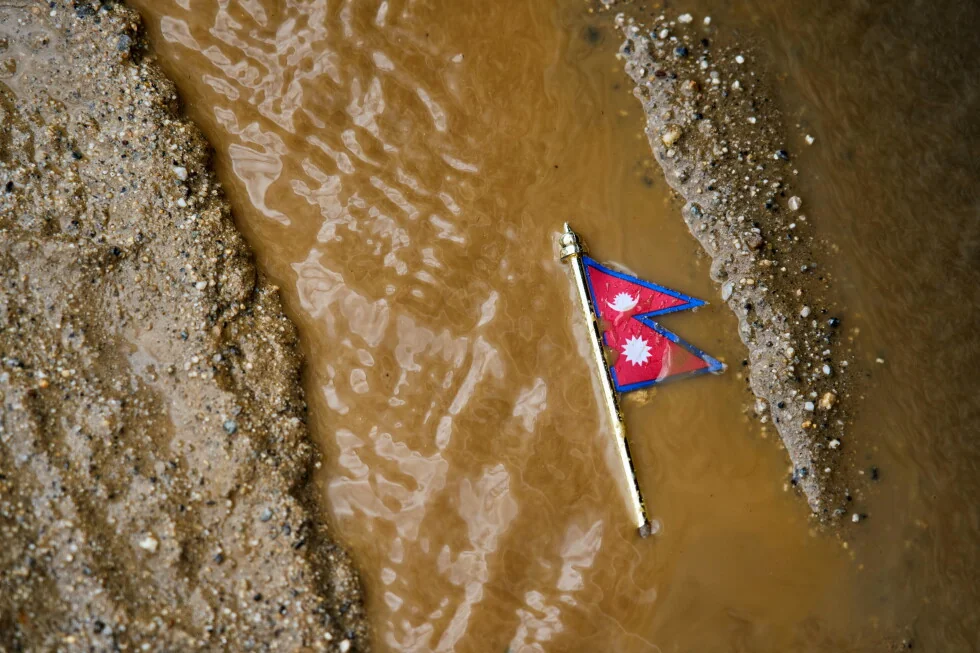
Las inhumaciones masivas en Nepal superan el millar de víctimas mortales por las inundaciones repentinas
September 1st, 2026
Las inhumaciones masivas en Nepal superan el millar de víctimas mortales por las inundaciones repentinas
🇪🇸 Español
On Tuesday, rescue teams accompanied by canine units continued to sift through mud, rock, and debris along the Nepal–China frontier in search of the thousands still unaccounted for in the wake of the catastrophic inundations that ravaged Himalayan communities, claiming upwards of 1,000 lives.
As police in Kathmandu interred scores of bodies across multiple trenches, Nepal’s disaster management authority reported that 1,003 fatalities had been documented in the region, with 3,916 individuals unaccounted for, among them 583 foreign nationals.
In its most recent communiqué, China confirmed 16 deaths and 546 persons missing, inclusive of 261 non-nationals.
The magnitude of the catastrophe that unfolded on Aug. 26 is severely impeding rescue operations across both nations, as landslides, obliterated thoroughfares, and extensive devastation have effectively severed access to isolated regions.
Emergency personnel contended with formidable conditions while navigating precarious terrain and vast expanses of rubble, prompting grave apprehensions that the casualty count may escalate precipitously as responders eventually reach these cut-off communities.
Rescuers are racing against time to reach hundreds of workers believed to be entombed within tunnels at hydropower installations in Nepal that have been ravaged by the floods.
Approximately 900 workers remain unaccounted for across 12 projects, with an estimated 500 thought to be trapped in the subterranean passages, according to local authorities.
Brig. Gen. Raja Ram Basnet, Nepal’s army spokesperson, stated that teams augmented by foreign specialists were engaged across multiple hydropower installations.
Imagery disseminated by the military depicted rescue contingents penetrating debris-laden tunnels and forging through mire and water in their quest to detect any vestige of survival.
On the Chinese front, rescue crews conducted exhaustive search operations across the mudslide-devastated areas, with particular emphasis on the Gyirong Port border crossing, which had been utterly obliterated.
Some rescuers, assisted by canine search teams, probed the interstices among rockfalls and detritus for vestiges of life.
Concurrently, other contingents deployed heavy earthmoving equipment to clear a principal thoroughfare leading to Gyirong Port, endeavoring to facilitate the unimpeded passage of machinery, personnel, and provisions into the afflicted zone, as reported by China’s state-run Global Times newspaper.
In Kathmandu, police toiled through torrential rain on Tuesday to inter scores of corpses in multiple trenches adjacent to a wooded expanse.
The perimeter was fortified with barbed wire, and the graves of those whose identities had yet to be ascertained were demarcated by blue, numbered markers.
Nepalese authorities have been interring the deceased in provisional burial sites pending formal identification, whilst concurrently extracting DNA specimens, photographing distinctive facial morphology, and cataloguing supplementary identifying characteristics.
Each body is assigned a unique reference identifier, thereby facilitating subsequent identification and retrieval by the families concerned.
According to Nepalese authorities, no fewer than 11,814 individuals have thus far been extracted from peril.
Emergency response teams have deployed helicopters and assorted fixed-wing aircraft to access isolated communities in regions where the deluge and landslides have obliterated roadways and bridges.
Relief operations are being intensified for survivors in regions where road networks and other transport arteries have been compromised or rendered impassable.
Guo Jiakun, spokesperson for China’s Foreign Ministry, announced that a second consignment of relief supplies—comprising drones, DNA-testing apparatus, and water-purification equipment—was being dispatched to Nepal, and further noted that Chinese experts in DNA analysis would assist in the identification of the deceased.
Bimal Sharma, a helicopter pilot who has been conducting rescue and relief operations, expressed his profound shock upon witnessing the devastation in Timure, a border town adjacent to Tibet with which he has maintained a long-standing familiarity.
“It felt as though I were soaring over an entirely alien terrain,” remarked Sharma, noting that he has had scant opportunity to converse with those he had rescued.
“I can discern the anguish in their eyes. It is profoundly disheartening,” he observed.
The catastrophe originated in the Himalayas when a glacial collapse precipitated vast quantities of rock, ice, and meltwater into the valleys below, engendering devastating floods downstream.
Analysts examining satellite imagery posited that the collapse likely stemmed from the structural failure of bedrock underlying a glacier within the Himalayan range, with the resultant rockfall generating sufficient force to register as a seismic event of magnitude 5.2.
The resultant torrential surge of water and debris cascaded into the river systems traversing the valleys of Tibet and Nepal, precipitating a rapid and perilous escalation in their water levels.
The ensuing inundation obliterated dwellings, edifices, thoroughfares, and bridges, whilst concurrently transporting vast quantities of silt and boulders downstream.
Nepal’s Prime Minister Balendra Shah asserted that the catastrophe served to underscore the imperative for decisive, coordinated measures to combat the escalating climate crisis.
“This incident has evinced that the perils confronting us in the Himalayan region are escalating in tandem with climate change,” Shah articulated in a social media post on Monday evening.
“Consequently, this region must remain vigilant, and simultaneously, the moment has arrived for us to forcefully foreground the issue of climate-induced calamities before the international community.”
September 1st, 2026
Trending Articles
Los líderes de la ONU se reúnen mientras el secretario general aboga por un «mundo construido sobre la interdependencia»
UN leaders convene as secretary-general advocates a ‘world built on interdependence’
Los líderes de la ONU se reúnen mientras el secretario general aboga por un «mundo construido sobre la interdependencia»
UN leaders convene as secretary-general advocates a ‘world built on interdependence’
Trump firma un pacto entre EE. UU., Dinamarca y Groenlandia para reforzar la seguridad en el Ártico
Trump Inks US-Denmark-Greenland Pact to Fortify Arctic Security
Trump firma un pacto entre EE. UU., Dinamarca y Groenlandia para reforzar la seguridad en el Ártico
Trump Inks US-Denmark-Greenland Pact to Fortify Arctic Security
En la ONU, Trump defiende ante los líderes mundiales la guerra contra Irán
At UN, Trump Defends War on Iran to World Leaders
En la ONU, Trump defiende ante los líderes mundiales la guerra contra Irán
At UN, Trump Defends War on Iran to World Leaders
Los diplomáticos describen un mundo en convulsión mientras se inaugura la reunión anual de la ONU: caótico, problemático, impredecible
Diplomats depict a world in turmoil as UN annual meeting convenes: messy, troubled, unpredictable
Los diplomáticos describen un mundo en convulsión mientras se inaugura la reunión anual de la ONU: caótico, problemático, impredecible
Diplomats depict a world in turmoil as UN annual meeting convenes: messy, troubled, unpredictable
La propuesta de la UE de un «miembro asociado» para Canadá: posibles implicaciones
The EU’s “associate member” overture to Canada: potential implications
La propuesta de la UE de un «miembro asociado» para Canadá: posibles implicaciones
The EU’s “associate member” overture to Canada: potential implications

La Casa Blanca anuncia que Trump se reunirá con la presidenta interina de Venezuela, Delcy Rodríguez, en Nueva York la próxima semana
Trump to convene with Venezuelan acting President Delcy Rodríguez in New York next week, White House announces
La Casa Blanca anuncia que Trump se reunirá con la presidenta interina de Venezuela, Delcy Rodríguez, en Nueva York la próxima semana
Trump to convene with Venezuelan acting President Delcy Rodríguez in New York next week, White House announces
La economía rusa en tiempos de guerra afronta una erosión a largo plazo por la deuda y el gasto militar
Russia’s Wartime Economy Faces Long-Term Erosion from Debt and Military Spending
La economía rusa en tiempos de guerra afronta una erosión a largo plazo por la deuda y el gasto militar
Russia’s Wartime Economy Faces Long-Term Erosion from Debt and Military Spending

Rusia emprende tres días de votación en unas elecciones parlamentarias dispuestas a afianzar el poder del Kremlin
Russia Embarks on Three Days of Voting in Parliamentary Election Poised to Entrench Kremlin’s Power
Rusia emprende tres días de votación en unas elecciones parlamentarias dispuestas a afianzar el poder del Kremlin
Russia Embarks on Three Days of Voting in Parliamentary Election Poised to Entrench Kremlin’s Power

EE. UU. concede visados a altos líderes iraníes para la reunión de alto nivel de la ONU pese a las hostilidades en tiempo de guerra
US grants visas to top Iranian leaders for UN high-level meeting despite wartime hostilities
EE. UU. concede visados a altos líderes iraníes para la reunión de alto nivel de la ONU pese a las hostilidades en tiempo de guerra
US grants visas to top Iranian leaders for UN high-level meeting despite wartime hostilities
Expertos respaldados por la ONU alegan posibles crímenes de guerra de EE. UU. en ataques contra Irán
UN-backed experts allege potential US war crimes in Iran strikes
Expertos respaldados por la ONU alegan posibles crímenes de guerra de EE. UU. en ataques contra Irán
UN-backed experts allege potential US war crimes in Iran strikes