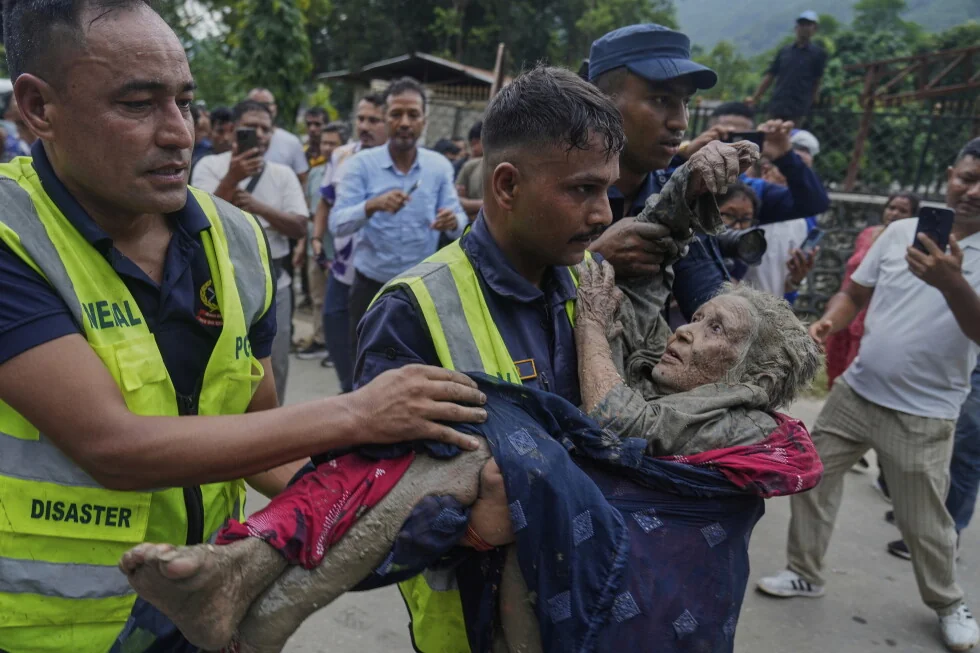
Las inundaciones catastróficas se cobran más de 360 vidas en Nepal y el Tíbet, con más de 1.400 personas aún sin localizar.
August 27th, 2026
Las inundaciones catastróficas se cobran más de 360 vidas en Nepal y el Tíbet, con más de 1.400 personas aún sin localizar.
🇪🇸 Español
On Thursday, rescue teams and military helicopters conducted an exhaustive search for hundreds of individuals reported missing along the Nepal–China frontier, where a catastrophic surge of water and mud, rising to the height of several storeys, had inundated communities the preceding day following the collapse of a glacier.
Footage of the catastrophe depicted individuals fleeing as the inundating waters engulfed them, sweeping away edifices and infrastructure.
Authorities reported a death toll exceeding 360, with upwards of 1,400 individuals unaccounted for, among them numerous foreign nationals and pilgrims.
Additionally, hundreds have been rendered homeless throughout the Himalayan expanse.
The precipitous escarpments and verdant valleys descending from the Himalayan massif — which harbor numerous of the planet's loftiest summits and its remaining glacial expanses — exhibit a pronounced susceptibility to inundation and slope failure.
The accelerated ablation of glaciers has become increasingly prevalent as a direct consequence of anthropogenic climate perturbation.
Imagery revealed what appeared to be the second storeys of edifices in Nepal’s severely afflicted Nuwakot district, encrusted with silt following the torrent’s passage.
Riverbanks and village thoroughfares lay submerged beneath a layer of mud.
Debris dangled from arboreal branches and overhead cables.
Motor vehicles were entombed, while certain stupefied survivors found themselves caked in sediment.
Broadcast by the state-run China Central Television, comparative imagery revealed a multi-storey edifice and upward of a dozen vehicles entombed beneath a thick layer of mud.
A two-lane thoroughfare skirting a river within a valley in Tibet’s Shigatse prefecture lay wholly submerged.
Aerial reconnaissance further disclosed the formation and expansion of a lake along the Sino-Nepalese frontier.
Nirajan Paudyal, a journalist based in Nepal's capital of Kathmandu, was consumed by profound trepidation regarding the well-being of his parents and other relatives residing in the district's village of Soley.
"I apprehend that no update will be forthcoming," Paudyal remarked.
The catastrophe has rendered no fewer than 910 individuals unaccounted for in Nepal, while the authorities in Tibet—an autonomous region of the People's Republic of China—have documented a minimum of three fatalities and 558 persons whose whereabouts remain unknown.
Nepalese officials reported that a multitude of bridges had been annihilated and approximately 40 kilometers (25 miles) of roadways left in a state of disrepair, thereby severely hampering search and rescue endeavors.
The Nepalese army has effected the aerial extraction of over one hundred individuals via helicopter, as confirmed by army spokesperson Brig. Gen. Raja Ram Basnet.
Furthermore, military contingents have successfully extricated personnel entrapped within installations associated with the Trishuli hydropower project, he added.
A considerable multitude of the wounded were conveyed to Kathmandu for the purpose of receiving specialized medical intervention.
Rescuers exhumed human remains in the Chitwan district, situated hundreds of kilometers downstream from the epicenter of the devastation, which bore the full force of the calamity.
Bishal Kumar Bhandari, chairman of the Nepal Red Cross Society, articulated that the organization has reoriented its strategic focus from rescue operations to comprehensive relief initiatives across the flood-ravaged districts.
He further expounded that approximately 1,200 individuals have been uprooted from at least three villages, underscoring the magnitude of the displacement.
In Tibet, a torrential mudslide that struck Wednesday near the land border crossing of Gyirong Port engulfed a multistory port building and deposited mud across the surrounding areas to an average depth exceeding 1½ meters (5 feet), Chinese state broadcaster CCTV reported.
All roads leading to the crossing were rendered impassable, while the persistence of rainfall in the region raised the specter of secondary collapses or landslides, it added.
Premier Li Qiang of China arrived in Gyirong on Thursday to orchestrate rescue operations, accompanied by 500 military and paramilitary personnel.
Military helicopters circled overhead, conducting aerial reconnaissance for survivors, appraising the extent of the devastation, and delineating viable rescue and evacuation corridors.
Chinese authorities further cautioned that the nascent lake, formed at the confluence of the Tsogyal and Purupqiangzangbu rivers, is currently experiencing overflow and poses an imminent risk of breach.
Tom Fletcher, the United Nations’ humanitarian chief, announced Thursday via X that he had authorized the disbursement of $2 million from the U.N.'s Central Emergency Response Fund to facilitate medical care, shelter, and water provision, characterizing the floods as “horrifying.”
"We pledge to support national efforts to deliver emergency aid and support," U.N. Secretary-General Antonio Guterres told reporters.
Within the disaster-stricken region, countless individuals languished in a state of profound uncertainty, desperately awaiting definitive news as to whether their cherished kin had managed to survive the calamitous event.
Shova Shrestha, 33, has devoted over a day to seeking any word of her husband, Rajan Shrestha.
She recounted that his phone rang upon her initial call following the floods, yet subsequently became unreachable.
Since that time, she has scrutinized every helicopter touching down in Bidur, the administrative seat of Nuwakot district, harboring the hope that he might number among the survivors.
"I find myself perpetually scrutinizing each helicopter, clinging to the faint hope that he will emerge from it," Shova remarked.
According to the Nepal Tourism Board, 517 foreign nationals are enumerated among the missing.
The board articulated that the cohort encompasses 178 individuals of Indian provenance, in excess of 60 hailing from the United States, and nationals originating from 30 other sovereign states, including Ukraine, the United Kingdom, South Africa, and Japan.
A substantial proportion of the missing are believed to have been undertaking a pilgrimage to Mount Kailash in Tibet, a site of profound sanctity for Hindus, Buddhists, and adherents of other faiths.
According to a post on X by Indian spiritual guru Sadhguru Jaggi Vasudev, seventy-seven members of a single pilgrimage cohort were entrapped by the inundation at the border's immigration office.
A visibly distraught Sadhguru conveyed in a video that the cohort comprised 22 Americans alongside individuals from a multitude of other nations, noting that no official intelligence had been received regarding their current whereabouts.
The U.S. State Department has reported that 90 American citizens remain unaccounted for in China and Nepal in the wake of the catastrophic flooding.
The department has stated that it is not aware of any U.S. fatalities and has confirmed that three Americans have been successfully rescued.
The Indian Ministry of External Affairs announced on Thursday that 288 of the nation's citizens, including several operatives engaged in a power-generation venture, remain unaccounted for.
Chinese Ministry of Foreign Affairs spokesperson Lin Jian announced that approximately one hundred Chinese nationals remain unaccounted for in Nepal, and based on preliminary intelligence, 260 of those reported missing in Tibet were foreign citizens.
The U.S. Geological Survey initially documented a magnitude 4.4 seismic event occurring in the early hours of Wednesday, situated approximately 65 kilometers (40 miles) north of Kathmandu, in close proximity to the border.
Subsequently, the agency revised its assessment, determining that the seismic event in question was, in fact, a magnitude 5.2 glacial collapse, which precipitated a downstream surge of debris.
Climate experts affiliated with the Kathmandu-based International Center for Integrated Mountain Development posited that a glacial avalanche was the probable catalyst for Wednesday's flash flood.
In an emailed statement, they asserted that water levels at a specific juncture along the Trishuli River surged by as much as 9 meters (27 feet) within a mere half-hour span.
The increasingly precarious Himalayan cryosphere imperils communities, critical infrastructure, and water security throughout one of the planet's most densely inhabited territories.
The region experienced analogous flash flood phenomena in August 2025, when a glacial lake in Tibet breached its confines as a consequence of anomalously elevated temperatures.
Nine fatalities were documented, and critical infrastructure—including the bridge linking Nepal and China—sustained considerable impairment.
August 27th, 2026
Trending Articles
Los líderes de la ONU se reúnen mientras el secretario general aboga por un «mundo construido sobre la interdependencia»
UN leaders convene as secretary-general advocates a ‘world built on interdependence’
Los líderes de la ONU se reúnen mientras el secretario general aboga por un «mundo construido sobre la interdependencia»
UN leaders convene as secretary-general advocates a ‘world built on interdependence’

Trump firma un pacto entre EE. UU., Dinamarca y Groenlandia para reforzar la seguridad en el Ártico
Trump Inks US-Denmark-Greenland Pact to Fortify Arctic Security
Trump firma un pacto entre EE. UU., Dinamarca y Groenlandia para reforzar la seguridad en el Ártico
Trump Inks US-Denmark-Greenland Pact to Fortify Arctic Security
En la ONU, Trump defiende ante los líderes mundiales la guerra contra Irán
At UN, Trump Defends War on Iran to World Leaders
En la ONU, Trump defiende ante los líderes mundiales la guerra contra Irán
At UN, Trump Defends War on Iran to World Leaders
Los diplomáticos describen un mundo en convulsión mientras se inaugura la reunión anual de la ONU: caótico, problemático, impredecible
Diplomats depict a world in turmoil as UN annual meeting convenes: messy, troubled, unpredictable
Los diplomáticos describen un mundo en convulsión mientras se inaugura la reunión anual de la ONU: caótico, problemático, impredecible
Diplomats depict a world in turmoil as UN annual meeting convenes: messy, troubled, unpredictable
La propuesta de la UE de un «miembro asociado» para Canadá: posibles implicaciones
The EU’s “associate member” overture to Canada: potential implications
La propuesta de la UE de un «miembro asociado» para Canadá: posibles implicaciones
The EU’s “associate member” overture to Canada: potential implications

La Casa Blanca anuncia que Trump se reunirá con la presidenta interina de Venezuela, Delcy Rodríguez, en Nueva York la próxima semana
Trump to convene with Venezuelan acting President Delcy Rodríguez in New York next week, White House announces
La Casa Blanca anuncia que Trump se reunirá con la presidenta interina de Venezuela, Delcy Rodríguez, en Nueva York la próxima semana
Trump to convene with Venezuelan acting President Delcy Rodríguez in New York next week, White House announces

La economía rusa en tiempos de guerra afronta una erosión a largo plazo por la deuda y el gasto militar
Russia’s Wartime Economy Faces Long-Term Erosion from Debt and Military Spending
La economía rusa en tiempos de guerra afronta una erosión a largo plazo por la deuda y el gasto militar
Russia’s Wartime Economy Faces Long-Term Erosion from Debt and Military Spending

Rusia emprende tres días de votación en unas elecciones parlamentarias dispuestas a afianzar el poder del Kremlin
Russia Embarks on Three Days of Voting in Parliamentary Election Poised to Entrench Kremlin’s Power
Rusia emprende tres días de votación en unas elecciones parlamentarias dispuestas a afianzar el poder del Kremlin
Russia Embarks on Three Days of Voting in Parliamentary Election Poised to Entrench Kremlin’s Power

EE. UU. concede visados a altos líderes iraníes para la reunión de alto nivel de la ONU pese a las hostilidades en tiempo de guerra
US grants visas to top Iranian leaders for UN high-level meeting despite wartime hostilities
EE. UU. concede visados a altos líderes iraníes para la reunión de alto nivel de la ONU pese a las hostilidades en tiempo de guerra
US grants visas to top Iranian leaders for UN high-level meeting despite wartime hostilities
Expertos respaldados por la ONU alegan posibles crímenes de guerra de EE. UU. en ataques contra Irán
UN-backed experts allege potential US war crimes in Iran strikes
Expertos respaldados por la ONU alegan posibles crímenes de guerra de EE. UU. en ataques contra Irán
UN-backed experts allege potential US war crimes in Iran strikes