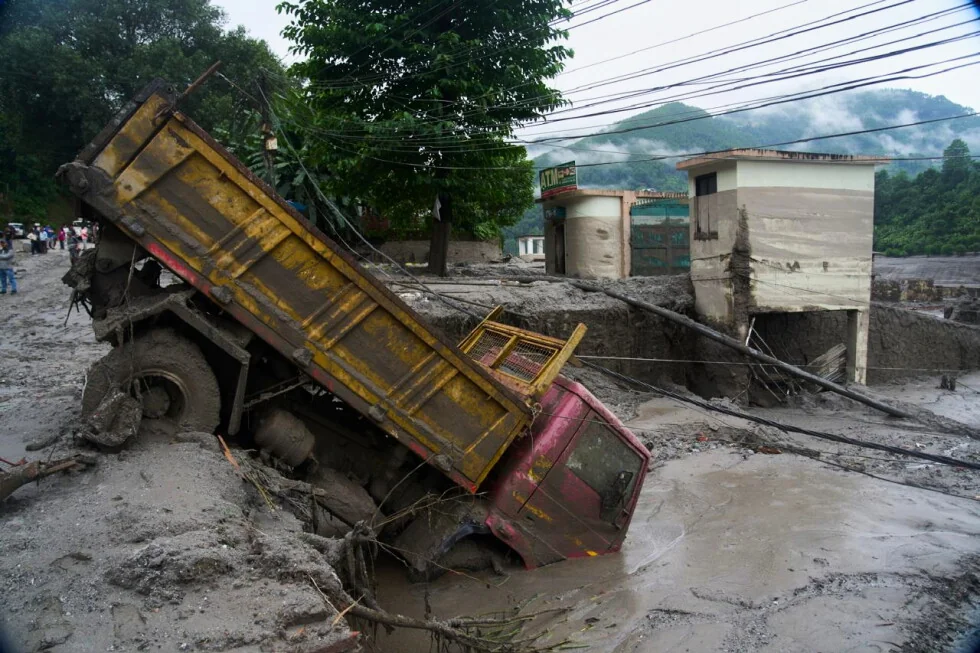
Las inundaciones catastróficas de Nepal subrayan los crecientes peligros glaciares en medio de un arco himalayo que se está calentando.
August 27th, 2026
Las inundaciones catastróficas de Nepal subrayan los crecientes peligros glaciares en medio de un arco himalayo que se está calentando.
🇪🇸 Español
Preliminary scientific investigations indicate that the catastrophic flash flood that struck Nepal on Wednesday was likely precipitated by the detachment of a substantial glacial mass, which transiently obstructed a river's course.
This impoundment, researchers posit, may have subsequently engendered the pent-up waters to surge downstream with formidable force several hours later.
Scientists are still endeavoring to synthesize satellite and ground-level data in order to ascertain precisely what precipitated the flood, a catastrophe that claimed at least 353 lives and left upwards of 1,300 individuals unaccounted for, among them foreign nationals and pilgrims.
The U.S. Geological Survey on Wednesday reported a magnitude 5.2 glacier collapse that precipitated a downstream debris flow with catastrophic repercussions for affected communities.
It stated that its determination was predicated upon data derived from proximate seismic stations, long-period seismic waves, and satellite imagery.
“The lower reaches of the glacier have quite simply detached,” remarked Jakob Steiner, a geoscientist at the University of Graz in Austria currently stationed in Bangladesh.
“Examining the imagery, it appears as though a colossal blade has sliced clean through the entire lower section, and the whole mass has sheared away.”
Steiner posited that a colossal mass of glacial ice plummeting from a considerable altitude could have produced an effect akin to a detonating bomb, thereby precipitating the ensuing pandemonium.
Scientists cautioned that it would be premature to establish a direct causal link between global warming and Wednesday’s catastrophe.
Nevertheless, they contended that as Earth’s temperature escalates owing to anthropogenic activities—namely the combustion of oil, gas, and coal—the probability of such calamities intensifies, particularly within the Himalayan range, which is undergoing warming at a rate considerably surpassing that of numerous other regions worldwide.
“We must exercise caution and refrain from drawing any conclusions at this juncture.
Nevertheless, rising temperatures are precipitating profound transformations across the Hindu Kush Himalaya region and accelerating glacial melt,” remarked Saswat Sanyal, a disaster risk reduction specialist affiliated with the Kathmandu-based International Centre for Integrated Mountain Development, a climate research consortium.
Across the Himalayan expanse, hundreds have been rendered homeless, while authorities have documented extensive devastation to critical infrastructure—encompassing hydropower installations, thoroughfares, edifices, and bridges—throughout the region.
Hydrological assessments conducted by the Kathmandu-based climate research collective indicate that river levels across the inundated region surged by as much as nine meters (29.5 feet) within a thirty-minute interval, a phenomenon attributable to the upstream glacial detachment's resultant displacement wave.
"It was a monumental surge, an abrupt and overwhelming inundation," Sanyal observed.
Preliminary evidence suggests that a substantial mass of ice and rock may have cascaded into the Lhende Khola, a tributary of the Bhote Koshi River.
Researchers posited that the collapse could have displaced water and entrained loose sediment and boulders, thereby generating a formidable surge downstream.
Investigators are also scrutinizing whether debris transiently impounded the river before the accumulated water breached the obstruction, thereby amplifying the flood's magnitude.
Steiner noted that the area possesses a history of catastrophic mountain hazards.
In 2025, a glacial lake outburst flood inundated the same valley, whereas an ice and rock avalanche manifested elsewhere in the region in 2024.
The broader Langtang area was likewise subjected to devastating avalanches during Nepal’s seismic event of 2015.
According to climate scientists, the Hindu Kush Himalaya is undergoing accelerated warming, precipitating profound transformations in its glacial systems, snow cover, permafrost dynamics, and montane slopes.
The mountain range harbors the most extensive accumulation of snow and ice outside the polar regions, with over 63,000 glaciers therein feeding no fewer than ten major Asian river systems, thereby underpinning the food, water, energy, and livelihood security of billions of people.
Nevertheless, approximately 78% of the glacial expanse, situated at elevations ranging from 4,500 to 6,000 meters above sea level, remains acutely susceptible to the effects of climatic warming.
“What transpired yesterday is regrettably the new paradigm.
The trajectory from this juncture portends further deterioration,” Steiner observed.
The penultimate decade constituted the most thermally extreme multi-year interval on the global instrumental record, with 2024 attaining the highest annual mean temperature ever documented.
United Nations assessments indicate that from 2000 through 2019, glacial mass loss averaged 267 gigatons annually—a volume commensurate with the aggregate mass of 46,500 Great Pyramids of Giza.
In an era of escalating global temperatures, the reports project that up to half of all glaciers—excluding those in Greenland and Antarctica—could vanish by 2100, even if the rise in global warming is constrained to 1.5 degrees Celsius (2.7 degrees Fahrenheit).
Extant global policy frameworks consign the planet to a warming trajectory of approximately 2.8 degrees Celsius (5 degrees Fahrenheit) above preindustrial baselines by the century's close.
Research conducted by the Kathmandu-based organization reveals that glaciers across this mountain range are undergoing accelerated ablation, with rates of ice-mass loss having doubled since the turn of the millennium.
The ablation of glaciers can engender the expansion of proglacial lakes, thereby amplifying the propensity for catastrophic outburst floods.
As glaciers recede, the mountain rock that was once insulated and buttressed by ice is now exposed to elevated temperatures, precipitation, and the relentless cycle of freeze–thaw weathering.
Permafrost — ground that has remained frozen for years — may likewise thaw, thereby destabilizing rock faces and slopes.
"The likelihood of material commencing downslope displacement from mountainous terrains is augmented," Steiner observed.
Sanyal posited that such a concatenation of cascading perils may well underlie Wednesday's catastrophic events in Nepal: an avalanche or glacial collapse precipitating a debris flow, subsequent river damming, and a devastating flash flood.
Steiner noted that roughly a tenth of Nepal's power generation capacity was concentrated in the valley ravaged by the latest catastrophe.
He further remarked that the recurring losses cast doubt on whether adequate measures have been undertaken to institute early-warning systems for both inhabitants and tourists, particularly in light of the floods and avalanches that have previously afflicted the region.
The country's topography has perpetually served as an irresistible magnet for tourists, with in excess of one million individuals converging upon its shores annually in recent times.
Scientists contend that increasingly robust early-warning systems, more rigorous monitoring protocols, and expedited cross-border intelligence dissemination will prove progressively indispensable as ambient temperatures escalate and mountainous terrains undergo mounting geomorphological instability.
The surveillance of thousands of glaciers, precipitous slopes, and riverine valleys spanning the Himalayan arc presents an exceptionally formidable challenge.
And when cascading disasters commence, there may be but a fleeting window of mere minutes in which to act.
“We are not afforded the luxury of hours,” Sanyal said.
“At times, we have but a few minutes to prepare.”
Steiner asserted that a "red line" has already been transcended, rendering certain regions of Nepal so hazardous as to be utterly uninhabitable at this juncture.
“We anticipated that prior analogous catastrophes would serve as an unequivocal admonition to the governments of the Himalayan region, yet it remains somewhat disheartening that the devastation never appears sufficiently calamitous to precipitate action,” Steiner remarked.
“I am not unduly sanguine that unequivocal solutions will materialize as of tomorrow,” he added.
“We are cognizant of the requisite measures, yet a multiplicity of stakeholders must effectuate concerted coordination to translate them into reality.”
For any further correspondence, Arasu may be followed on X at @sibi123, and he can be reached via email at [email protected].
The financial underwriting of reporters’ climate and environmental coverage is provided by a consortium of private foundations; however, the Associated Press retains sole editorial responsibility for all content.
Comprehensive details regarding AP’s protocols for philanthropic collaboration, an enumeration of its benefactors, and the delineated scope of funded reporting areas are accessible at AP.org.
August 27th, 2026
Trending Articles
Los líderes de la ONU se reúnen mientras el secretario general aboga por un «mundo construido sobre la interdependencia»
UN leaders convene as secretary-general advocates a ‘world built on interdependence’
Los líderes de la ONU se reúnen mientras el secretario general aboga por un «mundo construido sobre la interdependencia»
UN leaders convene as secretary-general advocates a ‘world built on interdependence’
Trump firma un pacto entre EE. UU., Dinamarca y Groenlandia para reforzar la seguridad en el Ártico
Trump Inks US-Denmark-Greenland Pact to Fortify Arctic Security
Trump firma un pacto entre EE. UU., Dinamarca y Groenlandia para reforzar la seguridad en el Ártico
Trump Inks US-Denmark-Greenland Pact to Fortify Arctic Security
En la ONU, Trump defiende ante los líderes mundiales la guerra contra Irán
At UN, Trump Defends War on Iran to World Leaders
En la ONU, Trump defiende ante los líderes mundiales la guerra contra Irán
At UN, Trump Defends War on Iran to World Leaders
Los diplomáticos describen un mundo en convulsión mientras se inaugura la reunión anual de la ONU: caótico, problemático, impredecible
Diplomats depict a world in turmoil as UN annual meeting convenes: messy, troubled, unpredictable
Los diplomáticos describen un mundo en convulsión mientras se inaugura la reunión anual de la ONU: caótico, problemático, impredecible
Diplomats depict a world in turmoil as UN annual meeting convenes: messy, troubled, unpredictable
La propuesta de la UE de un «miembro asociado» para Canadá: posibles implicaciones
The EU’s “associate member” overture to Canada: potential implications
La propuesta de la UE de un «miembro asociado» para Canadá: posibles implicaciones
The EU’s “associate member” overture to Canada: potential implications

La Casa Blanca anuncia que Trump se reunirá con la presidenta interina de Venezuela, Delcy Rodríguez, en Nueva York la próxima semana
Trump to convene with Venezuelan acting President Delcy Rodríguez in New York next week, White House announces
La Casa Blanca anuncia que Trump se reunirá con la presidenta interina de Venezuela, Delcy Rodríguez, en Nueva York la próxima semana
Trump to convene with Venezuelan acting President Delcy Rodríguez in New York next week, White House announces
La economía rusa en tiempos de guerra afronta una erosión a largo plazo por la deuda y el gasto militar
Russia’s Wartime Economy Faces Long-Term Erosion from Debt and Military Spending
La economía rusa en tiempos de guerra afronta una erosión a largo plazo por la deuda y el gasto militar
Russia’s Wartime Economy Faces Long-Term Erosion from Debt and Military Spending

Rusia emprende tres días de votación en unas elecciones parlamentarias dispuestas a afianzar el poder del Kremlin
Russia Embarks on Three Days of Voting in Parliamentary Election Poised to Entrench Kremlin’s Power
Rusia emprende tres días de votación en unas elecciones parlamentarias dispuestas a afianzar el poder del Kremlin
Russia Embarks on Three Days of Voting in Parliamentary Election Poised to Entrench Kremlin’s Power

EE. UU. concede visados a altos líderes iraníes para la reunión de alto nivel de la ONU pese a las hostilidades en tiempo de guerra
US grants visas to top Iranian leaders for UN high-level meeting despite wartime hostilities
EE. UU. concede visados a altos líderes iraníes para la reunión de alto nivel de la ONU pese a las hostilidades en tiempo de guerra
US grants visas to top Iranian leaders for UN high-level meeting despite wartime hostilities
Expertos respaldados por la ONU alegan posibles crímenes de guerra de EE. UU. en ataques contra Irán
UN-backed experts allege potential US war crimes in Iran strikes
Expertos respaldados por la ONU alegan posibles crímenes de guerra de EE. UU. en ataques contra Irán
UN-backed experts allege potential US war crimes in Iran strikes