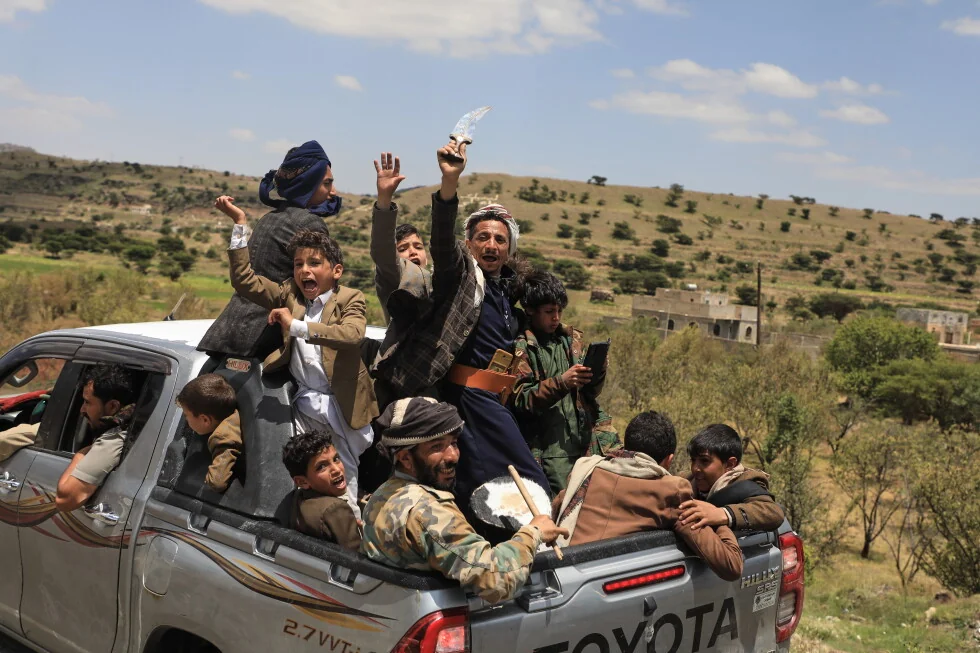
Les Houthis s'emparent de deux îles stratégiques de la mer Rouge dans un contexte de développements au Moyen-Orient
September 14th, 2026
Les Houthis s'emparent de deux îles stratégiques de la mer Rouge dans un contexte de développements au Moyen-Orient
🇫🇷 Français
Yemen’s Houthi insurgents have seized the strategically pivotal islands of Greater and Lesser Hanish in the southern Red Sea, thereby augmenting the Iran-backed rebels’ capacity to exercise dominion over a vital maritime shipping corridor.
Concurrently, repairs to a pivotal Saudi Arabian oil pipeline that sustained an attack last week could endure for three to five weeks, rendering it largely inoperative, according to two regional officials.
What ensues is a précis of the most recent developments in the Middle East.
Exhaustive coverage is obtainable here.
Houthi officials said Monday that rebels had seized the two islands, even as Saudi-backed government forces sought to claw back territory from the rebels’ rapid advances around the Bab el-Mandeb Strait, a vital maritime conduit serving as an alternative to the Strait of Hormuz.
Iran had, in effect, shuttered the Strait of Hormuz — the conduit through which a fifth of the world’s traded oil and gas passes in peacetime — within the opening days of the war.
The Saudis have since resorted to the Bab el-Mandeb Strait, which debouches from the Red Sea, for their crude oil exports.
The Houthis’ most recent conquest—following hard upon last week’s seizure of the Red Sea port of Mokha and a strategically situated island—intensifies the pressure bearing upon Saudi shipments and, by extension, upon global oil supplies and prices.
This could afford Iran augmented leverage in its hostilities with the United States.
Saudi Arabia depends upon the East-West Pipeline to convey crude from Gulf ports to ports along its western, Red Sea coast, whence it may be loaded onto tankers for export.
Two officials, briefed on the matter, averred that remediating the damage wrought by an assault on Sept. 10 could necessitate weeks, including at a principal pumping installation.
The officials, speaking on condition of anonymity owing to their lack of authorization to brief the media, disclosed that one of them indicated the line might function only partially while repair crews carry out their work.
China, a preeminent importer of Middle Eastern oil, denounced the Houthi assaults on Saudi energy infrastructure as “unacceptable,” declaring itself “deeply concerned” about further escalations by the rebels.
— By Samy Magdy, reporting from Cairo
Iranian Foreign Ministry spokesman Esmail Baghaei said Monday that Saudi Arabia had "demanded" that a meeting bringing together Iran with other regional countries to discuss the Strait of Hormuz be scrapped "for the time being."
Baghaei characterised the meeting, which was to be hosted by Oman, as a “proper opportunity” to restore security in the region.
The spokesman stated that an accord between Iran and Oman concerning the Strait of Hormuz had been concluded and would be disclosed at a subsequent juncture.
Saudi Arabia had proffered amendments to the agreement, adducing concerns that it might engender enduring ramifications for the Strait of Hormuz, to the detriment of other Gulf Cooperation Council countries, according to a Gulf official conversant with the matter who, lacking authorization to comment publicly, spoke on condition of anonymity.
Iran excoriated Austria on Monday for its refusal to grant visas to the head of the Iranian nuclear programme and other delegation members seeking to attend the International Atomic Energy Agency’s general conference in Vienna, denouncing the decision as “completely unjustified.”
Baghaei stated that Tehran had summoned the Austrian chargé d’affaires, contending that Austria, by virtue of its status as the host country, was under an obligation to issue the visas.
Baghaei levelled accusations against Western countries of depriving Iran of an opportunity to defend itself, and laid blame at the feet of the U.S. for bringing pressure to bear on Austria to deny the visas.
The refusal constitutes a component of the U.N. sanctions imposed upon Iran, reinstated in the preceding year, which encompass a travel ban targeting Iranian officials.
On Monday, U.S. Energy Secretary Chris Wright excoriated Iran for its failure to cooperate with the U.N. nuclear watchdog.
Wright was notably censorious of Tehran’s refusal to afford U.N. inspectors access to Iran’s nuclear sites affected by the war.
He said that Iran had “ample time to address its egregious negligence” toward its obligations “but that time is up.”
Delivering remarks before the IAEA general conference in Vienna, Wright contended that granting Iran further latitude “only delays overdue accountability.”
Wright asserted that the additional safeguards enshrined within a U.S.-Saudi nuclear accord encompass “absolutely rigorous” stipulations against proliferation.
He apprised the IAEA general conference that the U.N. nuclear agency “was part of it all along.”
The U.S.-Saudi accord, inked in July, might conceivably endow the kingdom with the wherewithal to enrich uranium for its civilian nuclear program.
Wright was responding to a media inquiry as to why the United States had requested that Iran—and not Saudi Arabia—sign an Additional Protocol, an agreement concluded between the IAEA and a given country that affords agency inspectors expanded access to nuclear sites.
Nearly 94,000 people have been displaced from their homes in Yemen since hostilities between Iran-backed Houthi rebels and government forces escalated this month, the International Organization for Migration said Monday.
The most grievously afflicted regions are Taiz and Lahj, wherein 48,000 individuals have been rendered displaced, according to the U.N. agency, which further noted that upwards of 2,000 persons have fled across the sea into Djibouti.
In southwestern Yemen, some 200 schools have been repurposed as shelters to accommodate an influx of families, according to the International Rescue Committee, an aid organisation.
Apprehensions are intensifying that Yemen is edging ever closer to a relapse into civil war—a conflict that claimed 150,000 lives prior to the 2022 ceasefire.
The World Health Organization reported that upwards of 500 people were killed over the weeklong period concluding Saturday, a precipitous escalation.
Israeli strikes conducted across the Gaza Strip on Monday, as reported by hospital officials and the health ministry, culminated in two fatalities and left several others wounded.
One individual was killed in Gaza City, whilst the other perished when a strike struck tents in Muwasi, according to Shifa and Nasser hospitals.
The health ministry reported that the strikes had additionally inflicted casualties in Zawaida, situated in central Gaza, and in Khan Younis, in the territory's south.
The Israeli military, for its part, acknowledged the strikes, asserting that they had been directed at militants.
The most ferocious hostilities between Israel and Hamas have abated since a ceasefire concluded last October; nonetheless, according to health officials in the territory, Israeli fire has claimed the lives of more than 1,360 Palestinians in Gaza.
The B’Tselem human rights group asserted on Monday that Israel is executing a systematic and accelerated undertaking designed to “dismantle the foundations of Palestinian existence” throughout the occupied West Bank.
The group asserted in a newly issued report that Israeli actions against Palestinians in the West Bank—perpetrated by settlers and the military alike—are calculated to undermine Palestinian collective life “while entrenching a permanent system of Jewish supremacy” throughout the territory.
Settler violence has surged under the ultranationalist government of Israeli Prime Minister Benjamin Netanyahu.
Rights groups contend that the military routinely turns a blind eye to such violence, and that when it does intervene, its efforts are frequently directed toward shielding the settlers.
The B’Tselem report further asserts that Israeli actions are predicated to a considerable extent upon overt cooperation between state authorities and armed settlers who mount attacks against Palestinian communities, whilst the military either neglects to forestall such violence or, on occasion, actively partakes in it.
On Monday, the U.S. Treasury Department levied comprehensive sanctions against VTB Bank — one of Russia's preeminent financial institutions — in furtherance of its endeavor to sever Iran's residual financial lifelines.
Yet the efficacy of these sanctions remains ambiguous, given that the Biden administration had likewise imposed far-reaching sanctions on the state-owned bank in the immediate aftermath of Russia's 2022 invasion of Ukraine.
Under Trump, U.S. officials now level accusations against the institution, alleging that it has abetted the Islamic Republic in evading sanctions through the establishment of correspondent relationships with sanctioned Iranian banks.
For years, VTB Bank has been steadily expanding its global footprint, opening branches in China, India and Iran.
This report shall be subject to continual revision over the course of the day, as further developments transpire.
September 14th, 2026
Trending Articles
Warren Buffett cède la présidence de Berkshire Hathaway, avançant son plan de succession
Warren Buffett relinquishes Berkshire Hathaway chairmanship, advancing his succession plan
Warren Buffett cède la présidence de Berkshire Hathaway, avançant son plan de succession
Warren Buffett relinquishes Berkshire Hathaway chairmanship, advancing his succession plan
Trump intensifie son offensive contre les médias, promettant d’interdire l’accès de CNN, MS NOW et Politico à la Maison-Blanche
Trump escalates media offensive, vowing to bar CNN, MS NOW and Politico from the White House
Trump intensifie son offensive contre les médias, promettant d’interdire l’accès de CNN, MS NOW et Politico à la Maison-Blanche
Trump escalates media offensive, vowing to bar CNN, MS NOW and Politico from the White House
La Banque du Japon relève son taux directeur à 1,25 %, un sommet en 31 ans
Bank of Japan Lifts Benchmark Rate to 1.25%, a 31-Year Peak
La Banque du Japon relève son taux directeur à 1,25 %, un sommet en 31 ans
Bank of Japan Lifts Benchmark Rate to 1.25%, a 31-Year Peak

Anthropic affirme que Claude joue un rôle déterminant dans le développement de son propre successeur
Anthropic claims Claude is instrumental in developing its own successor
Anthropic affirme que Claude joue un rôle déterminant dans le développement de son propre successeur
Anthropic claims Claude is instrumental in developing its own successor
Pourquoi la Réserve fédérale relève ses taux maintenant — et ce que cela laisse présager
Why the Federal Reserve is raising rates now — and what it portends
Pourquoi la Réserve fédérale relève ses taux maintenant — et ce que cela laisse présager
Why the Federal Reserve is raising rates now — and what it portends

Les actions américaines bondissent à leur plus haut niveau en six semaines, le pétrole et les rendements obligataires reculant
US equities surge to six-week peak as oil and bond yields retreat
Les actions américaines bondissent à leur plus haut niveau en six semaines, le pétrole et les rendements obligataires reculant
US equities surge to six-week peak as oil and bond yields retreat
La Fed relève son taux directeur pour la première fois en trois ans, ignorant les exigences de baisse de Trump
Fed hikes key rate for 1st time in 3 years, flouting Trump's cut demands
La Fed relève son taux directeur pour la première fois en trois ans, ignorant les exigences de baisse de Trump
Fed hikes key rate for 1st time in 3 years, flouting Trump's cut demands
Les demandes d'allocations chômage chutent à 196 000, un plus bas depuis la mi-juillet dans un contexte de licenciements durablement faibles
Unemployment Claims Plummet to 196,000, Lowest Since Mid-July Amid Sustained Layoff Lows
Les demandes d'allocations chômage chutent à 196 000, un plus bas depuis la mi-juillet dans un contexte de licenciements durablement faibles
Unemployment Claims Plummet to 196,000, Lowest Since Mid-July Amid Sustained Layoff Lows
Trump dénonce les risques liés à l’IA comme une « fumisterie », alléguant une « MALADIEuse conspiration » contre l’IA et les centres de données
Trump denounces AI risks as ‘hoax,’ alleges ‘SICK conspiracy’ against AI and data centers
Trump dénonce les risques liés à l’IA comme une « fumisterie », alléguant une « MALADIEuse conspiration » contre l’IA et les centres de données
Trump denounces AI risks as ‘hoax,’ alleges ‘SICK conspiracy’ against AI and data centers

La Cour suprême va décider si elle examinera le recours d’un pêcheur de homards du Maine contre l’obligation d’installer un traceur GPS sur son bateau
Supreme Court to Determine Whether to Hear Maine Lobsterman’s Challenge to GPS Boat Tracker Mandate
La Cour suprême va décider si elle examinera le recours d’un pêcheur de homards du Maine contre l’obligation d’installer un traceur GPS sur son bateau
Supreme Court to Determine Whether to Hear Maine Lobsterman’s Challenge to GPS Boat Tracker Mandate