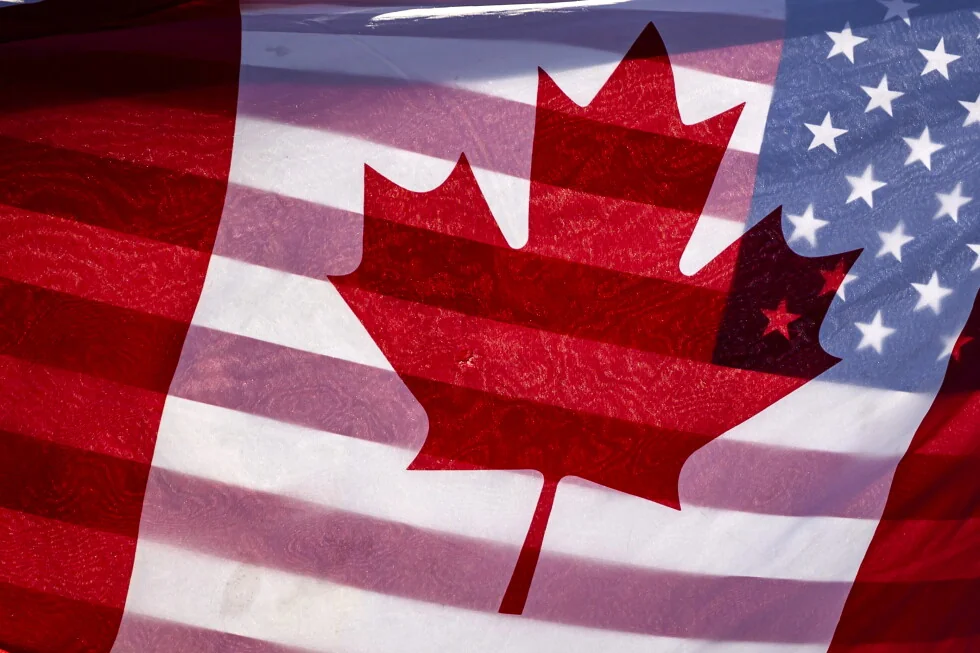
La guerre commerciale croissante du Canada avec les États-Unis : Carney riposte par des droits de douane
September 8th, 2026
La guerre commerciale croissante du Canada avec les États-Unis : Carney riposte par des droits de douane
🇫🇷 Français
In a calculated act of economic retaliation, Canada levied tariffs on approximately $20 billion worth of American commodities on Tuesday, thereby directly countering the most recent tranche of duties imposed by U.S. President Donald Trump.
The reverberations of this development could extend far beyond Canada's frontiers, functioning as a barometer for other nations regarding whether a diminutive U.S. ally can endure Trump's economic duress.
Canadian Prime Minister Mark Carney contends that U.S. demands could eviscerate pivotal domestic industries and curtail the nation’s autonomy, whereas Trump’s menaces to Canadian sovereignty have galvanized public sentiment in his favor.
“Carney and Canada have become emblematic of resistance to him,” Canadian historian Robert Bothwell observed.
“And what he’ll seek to do is make a cautionary example of Carney and Canada, thereby theoretically instilling terror in all others while simultaneously demonstrating to them that they must distance themselves from the United States even further.”
The tariffs impinge upon a vast array of American commodities—spanning steel, aluminum, cheese, appliances, apparel, cosmetics, and agricultural machinery—levying duties of 15%, 25%, or 50%.
Herein lies the crux of what warrants one's attention.
Canada asserts that its retaliatory tariffs mirror Washington’s on a dollar-for-dollar and rate-for-rate basis.
These measures are slated to come into force at 12:01 a.m. Tuesday pursuant to an executive instrument designated as an order in council, encompassing approximately $20 billion in American goods—roughly 6 percent of the $333.6 billion that the United States exported to Canada during the preceding year.
RBC Economics, the research arm of the Royal Bank of Canada, contended that these measures were highly unlikely to exert any discernible impact on the overall trajectory of U.S. growth, yet they could nevertheless inflict substantial harm upon a subset of businesses.
Canada has already surpassed the mere imposition of tariffs through a spectrum of alternative measures.
Eight of its ten provinces continue to enforce restrictions or outright bans on the sale of American alcoholic beverages.
As reported by the Distilled Spirits Council, exports of United States spirits to Canada experienced a year-over-year decline exceeding 70% subsequent to the implementation of these measures.
Following the collapse of Canada-U.S. trade negotiations on August 21, Trump and his administration have unleashed a relentless volley of tariffs, bellicose threats, and ad hominem attacks, casting Canada as enfeebled and subservient.
On Monday, Trump issued an unequivocal ultimatum, threatening to impose a prohibition on the sale of aircraft manufactured by Canada's Bombardier unless the company acquiesced to relocating its entire production operations within the United States.
“THE SALE OF BOMBARDIER AIRCRAFT WITHIN THE UNITED STATES MUST CEASE IMMEDIATELY! Their offerings are demonstrably substandard!” Trump declared via Truth Social.
“Should they wish to access our market, they are obliged to manufacture domestically, and desist from regarding America as a mere ‘piggybank.’”
Flavio Volpe, the president of APMA Canada—a manufacturing trade association—responded on X that Bombardier relies on jet engines produced by GE and Honeywell in the United States, and that it employs approximately 3,000 American workers.
Trump previously cautioned that Canada’s economy could face collapse should Carney persist in regarding him as “the enemy,” and threatened repercussions “worse than anything that has ever happened to a Canadian Politician.”
U.S. Trade Representative Jamieson Greer has intimated that Washington may resort to an outright prohibition on select Canadian commodities as a retaliatory measure.
Trump went so far as to rechristen Lake Ontario “Lake America,” a designation met with derision and outright disregard in Canada.
Google and Apple capitulated to Trump’s coercion, amending their cartographic representations exclusively for U.S. users.
On Monday, he disseminated across social media a depiction of North America entirely emblazoned with the U.S. flag.
“Having already rechristened a gulf and a lake, might his subsequent endeavor be to bestow a new appellation upon a river?” posited Daniel Béland, a political scientist at McGill University.
Trump’s protectionist trade war and his reiterated overtures regarding the annexation of Canada as the 51st state have ignited widespread indignation, galvanizing support behind Carney.
Canadians have drastically curtailed their travel to the United States and have undertaken concerted boycotts of American goods.
The current trade conflict was precipitated by Trump's return to office, whereupon he levied a succession of tariffs on Canadian goods—despite having negotiated and repeatedly lauded the North American trade agreement during his prior tenure—many of which contravene the provisions of that accord.
The rupture is all the more conspicuous given that the two nations have, for decades, maintained one of the most intimate bilateral relationships on the global stage—characterized by profoundly interwoven economies, close collaboration on defense and security, extensive cultural affinities, and, prior to the deterioration of ties, an approximate daily cross-border movement of 400,000 individuals.
Carney has intimated that negotiations could be reinstated once the Americans cease their penchant for memes, abandon their proclivity for disparagement, and relinquish their posturing of toughness, instead embracing a demeanor of unequivocal earnestness.
Thus far, Trump’s coercive overtures have proven counterproductive in Canada, galvanising public backing for Carney rather than compelling any substantive capitulation.
Nelson Wiseman, professor emeritus of political science at the University of Toronto, contended that Trump’s 2024 reelection exacerbated Canadians’ profound disillusionment with the United States—extending beyond its governmental apparatus to encompass the very discernment of its citizenry.
“Canada-U.S. relations, even absent overt confrontation, will never revert to their pre-Trump trajectory,” he observed.
During the World Economic Forum's January gathering in Davos, Carney cautioned that major powers are leveraging economic interdependence as an instrument of coercion against smaller nations.
This address served to consolidate his position as the preeminent voice among those nations seeking strategies to counteract Trump.
A day later, Trump retaliated by asserting that Canada “lives because of the United States,” and delivered the stern admonition: “Mark, remember that next time you make your statements.”
Carney is slated to address the European Parliament next week, thereby affording him yet another prominent platform of considerable magnitude.
"The Canadian public is behind the Carney government and the world is watching what will happen next," said Béland, the McGill political scientist.
If Canada's defiant approach succeeds, he said, it "could be used as a template" for resisting the Trump administration's trade policies.
Trump has further intimated the imposition of 50% tariffs on Canadian vehicles, automotive components, and steel in the coming year should Canada fail to "fall in line," a potentially cataclysmic escalation for industries predicated upon intricately interwoven North American supply chains.
"Our unequivocal intention is for the vehicles to be fabricated in Detroit, in South Carolina, in Tennessee, and across every one of our domestic manufacturing hubs.
We are categorically opposed to their production in Canada," Trump declared.
A 50% tariff on automobiles could wreak havoc on Canadian manufacturing facilities and precipitate a surge in vehicle prices throughout North America, given that components and finished vehicles traverse the border repeatedly throughout the production process.
Carney contends that the terms proffered by Washington could precipitate a scenario wherein Canadian industries are "gradually wound down in Canada and wiped out."
Canada is beset by an inherent structural disadvantage from the very inception of any bilateral engagement: the United States' economic might eclipses its own by an order of magnitude of roughly thirteen, and a preponderant share—upwards of seventy percent—of Canadian exports is inexorably channeled toward its southern neighbor.
Béland, however, contended that this constitutes no ordinary trade dispute, adducing Trump’s domestic unpopularity, the impending midterm elections, and judicial challenges poised to dismantle additional U.S. tariffs as evidence of its anomalous nature.
"Under normative conditions, this would represent an undertaking of exceptionally improbable success for Canada," he remarked.
Yet Washington is not without its own susceptibilities.
American refining infrastructure draws upon approximately four million barrels of crude per diem from Canada, while the nation's agricultural sector exhibits profound dependence on Canadian potash-based fertilizers.
Nevertheless, to date, Canadian authorities have eschewed the deployment of such leverage—whether through the imposition of tariffs or the curtailment of critical exports—as a strategic instrument.
Canada commenced this phase buoyed by formidable economic impetus, its gross domestic product having surged at a seasonally adjusted annualized clip of 3.2% during the second quarter—a rate eclipsing by more than twofold the 1.5% tempo registered in the United States.
Industry Minister Mélanie Joly articulated the government's ambitions with unvarnished candour:
I am unequivocally persuaded that we shall demonstrate to the global community Canada's unequivocal ascendancy in this trade conflict.
September 8th, 2026
Trending Articles
Warren Buffett cède la présidence de Berkshire Hathaway, avançant son plan de succession
Warren Buffett relinquishes Berkshire Hathaway chairmanship, advancing his succession plan
Warren Buffett cède la présidence de Berkshire Hathaway, avançant son plan de succession
Warren Buffett relinquishes Berkshire Hathaway chairmanship, advancing his succession plan
Trump intensifie son offensive contre les médias, promettant d’interdire l’accès de CNN, MS NOW et Politico à la Maison-Blanche
Trump escalates media offensive, vowing to bar CNN, MS NOW and Politico from the White House
Trump intensifie son offensive contre les médias, promettant d’interdire l’accès de CNN, MS NOW et Politico à la Maison-Blanche
Trump escalates media offensive, vowing to bar CNN, MS NOW and Politico from the White House
La Banque du Japon relève son taux directeur à 1,25 %, un sommet en 31 ans
Bank of Japan Lifts Benchmark Rate to 1.25%, a 31-Year Peak
La Banque du Japon relève son taux directeur à 1,25 %, un sommet en 31 ans
Bank of Japan Lifts Benchmark Rate to 1.25%, a 31-Year Peak

Anthropic affirme que Claude joue un rôle déterminant dans le développement de son propre successeur
Anthropic claims Claude is instrumental in developing its own successor
Anthropic affirme que Claude joue un rôle déterminant dans le développement de son propre successeur
Anthropic claims Claude is instrumental in developing its own successor
Pourquoi la Réserve fédérale relève ses taux maintenant — et ce que cela laisse présager
Why the Federal Reserve is raising rates now — and what it portends
Pourquoi la Réserve fédérale relève ses taux maintenant — et ce que cela laisse présager
Why the Federal Reserve is raising rates now — and what it portends

Les actions américaines bondissent à leur plus haut niveau en six semaines, le pétrole et les rendements obligataires reculant
US equities surge to six-week peak as oil and bond yields retreat
Les actions américaines bondissent à leur plus haut niveau en six semaines, le pétrole et les rendements obligataires reculant
US equities surge to six-week peak as oil and bond yields retreat
La Fed relève son taux directeur pour la première fois en trois ans, ignorant les exigences de baisse de Trump
Fed hikes key rate for 1st time in 3 years, flouting Trump's cut demands
La Fed relève son taux directeur pour la première fois en trois ans, ignorant les exigences de baisse de Trump
Fed hikes key rate for 1st time in 3 years, flouting Trump's cut demands
Les demandes d'allocations chômage chutent à 196 000, un plus bas depuis la mi-juillet dans un contexte de licenciements durablement faibles
Unemployment Claims Plummet to 196,000, Lowest Since Mid-July Amid Sustained Layoff Lows
Les demandes d'allocations chômage chutent à 196 000, un plus bas depuis la mi-juillet dans un contexte de licenciements durablement faibles
Unemployment Claims Plummet to 196,000, Lowest Since Mid-July Amid Sustained Layoff Lows
Trump dénonce les risques liés à l’IA comme une « fumisterie », alléguant une « MALADIEuse conspiration » contre l’IA et les centres de données
Trump denounces AI risks as ‘hoax,’ alleges ‘SICK conspiracy’ against AI and data centers
Trump dénonce les risques liés à l’IA comme une « fumisterie », alléguant une « MALADIEuse conspiration » contre l’IA et les centres de données
Trump denounces AI risks as ‘hoax,’ alleges ‘SICK conspiracy’ against AI and data centers

La Cour suprême va décider si elle examinera le recours d’un pêcheur de homards du Maine contre l’obligation d’installer un traceur GPS sur son bateau
Supreme Court to Determine Whether to Hear Maine Lobsterman’s Challenge to GPS Boat Tracker Mandate
La Cour suprême va décider si elle examinera le recours d’un pêcheur de homards du Maine contre l’obligation d’installer un traceur GPS sur son bateau
Supreme Court to Determine Whether to Hear Maine Lobsterman’s Challenge to GPS Boat Tracker Mandate