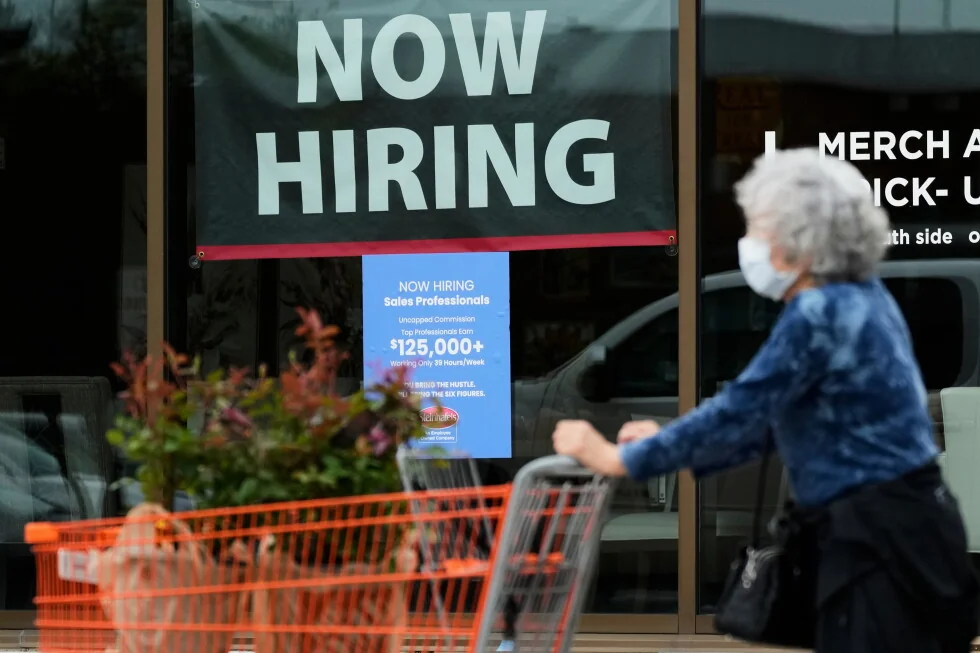
Trump célèbre un boom économique, et pourtant même un rapport sur l'emploi solide s'avère préjudiciable à ses intérêts.
September 5th, 2026
Trump célèbre un boom économique, et pourtant même un rapport sur l'emploi solide s'avère préjudiciable à ses intérêts.
🇫🇷 Français
President Donald Trump has spent twenty months proclaiming that America stood on the precipice of an economic renaissance.
Yet Friday's unexpectedly robust employment figures ultimately elicited nothing but exasperation from the President.
The August employment figures might have afforded a welcome respite from the protracted stagnation in hiring and the inflationary anxieties that have beset Trump and his party a mere two months before Election Day.
Yet, addressing the nation from the Oval Office, Trump instead embarked upon a diatribe against inflation and interest rates, directing his ire toward the financial markets, the Federal Reserve, and America's trading partners.
He took umbrage at the prevailing economic orthodoxy positing that the unexpected accretion of 162,000 jobs in August could exacerbate inflationary pressures.
“Success does not engender inflation; it is stupidity that engenders inflation,” Trump fulminated in the Oval Office, decrying as “crazy” the Friday decline of the stock markets precipitated by inflationary apprehensions.
The confluence, across his second term, of diminished hiring and escalating prices has persistently beleaguered Trump, undermining his pledge to instantaneously inaugurate an unprecedented epoch of economic expansion.
“When I win the election, we will immediately begin a brand new Trump economic boom,” Trump said at an August 2024 rally in North Carolina.
Yet, to date, the economy has expanded at an annualized rate of roughly 2%, a trajectory markedly more sluggish than the growth achieved under the Biden administration.
Trump attributed his failure to deliver more robust economic growth to elevated interest rates on U.S. government debt, asserting via social media that Washington could retaliate by severing trade relations with foreign nations.
Yields have been ascending in response to persistently elevated inflation, exacerbated by Trump’s tariffs and petroleum scarcities stemming from the Iran conflict.
The national debt has now surpassed the formidable $40 trillion threshold, while the yield on the 10-year U.S. Treasury note climbed to 4.79% on Friday.
As the anticipated growth has yet to come to fruition, the president has forfeited a measure of public confidence in his capacity to navigate the world's foremost economy.
His own policies have, in part, precipitated the inflationary pressures and elevated interest rates that he endeavors to attribute to external factors.
“The administration’s credibility on growth, inflation, rates, debt and deficit dynamics have taken a hit given the outsized predictions that are not aligned with economic reality,” said Joe Brusuelas, chief economist at the consultancy RSM US.
Should the Federal Reserve capitulate to President Trump’s entreaties and reduce its benchmark interest rate to stimulate a greater influx of liquidity into the U.S. economy, the ensuing surge of capital would likely exacerbate inflationary pressures, thereby compounding the political and economic tribulations already besetting him.
Yet the president repudiated this foundational tenet of monetary theory, asserting on Friday that gross domestic product would expand at “12, 13, 14, 15%" should interest rates be diminished, seemingly dismissing the attendant inflationary perils.
“We could conceivably achieve a gross domestic product that would shatter every extant record,” Trump asserted.
According to polling conducted by the NORC Center for Public Affairs Research, the president's economic approval rating languished at a mere 32% in the height of summer.
By contrast, when Republicans last confronted midterm electorates in 2018 under Trump, his economic approval rating stood at 50%.
Trump’s threat to sever foreign trade relations could imperil economic growth, thereby further eroding his approval ratings.
His recent imposition of tariffs on Canada has become a liability for Republicans in the Maine and Michigan Senate contests.
Administration officials contend that their policies are yielding precisely the outcomes for which they were designed.
They posit that advancements in artificial intelligence will catalyze enhanced productivity, thereby stimulating economic growth.
Furthermore, they assert that the tariffs imposed last year should ultimately repatriate manufacturing operations to American soil, whilst the president’s tax reductions are anticipated to foster augmented corporate investment, and his administration’s initiatives to uncover malfeasance are projected to generate fiscal savings for taxpayers.
“I anticipate a more pronounced trajectory of growth,” asserted Christopher Phelan, chair of the White House Council of Economic Advisers.
“We are undertaking measures designed to catalyze favorable outcomes.”
Phelan observed that recent job gains have been roughly twice the magnitude necessary to keep pace with population growth.
He deemed it entirely plausible that productivity enhancements could propel overall expansion for the foreseeable future, even as he conceded that growth in isolation might prove insufficient to surmount the nation’s full spectrum of fiscal adversities.
Given that the outlays for Social Security and Medicare are escalating at a pace exceeding that of their revenue streams, reliance on economic expansion alone is unlikely to yield any substantive mitigation of fiscal deficits.
Should U.S. economic expansion sustain an annual growth rate exceeding 3% over the forthcoming decade, such momentum would merely suffice to arrest the escalation of the federal government's already formidable debt burden, as delineated in an analysis by Ernie Tedeschi, who serves as head of economic insights and research at Stripe, the financial technology enterprise.
Tedeschi remarked that he would be “thrilled” should artificial intelligence prove capable of delivering such gains over a decade-long horizon, yet historical precedent suggests that growth of that magnitude, attributable to advancements in computing, was likely “wildly optimistic.”
“We must categorically refrain from contingency planning premised upon the most favorable trajectory,” Tedeschi asserted.
Prior to the president’s remarks on interest rates delivered Friday, the Trump administration had devoted the preceding week to cultivating a heightened sense of economic assurance among the electorate.
At the G20 summit convened for finance ministers in North Carolina, Treasury Secretary Scott Bessent explicitly extolled the virtues of accelerated economic expansion, while Commerce Secretary Howard Lutnick similarly championed such growth within the framework of the G20 deliberations on innovation.
Nonetheless, Bessent informed the Associated Press in an interview that he is concurrently collaborating with White House budget director Russ Vought to unveil a strategy aimed at “bring down the level of the debt, deficit.”
There is inherent political peril in endeavoring to meaningfully curtail an annual budget deficit of roughly $2 trillion, a figure projected to surpass $3 trillion within a decade.
Mitigating the trajectory of fiscal deficits would likely exert downward pressure on interest rates, yet such measures could engender politically fraught repercussions, manifesting as reductions in expenditure and elevations in taxation.
Brusuelas, the chief economist at RSM US, underscored that Trump would likely be compelled to make substantial concessions to meaningfully redress the debt burden and assuage apprehensions within the financial markets.
“We require a period of decelerated expansion in governmental outlay — encompassing outright curtailment of expenditure alongside fiscal levies, all of which would serve to diminish deficits and depress interest rates,” he articulated.
September 5th, 2026
Trending Articles
Warren Buffett cède la présidence de Berkshire Hathaway, avançant son plan de succession
Warren Buffett relinquishes Berkshire Hathaway chairmanship, advancing his succession plan
Warren Buffett cède la présidence de Berkshire Hathaway, avançant son plan de succession
Warren Buffett relinquishes Berkshire Hathaway chairmanship, advancing his succession plan
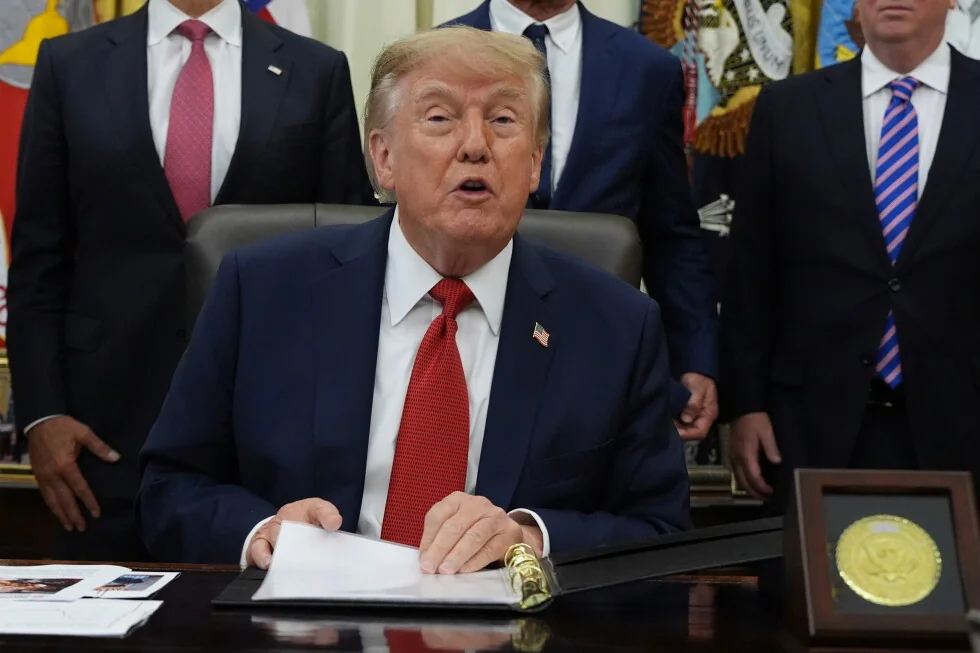
Trump intensifie son offensive contre les médias, promettant d’interdire l’accès de CNN, MS NOW et Politico à la Maison-Blanche
Trump escalates media offensive, vowing to bar CNN, MS NOW and Politico from the White House
Trump intensifie son offensive contre les médias, promettant d’interdire l’accès de CNN, MS NOW et Politico à la Maison-Blanche
Trump escalates media offensive, vowing to bar CNN, MS NOW and Politico from the White House

La Banque du Japon relève son taux directeur à 1,25 %, un sommet en 31 ans
Bank of Japan Lifts Benchmark Rate to 1.25%, a 31-Year Peak
La Banque du Japon relève son taux directeur à 1,25 %, un sommet en 31 ans
Bank of Japan Lifts Benchmark Rate to 1.25%, a 31-Year Peak

Anthropic affirme que Claude joue un rôle déterminant dans le développement de son propre successeur
Anthropic claims Claude is instrumental in developing its own successor
Anthropic affirme que Claude joue un rôle déterminant dans le développement de son propre successeur
Anthropic claims Claude is instrumental in developing its own successor
Pourquoi la Réserve fédérale relève ses taux maintenant — et ce que cela laisse présager
Why the Federal Reserve is raising rates now — and what it portends
Pourquoi la Réserve fédérale relève ses taux maintenant — et ce que cela laisse présager
Why the Federal Reserve is raising rates now — and what it portends
Les actions américaines bondissent à leur plus haut niveau en six semaines, le pétrole et les rendements obligataires reculant
US equities surge to six-week peak as oil and bond yields retreat
Les actions américaines bondissent à leur plus haut niveau en six semaines, le pétrole et les rendements obligataires reculant
US equities surge to six-week peak as oil and bond yields retreat
La Fed relève son taux directeur pour la première fois en trois ans, ignorant les exigences de baisse de Trump
Fed hikes key rate for 1st time in 3 years, flouting Trump's cut demands
La Fed relève son taux directeur pour la première fois en trois ans, ignorant les exigences de baisse de Trump
Fed hikes key rate for 1st time in 3 years, flouting Trump's cut demands
Les demandes d'allocations chômage chutent à 196 000, un plus bas depuis la mi-juillet dans un contexte de licenciements durablement faibles
Unemployment Claims Plummet to 196,000, Lowest Since Mid-July Amid Sustained Layoff Lows
Les demandes d'allocations chômage chutent à 196 000, un plus bas depuis la mi-juillet dans un contexte de licenciements durablement faibles
Unemployment Claims Plummet to 196,000, Lowest Since Mid-July Amid Sustained Layoff Lows
Trump dénonce les risques liés à l’IA comme une « fumisterie », alléguant une « MALADIEuse conspiration » contre l’IA et les centres de données
Trump denounces AI risks as ‘hoax,’ alleges ‘SICK conspiracy’ against AI and data centers
Trump dénonce les risques liés à l’IA comme une « fumisterie », alléguant une « MALADIEuse conspiration » contre l’IA et les centres de données
Trump denounces AI risks as ‘hoax,’ alleges ‘SICK conspiracy’ against AI and data centers

La Cour suprême va décider si elle examinera le recours d’un pêcheur de homards du Maine contre l’obligation d’installer un traceur GPS sur son bateau
Supreme Court to Determine Whether to Hear Maine Lobsterman’s Challenge to GPS Boat Tracker Mandate
La Cour suprême va décider si elle examinera le recours d’un pêcheur de homards du Maine contre l’obligation d’installer un traceur GPS sur son bateau
Supreme Court to Determine Whether to Hear Maine Lobsterman’s Challenge to GPS Boat Tracker Mandate