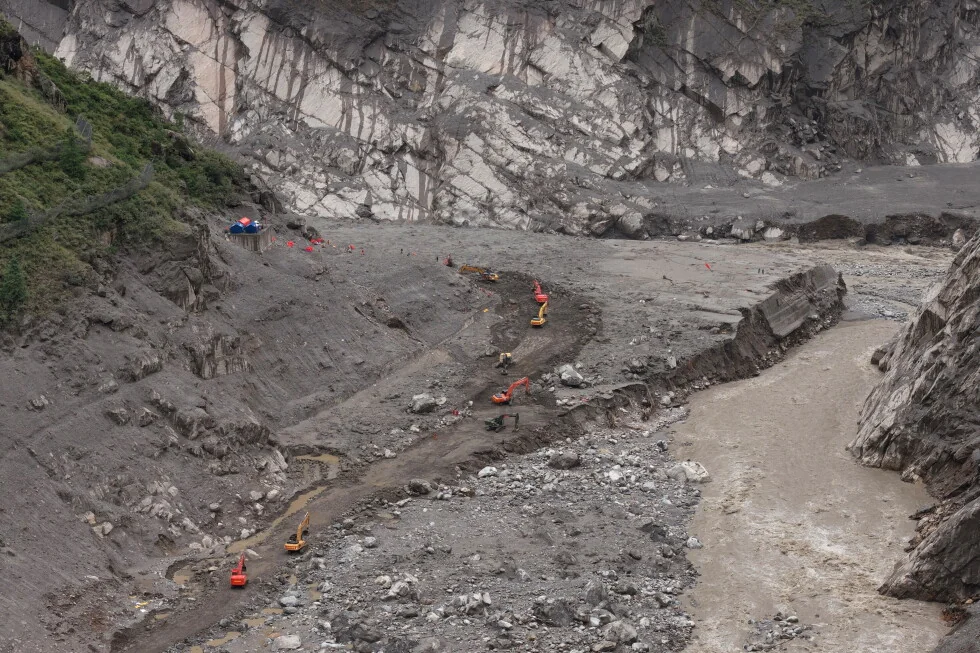
中国はネパール国境沿いの洪水を受けて、情報統制の締め付けを強化している。
September 5th, 2026
中国はネパール国境沿いの洪水を受けて、情報統制の締め付けを強化している。
🇯🇵 日本語
Over a fortnight has elapsed since catastrophic flash floods claimed hundreds of lives and rendered thousands unaccounted for along the Sino-Nepalese frontier, yet virtually no information has emerged concerning the casualties on the Chinese side of the border.
The calamity, which has claimed over 1,000 lives and left upwards of 4,500 unaccounted for across the two nations, has once again underscored Beijing's stringent stranglehold on disaster-related information and its concerted endeavors to dictate the permissible parameters of public discourse surrounding such events.
The casualty figures are revised only at intervals of several days, and ingress to the affected zone has been vouchsafed exclusively to premier-tier state media, which have eschewed disseminating the identities or visages of the missing and their kin in favor of footage foregrounding the orchestration of relief distribution or the exertions of canine search units.
Meanwhile, at least ten individuals across China have been subjected to detention or pecuniary penalties for social media postings that called into question various facets of the official account of events.
This stands in stark contrast to the Nepalese side of the frontier, where authorities have meticulously maintained up-to-date registers of the deceased and missing, whilst journalists and social media postings have meticulously chronicled the catastrophe as it unfolds, alongside the concomitant recovery operations.
The bereaved were rendered conspicuous, their lamentations lending voice and form to the departed, as mourners conducted symbolic interment ceremonies or embarked upon solitary quests in pursuit of their missing kin.
Following an update on Sunday, China withheld fresh figures until Wednesday, at which point it reported 21 fatalities and 541 individuals unaccounted for in Tibet, 261 of whom were foreign nationals hailing from 23 countries.
Late Friday, the death toll was revised upward to 31, with 531 persons still listed as missing.
The Government of Nepal has issued a sustained stream of updates pertaining to rescue operations, notably establishing a dedicated website enumerating the identities of those recovered.
Concurrently, the military has disseminated aerial footage depicting helicopter extractions, alongside imagery of individuals being extricated from the hydropower tunnels, their forms entirely encrusted with mud.
Nepal has issued near-daily communiqués documenting the recovery of individuals, while concurrently affording journalists—both indigenous and foreign—unrestricted access to report from the affected region.
Journalists have been afforded access to disaster-stricken sites.
Although the Nepalese government did impose certain restrictions—notably mandating that reporters furnish accreditation—correspondents were ultimately permitted to operate from official installations such as aid camps, where rescued survivors are presently being accommodated, and to visit mass burial grounds.
Conversely, access within China was circumscribed to a mere handful of journalists affiliated exclusively with the nation’s two state-controlled media organs, namely Xinhua News and CCTV.
Journalists petitioned for access to the afflicted zones in the immediate aftermath of the catastrophe, yet authorization to enter the vicinity has remained withheld.
The People's Republic of China habitually endeavors to regulate the dissemination of information pertaining to calamities; nevertheless, within the rigorously administered autonomous region of Tibet, the influx of data has been subjected to particularly stringent curtailment.
Tibet constitutes an autonomous region of the People's Republic of China, having undergone successive cycles of protest, civil unrest, and governmental suppression since Beijing consolidated its authority over the territory in 1951.
In the contemporary era, the region serves as the focal point of substantial central government investment and extensive poverty eradication initiatives.
Concurrently, telecommunications infrastructure remains subject to rigorous surveillance and stringent restrictions, thereby impeding Tibetans' capacity to engage in unfettered communication with individuals beyond China's borders.
Furthermore, ingress into Tibet necessitates special governmental authorization for all foreign nationals, with particular stringency applied to journalists, notwithstanding their full accreditation to operate within mainland China.
State media coverage has foregrounded the official response, foregrounding President Xi Jinping’s directives for disaster relief and foregrounding dispatches that foreground acts of valor—such as rescuers airlifted by drone, suspended by rope, or police officers consoling bereaved relatives.
Xinhua News Agency has released both official communiqués on the calamity and technical briefings elucidating the glaciological mechanisms of the glacial lakes.
According to Human Rights Watch, certain Chinese journalists have been directed to abstain from conducting interviews with the kin of those who have perished or vanished, and to depend solely on material procured from Xinhua.
Concurrently, China has conspicuously showcased its punitive measures against individuals who have articulated reservations concerning the officially promulgated accounts.
State media have extensively disseminated a report issued by the Tibetan Cyberpolice detailing ten instances in which law enforcement authorities across China imposed sanctions on individuals for "spreading rumors online" pertaining to the disaster.
Such discrepancies might entail, for instance, interrogating the veracity of the official casualty figures, as exemplified by one post asserting: “It’s clear that at least 1,000 people were washed away, yet the official report only says three people dead and 265 missing.”
The punitive measures encompassed custodial sentences ranging from five to ten days, as administered by the constabulary, with a monetary sanction of $150 imposed in select instances.
The People's Republic of China frequently exhibits a marked reticence in disseminating comprehensive mortality figures pertaining to significant calamities.
Subsequent to a typhoon-induced deluge that inundated the southwestern province of Guangxi in early July, the governmental authorities revised the official casualty tally—more than a month thereafter—from 39 deceased individuals to 159.
The government has iteratively escalated its officially promulgated mortality statistics pertaining to the inundation, with the latest emendation, promulgated on Friday, augmenting the aggregate to 31.
Relatives of a handful of the missing have availed themselves of the sparse channels of communication that operate beyond the purview of direct Chinese oversight, making their appeals publicly known.
Aquarian, an independent Chinese media outlet operating in exile, conducted interviews with the family members of Chinese nationals who have disappeared, among them Peng Guangming, a young man employed on a Chinese-funded highway project situated on the Nepalese side of the border.
Peng was last in contact with a colleague approximately ten minutes prior to the onset of the flood.
Among the missing is also a woman identified as He Hongrong, per the X account Fat Parrot, which has been relaying posts from Chinese social media onto the platform.
The account holder declined an interview but stated they had maintained contact with He’s family and a close associate.
Her final sighting transpired on the Nepalese side of the frontier, where she was espied bearing a green rucksack, poised to re-enter China.
She had procured the services of a chauffeur to transport her back to Lhasa, in Tibet.
Her kin hold out hope that by circulating her photograph on X, they may encounter an individual capable of furnishing intelligence regarding her present location.
September 5th, 2026
Trending Articles

EUのカナダに対する「準加盟国」提案:潜在的な影響
The EU’s “associate member” overture to Canada: potential implications
EUのカナダに対する「準加盟国」提案:潜在的な影響
The EU’s “associate member” overture to Canada: potential implications

ホワイトハウスは、トランプ氏が来週ニューヨークでベネズエラのデルシー・ロドリゲス暫定大統領と会談すると発表した。
Trump to convene with Venezuelan acting President Delcy Rodríguez in New York next week, White House announces
ホワイトハウスは、トランプ氏が来週ニューヨークでベネズエラのデルシー・ロドリゲス暫定大統領と会談すると発表した。
Trump to convene with Venezuelan acting President Delcy Rodríguez in New York next week, White House announces

ロシアの戦時経済は債務と軍事支出による長期的な侵食に直面している
Russia’s Wartime Economy Faces Long-Term Erosion from Debt and Military Spending
ロシアの戦時経済は債務と軍事支出による長期的な侵食に直面している
Russia’s Wartime Economy Faces Long-Term Erosion from Debt and Military Spending

ロシア、議会選挙で3日間の投票を開始、クレムリンの権力固めの様相
Russia Embarks on Three Days of Voting in Parliamentary Election Poised to Entrench Kremlin’s Power
ロシア、議会選挙で3日間の投票を開始、クレムリンの権力固めの様相
Russia Embarks on Three Days of Voting in Parliamentary Election Poised to Entrench Kremlin’s Power

アメリカ合衆国は、戦時下の敵対関係にもかかわらず、国連ハイレベル会合のためにイランの最高指導者らにビザを付与した。
US grants visas to top Iranian leaders for UN high-level meeting despite wartime hostilities
アメリカ合衆国は、戦時下の敵対関係にもかかわらず、国連ハイレベル会合のためにイランの最高指導者らにビザを付与した。
US grants visas to top Iranian leaders for UN high-level meeting despite wartime hostilities
国連支援の専門家らは、イラン攻撃における潜在的なアメリカ合衆国の戦争犯罪を主張
UN-backed experts allege potential US war crimes in Iran strikes
国連支援の専門家らは、イラン攻撃における潜在的なアメリカ合衆国の戦争犯罪を主張
UN-backed experts allege potential US war crimes in Iran strikes

ルーマニア国境沿いの住民、ドローン警報の激化に警戒を強める
Romanian Border Residents Alarmed as Drone Alerts Escalate
ルーマニア国境沿いの住民、ドローン警報の激化に警戒を強める
Romanian Border Residents Alarmed as Drone Alerts Escalate

カーニー、EU準加盟提案を受け入れる――トランプがカナダをヨーロッパへと押しやる中で
Carney Embraces EU Associate Membership Proposal as Trump Propels Canada Toward Europe
カーニー、EU準加盟提案を受け入れる――トランプがカナダをヨーロッパへと押しやる中で
Carney Embraces EU Associate Membership Proposal as Trump Propels Canada Toward Europe

ホルムズ海峡再開:終わらぬイラン戦争のなかでのアメリカ合衆国の前進
Strait of Hormuz Reopened: US Progress Amid an Unfinished Iran War
ホルムズ海峡再開:終わらぬイラン戦争のなかでのアメリカ合衆国の前進
Strait of Hormuz Reopened: US Progress Amid an Unfinished Iran War

ナイジェリア人6名、ロマンス詐欺で女性から600万ドルを騙し取った容疑でアメリカ合衆国へ身柄引き渡し
Six Nigerians Extradited to US for Defrauding Women of $6M in Romance Scams
ナイジェリア人6名、ロマンス詐欺で女性から600万ドルを騙し取った容疑でアメリカ合衆国へ身柄引き渡し
Six Nigerians Extradited to US for Defrauding Women of $6M in Romance Scams