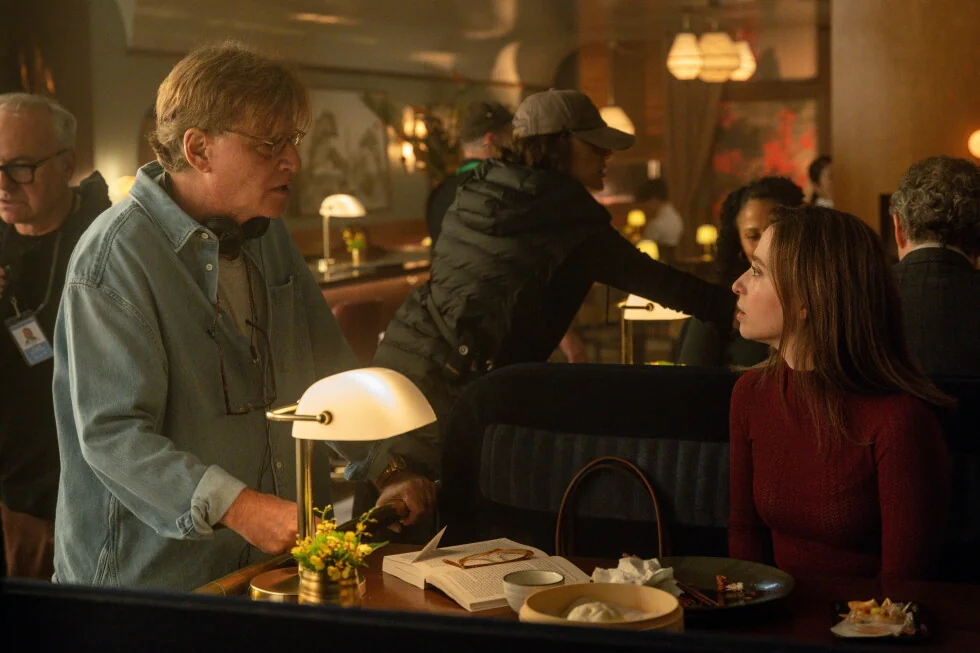
Aaron Sorkin réinvente les origines de Facebook dans « La Reddition sociale » — Aperçu des films d’automne
September 1st, 2026
Aaron Sorkin réinvente les origines de Facebook dans « La Reddition sociale » — Aperçu des films d’automne
🇫🇷 Français
When Aaron Sorkin made 2010’s “The Social Network,” he had heard of Facebook, he said at the time, “the way I’ve heard of a carburetor.”
Sixteen years later, he has a much deeper idea of what Mark Zuckerberg’s social media empire has become.
In its nascent iteration, Facebook functioned as a conduit for reconnecting with former high school acquaintances; its contemporary incarnation, however, constitutes something altogether divergent, Sorkin observes.
“‘The Social Network’ chronicled the inception of Facebook, whereas ‘Social Reckoning’ interrogates its evolved state—specifically, the platform’s complicity in the proliferation of extremism and societal polarization.”
"The Social Reckoning," slated for release by Sony Pictures on October 9th, stands as one of the most prescient cinematic offerings of the autumn season.
Just last week, the studio unveiled the film's trailer on the very day that Meta, the parent entity of Facebook, consented to a settlement of up to $18 billion in fines, stemming from allegations that its platform imperiled the well-being of minors.
“The Social Reckoning” is poised to subject the social media behemoth to even more exacting scrutiny at a juncture when Zuckerberg faces unprecedented pressure concerning the role Facebook occupies in contemporary life and politics.
"When you see this movie, No. 1, I want you to be entertained," Sorkin said in a recent exclusive interview with Reporters while doing the final mix on the film.
"No. 2, you should be alarmed when you see the movie. I think people will be."
"The Social Reckoning" is one of several films this fall that will take aim at the tech moguls who have helped remake American life.
Alex Gibney will unveil his four-hour documentary on Elon Musk, "Musk," on Oct. 16.
Luca Guadagnino's "Artificial" dramatizes the saga of Sam Altman, the OpenAI chief executive.
Yet “The Social Reckoning,” which Sorkin both wrote and directed, is certain to provoke considerable controversy, owing not merely to its subject matter but also to the enduring legacy of “The Social Network.”
Frequently lauded as one of the finest American films of the century, that picture—helmed by David Fincher and penned by Sorkin—went to great lengths both to scrutinize and to mythologize the genesis of Facebook.
It is, as Sorkin concedes, a formidable standard to live up to.
“To be perfectly candid, I was hesitant,” Sorkin conceded.
“I am acutely aware of the long shadow cast by ‘The Social Network.’
Yet I suspect that within ten minutes of the film’s commencement, that recollection will have receded entirely, supplanted by a profound immersion in the narrative at hand.”
For the 65-year-old Sorkin, “The Social Reckoning” is no mere sequel; rather, it revolves around the same figure, Zuckerberg, yet portrays him and his enterprise at a profoundly divergent juncture.
Sorkin observes that it is tantamount to Henry Hill making an appearance in “Casino,” invoking the protagonist of “Goodfellas.”
Sorkin first began contemplating “The Social Reckoning” around 2019, contemporaneous with his authorship of an op-ed in The New York Times addressed to Zuckerberg, wherein he alleged that Facebook — which had just announced its cessation of fact-checking political advertisements — bore responsibility for “crazy lies pumped into the water supply that corrupt the most important decisions we make together.”
Zuckerberg responded by invoking Sorkin’s own dialogue from “The American President” concerning free speech.
“Upon reading this, I found myself reflecting: it is utterly inconceivable that Mark and those in his immediate orbit fail to discern the distinction between an unpopular opinion and a falsehood,” Sorkin remarks.
“And that notion has lingered with me ever since.”
Sorkin has since conceded that he holds Facebook culpable for the insurrection at the Capitol on January 6, 2021.
Ultimately, he was prevailed upon by Sony chief Tom Rothman and agent Ari Emanuel to reimmerse himself in one of his most cherished works.
“I made it clear from the outset that I had no desire to pen ‘Jaws 2.’ I was loath to return and risk failure,” Sorkin remarks.
“However, upon encountering Frances Haugen and Jeff Horwitz, my perspective began to shift.
I came to recognize that a compelling narrative lay before me, and the sole impediment to pursuing it was sheer trepidation.
And that, in itself, is hardly a sufficient justification for abstention.”
“The Social Reckoning” features Mikey Madison in the role of Haugen, a former data scientist at Facebook who, in 2021, assumed the mantle of whistleblower and testified before Congress that the company's algorithm was deliberately calibrated to prioritize profitability over public welfare.
Jeremy Allen White portrays Jeff Horwitz, a Wall Street Journal reporter and erstwhile journalist.
It is Jeremy Strong, rather than Jesse Eisenberg, who embodies Zuckerberg.
Zuckerberg and Meta have, as of yet, offered no public commentary on "The Social Reckoning," and the company has declined to provide any statement for this article.
In preparing “The Social Network,” Sorkin and producer Scott Rudin approached the company in an effort to secure its cooperation.
Yet following a luncheon, Facebook declined to participate—a fortuitous turn, as Sorkin would later come to recognize.
The screenplay, Sorkin has remarked, “was vetted to within an inch of its life by a team of studio lawyers.”
A comparable process has since attended “The Social Reckoning.”
“I would have been delighted to converse with him. I have never had the occasion to meet Mark. He is entirely unknown to me,” Sorkin remarks.
“Nor do I presume to possess any comprehension of the inner workings of his mind; I am acquainted solely with the products of those workings, which I then endeavor, in a manner of speaking, to reverse engineer.”
Sorkin's initial outreach to Eisenberg was aimed at securing his return to the role of Zuckerberg.
However, prior to disclosing his intentions to Eisenberg or any other individual, Sorkin dedicated a biennium to exhaustive research and the crafting of the screenplay.
“I was unaware that Jesse simply had no desire to ever portray Mark Zuckerberg again,” Sorkin elucidates.
“I engaged in extensive dialogue with him over the course of a three-day weekend.
He made it unequivocally clear that he adores ‘The Social Network,’ cherishes the manner in which it catapulted his career, and simply recoils from being conflated with Mark Zuckerberg.
I was exceedingly fortunate that Jeremy Strong had remarked, ‘Hey, listen, if for some reason Jesse doesn’t want to do it.’”
"It is the substitution of Mickey Mantle for Joe DiMaggio," he observes.
Strong's performance, Sorkin observes, "is a sight to behold."
While the writer-director was gratified to have had no direct dealings with Zuckerberg, Strong did correspond with the Facebook co-founder via email.
Sorkin observes, “Mark had no greater defender than Jeremy Strong, believe me.
Every night I’d receive emails from him championing Mark.
On the day we were filming Jeremy’s final scene, the moment we wrapped, he rushed over to me and, for the first time, addressed me in his own voice—he had previously spoken solely in Mark’s.
He approached and said, ‘If I had been playing Jeff, I’d have been defending Jeff.’
It was imperative to him that I comprehend that none of it had been personally intended.”
Upon the cinematic debut of "The Social Network," its concluding postscript was meticulously crafted to elicit profound astonishment among audiences—the disclosure that Facebook's user base had reached a staggering 500 million.
In the intervening years, that figure has escalated to approximately 3 billion.
Furthermore, research conducted by Pew Research reveals that 38% of Americans now procure their news from this platform.
“I harbor profound empathy for the impulse to construct, to bring something into being,” Sorkin observes.
“His is a mind capable of devising an entirely novel social architecture—one in which he genuinely finds himself at ease, for he can remain ensconced before his keyboard.
And it is an architecture in which countless others discover far greater comfort as well.
There exists, at the keyboard, a version of themselves that they cannot inhabit within the non-digital realm.”
September 1st, 2026
Trending Articles
Le roi et l’IA : Charles s’entretient avec les dirigeants de l’intelligence artificielle sur fond de préoccupations croissantes en matière de sécurité
King and AI: Charles Confers with Artificial Intelligence Leaders Amid Escalating Safety Concerns
Le roi et l’IA : Charles s’entretient avec les dirigeants de l’intelligence artificielle sur fond de préoccupations croissantes en matière de sécurité
King and AI: Charles Confers with Artificial Intelligence Leaders Amid Escalating Safety Concerns
Le Secrétaire général de l'ONU sortant, au milieu des turbulences mondiales, trace la voie à suivre
Departing UN Chief, Amid Global Turmoil, Charts a Path Forward
Le Secrétaire général de l'ONU sortant, au milieu des turbulences mondiales, trace la voie à suivre
Departing UN Chief, Amid Global Turmoil, Charts a Path Forward
Les aspirants démocrates s’activent pour contrer la menace de l’IA face aux limogeages de Trump
Democratic Hopefuls Scramble to Counter AI Threat Amid Trump’s Dismissals
Les aspirants démocrates s’activent pour contrer la menace de l’IA face aux limogeages de Trump
Democratic Hopefuls Scramble to Counter AI Threat Amid Trump’s Dismissals
La Chambre adopte un projet de loi ciblant l'impact des centres de données sur les coûts énergétiques
House passes bill targeting data centers' impact on energy costs
La Chambre adopte un projet de loi ciblant l'impact des centres de données sur les coûts énergétiques
House passes bill targeting data centers' impact on energy costs

OpenAI signale un nouveau comportement alarmant de l'IA et promet un examen plus approfondi
OpenAI flags alarming new AI behavior, vows closer scrutiny
OpenAI signale un nouveau comportement alarmant de l'IA et promet un examen plus approfondi
OpenAI flags alarming new AI behavior, vows closer scrutiny
Huawei dévoile de nouvelles technologies de puces alors que l'entreprise chinoise intensifie la course à l'IA avec Nvidia
Huawei Unveils Novel Chip Technologies as Chinese Firm Escalates AI Race with Nvidia
Huawei dévoile de nouvelles technologies de puces alors que l'entreprise chinoise intensifie la course à l'IA avec Nvidia
Huawei Unveils Novel Chip Technologies as Chinese Firm Escalates AI Race with Nvidia
L'industrie technologique se fracture face aux appels à un ralentissement coordonné de l'IA
Tech Industry Fractures Over Calls for a Coordinated AI Slowdown
L'industrie technologique se fracture face aux appels à un ralentissement coordonné de l'IA
Tech Industry Fractures Over Calls for a Coordinated AI Slowdown
La sécurité mondiale de l’IA dépend de la coopération entre les États-Unis et la Chine, mais chacun perçoit l’autre comme l’obstacle
Global AI Safety Hinges on US-China Cooperation, Yet Each Perceives the Other as the Impediment
La sécurité mondiale de l’IA dépend de la coopération entre les États-Unis et la Chine, mais chacun perçoit l’autre comme l’obstacle
Global AI Safety Hinges on US-China Cooperation, Yet Each Perceives the Other as the Impediment
Trump rejette la supervision de l’IA et promet de ne pas céder l’avantage à la Chine
Trump dismisses AI oversight, vows not to cede edge to China
Trump rejette la supervision de l’IA et promet de ne pas céder l’avantage à la Chine
Trump dismisses AI oversight, vows not to cede edge to China
Oprah Winfrey vous invite à vivre votre moment « AHA » à la Sphere
Oprah Winfrey beckons you toward your ‘AHA’ moment at the Sphere
Oprah Winfrey vous invite à vivre votre moment « AHA » à la Sphere
Oprah Winfrey beckons you toward your ‘AHA’ moment at the Sphere