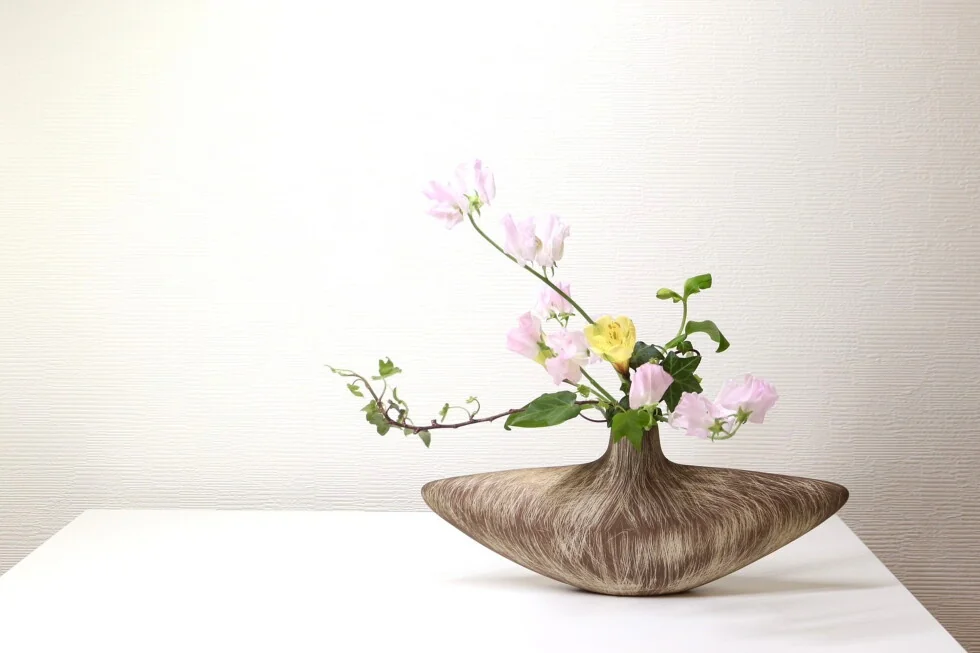
El arte japonés del ikebana, con siglos de antigüedad, atrae a quienes buscan serenidad
September 22nd, 2026
El arte japonés del ikebana, con siglos de antigüedad, atrae a quienes buscan serenidad
🇪🇸 Español
Ikebana, the Japanese art of arranging flowers, constitutes a form of expression whose origins stretch back over 500 years.
It continues to flourish, unobtrusively, not only among traditionalists but also among newcomers who find its fusion of creativity and mindfulness to be restorative.
Ikebana can resemble solving a puzzle, except that there is no definitive solution.
Since every flower, much like every individual, is distinct, a multitude of possibilities arises.
"There's a 'detox' purifying factor, and a healing," says Hiroyuki Okada, 40, who began taking lessons in ikebana about seven years ago.
He now teaches Ikenobo, the oldest of three major ikebana schools.
Okada, who also teaches backflips to anyone who wants to learn, usually wears silver chains and jeans, but he wears a nice kimono when he formally demonstrates his arrangements.
He sees himself as typical of those drawn to ikebana today, people looking for joy, purpose, or comfort from the daily grind or pain of modern life.
“When you arrange flowers, you are engaging with the life that is present, with its beauty, certainly, but you also discover what resides within your own heart,” said Okada.
“You come face to face with yourself.”
The Ikenobo school, headquartered in Kyoto and grounded in Buddhist tradition, has since established chapters across the globe.
Okada’s prior role at a nonprofit had entailed conversing with individuals from across the globe, and through this he came to appreciate both the disparities and the commonalities among people.
Upon transitioning to his present position at a flower shop, he resolved to pursue an activity that was distinctly Japanese, thereby allowing him to delve into that dimension of his identity, and one that could be sustained over the long term, in solitude.
Ikebana entails engaging with nature, albeit on a diminutive scale — typically within a modest vase.
"It concerns the relationship between the creator and the flowers," said Senko Ikenobo, headmaster-designate of the Ikenobo school.
Her family can be traced back through many generations to the pioneers of the art, and her father is currently its headmaster.
Jeannette Haviland-Jones, a professor of social psychology at Rutgers University, asserts that studies have demonstrated “that flowers and even flower scents promote happiness in people.
We suggested a coevolutionary theory for this in which flowers became the ‘pets’ of the plant world.”
Beyond a flower’s visual beauty and fragrance, the feel of its petals and leaves to the touch is crucial, much like petting a kitten or a puppy, according to Okada.
There are toddlers who practise Ikenobo by copying their mothers, as well as devoted centenarians.
The headmaster-designate says she has seen ikebana help women who are juggling work and motherhood, or looking after aging parents.
Ikebana exerts a restorative effect comparable to that of yoga, meditation or play, according to Mayu Shimizu, who is employed by an online educational service and has been receiving instruction from Okada for approximately three years.
“I relish this moment of nothingness when you are concentrating on the flowers before you,” she says.
“My mind feels clearer.
I feel more at peace, and gentle.”
One traditional Ikenobo arrangement is shoka shofutai, which endeavours to arrange the flowers, leaves and branches as they might appear in nature, reaching toward sunlight or bending in the wind.
The vase, sometimes crafted from wood or pottery, likewise becomes integral to the arrangement’s vision.
Yet the overall aesthetic remains pure and unadorned, articulating the life cycle of flowers — from blossoming through withering — by means of three principal elements:
Shin, the tallest of the elements, is positioned foremost, symbolizing one's core as it ascends toward the heavens.
Soe, which is trimmed to approximately two-thirds the height of the shin and positioned at the side, expresses the flower's individuality.
The leaves might be slightly faded, representing the later stages of life.
— Tai, the third element, embodies the future.
Select a blossom or tender young leaves — entities in the very process of being born.
There are also freer, spinoff styles that look more like casual, Western-style bouquets than the austere, textbook-oriented shoka shofutai.
For beginners, these may feel easier and more fun.
Just as ikebana forges a connection between a person and flowers, those who practise the art maintain that it also concerns the transmission of the art across generations, thereby connecting people.
Yuri Kageyama may be found on Threads at the following URL: https://www.threads.com/@yurikageyama
September 22nd, 2026
Trending Articles
Una simple manta de protección puede proteger las verduras de finales del verano de las heladas inminentes
A simple row cover can protect late-summer vegetables from impending frost
Una simple manta de protección puede proteger las verduras de finales del verano de las heladas inminentes
A simple row cover can protect late-summer vegetables from impending frost

Una constante de 250 años: la duradera disposición de los estadounidenses a dejarse engañar
A 250-Year Constant: Americans’ Enduring Willingness to Be Duped
Una constante de 250 años: la duradera disposición de los estadounidenses a dejarse engañar
A 250-Year Constant: Americans’ Enduring Willingness to Be Duped

Camionero construye una maqueta de Nueva York de 800.000 estructuras por diversión—ahora es una exposición de museo
Truck driver builds 800,000-structure NYC model for fun—now a museum exhibit
Camionero construye una maqueta de Nueva York de 800.000 estructuras por diversión—ahora es una exposición de museo
Truck driver builds 800,000-structure NYC model for fun—now a museum exhibit

DoorDash y Uber Eats comenzarán a entregar desde las tiendas Costco en todo Estados Unidos
DoorDash and Uber Eats to Begin Delivering from Costco Stores Across the US
DoorDash y Uber Eats comenzarán a entregar desde las tiendas Costco en todo Estados Unidos
DoorDash and Uber Eats to Begin Delivering from Costco Stores Across the US

El chef David Chang recorre Estados Unidos en una nueva serie de viajes de CNN centrada en la comida
Chef David Chang traverses the US in new CNN travel series centred on food
El chef David Chang recorre Estados Unidos en una nueva serie de viajes de CNN centrada en la comida
Chef David Chang traverses the US in new CNN travel series centred on food

El gran viaje por carretera estadounidense, impulsado y socavado por el automóvil que lo engendró
The great American road trip, powered and undermined by the automobile that spawned it
El gran viaje por carretera estadounidense, impulsado y socavado por el automóvil que lo engendró
The great American road trip, powered and undermined by the automobile that spawned it
El pollo con sésamo y comino de Betty Liu: doble fritura para lograr sabor y crujiente
Betty Liu’s Sesame-Cumin Chicken: Double-Fried for Flavor and Crispiness
El pollo con sésamo y comino de Betty Liu: doble fritura para lograr sabor y crujiente
Betty Liu’s Sesame-Cumin Chicken: Double-Fried for Flavor and Crispiness

Una pelota de golf hallada entre los escombros del World Trade Center se convirtió en símbolo de una pérdida incomprensible
Golf ball found in World Trade Center rubble became a symbol of incomprehensible loss
Una pelota de golf hallada entre los escombros del World Trade Center se convirtió en símbolo de una pérdida incomprensible
Golf ball found in World Trade Center rubble became a symbol of incomprehensible loss
La tarta de manzana, junto con mamá, se convirtió en el plato icónico de la nación.
The apple pie, alongside mom, became the nation's iconic dish.
La tarta de manzana, junto con mamá, se convirtió en el plato icónico de la nación.
The apple pie, alongside mom, became the nation's iconic dish.