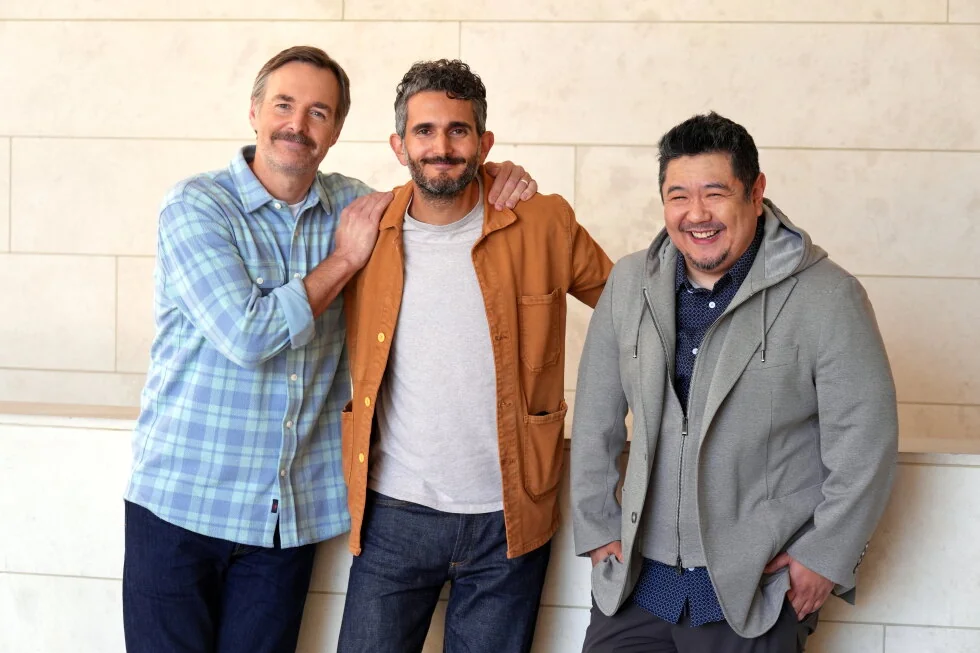
Warner Bros. legte ‚Coyote vs. Acme‘ auf Eis – doch drei Jahre später hält die Saga weiter an.
August 14th, 2026
Warner Bros. legte ‚Coyote vs. Acme‘ auf Eis – doch drei Jahre später hält die Saga weiter an.
🇩🇪 Deutsch
Prior to its appellation as "the funeral screening," the occasion was merely the juncture at which Will Forte had resolved to attend the cinematic presentation.
“Coyote vs. Acme” was completed.
Director Dave Green, galvanized by “Who Framed Roger Rabbit?”, had finalized the editing of the Looney Tunes amalgamation of animation and live action.
The entire endeavor, drawing upon an Ian Frazier “Shouts and Murmurs” column from The New Yorker as its foundational text, constituted a daring comedic stratagem that appeared to be yielding dividends.
Anticipation was palpable, and audience test scores proved auspicious.
Yet mere days before Forte, who portrays Wile E. Coyote’s legal counsel, could witness “Coyote vs. Acme,” Warner Bros. abruptly shelved it—not merely the screening, but the entire production.
The studio had neither postponed its release nor relegated it to streaming; they were consigning it to oblivion altogether.
Forte recollects, "My immediate reaction was: 'Well, if they're scrapping the film, it must be utterly subpar.'"
Forte and his wife, conjecturing that the cinematic endeavor had indubitably proven a fiasco, convened with the cast and crew to bid adieu to a production fated for utter oblivion.
“That was when the authentic emotional turbulence commenced,” Forte remarks.
“It embodied everything I had aspired for the film to be, and surpassed it.
Its exceptionality rendered it all the more exasperating and cataclysmic.
The bewilderment escalated, succeeded by frustration, and ultimately, incandescent fury.
"Subsequently, it became even more incomprehensible," he adds.
"We all exchanged bewildered glances, as if to say, 'What on earth is transpiring here?'"
The abrupt cancellation of “Coyote vs. Acme” sent seismic tremors through the Hollywood establishment.
While those entrenched in the film industry are inured to capricious and devastating reversals of fortune, the wholesale obliteration of a fully completed production with greater alacrity than one can utter “Meep! Meep!” constituted an unprecedented phenomenon.
David Zaslav, chief executive of Warner Bros., was resolute in his determination to extricate the company from the direct-to-HBO Max ventures championed by his predecessor.
The anticipated marketing expenditure — approximately $30–40 million — required to launch “Coyote vs. Acme” was deemed by the studio to be an unjustifiable outlay.
It was more advantageous, the studio contended, to avail itself of a tax write-off on the $70 million production.
Alongside two other titles — “Batgirl” and “Scoob! Holiday Haunt” — “Coyote vs. Acme” was consigned to the archives.
Nearly three years after that purported “funeral screening,” the film, much like its indefatigable protagonist, has staged a resurrection.
Following a groundswell of public protest, Warner Bros. opted to divest itself of “Coyote vs. Acme.”
Ketchup Entertainment—an independent distributor that, last year, released the Looney Tunes feature “The Day the Earth Blew Up”—acquired the property for approximately $50 million.
On August 28, “Coyote vs. Acme” will at long last emerge into the light of day.
The sequence of events has proven nothing short of vertiginous for all parties concerned.
Eric Bauza, who lends his voice to Daffy Duck, Bugs Bunny, and other characters in the production, remained skeptical until he chanced upon “Obsession” at his neighborhood cinema.
“Upon emerging from the theater, there in a diminutive marquee enclosure hung the poster for ‘Coyote vs. Acme,’” Bauza recounts.
“It struck me with sudden clarity: This is destined to be witnessed by audiences.”
In a recent interview, Green remained utterly incredulous, as if the very notion of what had transpired was beyond the realm of his comprehension.
"I must be dreaming," said Green.
"It is nothing short of miraculous that I find myself ensconced here, engaged in discourse with you this very day."
The filmmakers and their new distributor have leaned into the project’s tortured history, promoting it as “the film ACME didn’t want you to see.”
More than that, “Coyote vs. Acme” now possesses a newfound meta quality.
The film’s premise is that Coyote, having endured years of defective products, takes Acme to court.
Like the drama surrounding the film, it is an underdog victimized by a monolithic corporation.
“I found myself compelled to regard the film through an entirely novel lens, given the metatextual intersections between its narrative and the cultural significance it had accrued over time,” Green observes.
“It was almost as though we had conceived the screenplay in the aftermath of the news breaking.”
The cancellation of “Coyote vs. Acme” transformed its fate into a clarion call.
Filmmakers including Christopher Miller, Phil Lord, Daniel Kwan, and Daniel Scheinert championed the project as far too exceptional to be relegated to oblivion.
Even political figures, such as Democratic Representative Joaquin Castro of Texas, urged the Justice Department to scrutinize Warner Bros.'s decision.
Bauza, a seasoned voice actor, amplified the hashtag #ReleaseCoyoteVsACME across social media platforms.
His most conspicuous gambit, however, unfolded at the 2024 Annie Awards, where he elicited resounding applause by articulating that very argument from the podium—ventriloquized through the unmistakable cadence of Daffy Duck.
“He is the quintessential cartoon figure, preeminent above all others, when it comes to supplication and entreaty,” Bauza remarks.
“It seemed a fitting choice.”
Such was the overwhelming groundswell of public advocacy for the film that Green never once experienced a solitary moment throughout the entire harrowing ordeal.
“I would unlock my phone on any given morning to discover an individual attired in a Wile E. Coyote ensemble, positioned beyond the studio’s perimeter, brandishing a placard in the downpour — occurrences of such incredulity were simply beyond comprehension,” remarks Green.
Simultaneously, the entire affair portended a somber new chapter in the cinematic industry, one that has left numerous figures associated with “Coyote vs. Acme” profoundly unsettled.
This was not a nascent filmmaker encountering rejection on their debut project; rather, it represented two years of labor devoted to one of Warner Bros.’ most venerated franchises—a production even helmed under the auspices of DC Studios chief James Gunn.
“I remain uncertain as to the basis of their assessment,” Bauza remarks.
“Were they even cognizant of the underlying circumstances, or were they merely scrutinizing figures?
It is a formidable predicament to observe from the periphery, contemplating: ‘If such is the treatment afforded to the Looney Tunes, what fate awaits my own narrative?’”
"The pipeline has undergone a profound metamorphosis," he adds.
"The trajectory to the finish line now constitutes an entirely different odyssey."
“Coyote vs. Acme” was greenlit at a juncture when studios were still charting their course through the pandemic’s murky waters and cinemas were fighting for solvency.
Yet Green’s film now arrives at a markedly divergent moment in the cultural landscape.
The theatrical sector is flourishing, owing in no small measure to the visionary endeavors of filmmakers ranging from Christopher Nolan to Curry Barker.
For Green, the fact that “Coyote vs. Acme” is finally receiving its day in the court of public opinion signals Hollywood’s reversion to its foundational principles.
“The film industry, however counterintuitive it may seem, is propelled and governed by the creative imperative of artists, filmmakers, actors, and writers,” asserts Green.
“No force can ever divest creators of that intrinsic desire.
As long as we persist in our creative endeavors, the cinematic enterprise will endure.”
Forte remains bereft of a felicitous resolution, still grappling to secure a propitious denouement.
The film’s initial cancellation, he contends, was “cruel and heartless.”
“The drawback is: place your trust in no one,” Forte remarks.
“And the silver lining is: relinquish not hope.
And it is that latter sentiment that I believe I shall retain.”
August 14th, 2026
Trending Articles
Jon Stewart erläutert seine anhaltende philanthropische Unterstützung von Ersthelfern
Jon Stewart elucidates his sustained philanthropic backing of first responders
Jon Stewart erläutert seine anhaltende philanthropische Unterstützung von Ersthelfern
Jon Stewart elucidates his sustained philanthropic backing of first responders
Duncan Sheik, Tony- und Grammy-prämierter Komponist von „Spring Awakening“ und Pop-Ikone, ist im Alter von 56 Jahren gestorben
Duncan Sheik, Tony- and Grammy-winning ‘Spring Awakening’ composer and pop icon, dies at 56
Duncan Sheik, Tony- und Grammy-prämierter Komponist von „Spring Awakening“ und Pop-Ikone, ist im Alter von 56 Jahren gestorben
Duncan Sheik, Tony- and Grammy-winning ‘Spring Awakening’ composer and pop icon, dies at 56
Kennedy Center muss vor größeren baulichen Veränderungen 30 Tage im Voraus benachrichtigen, entscheidet Richter
Kennedy Center Must Give 30 Days’ Notice Before Major Physical Changes, Judge Rules
Kennedy Center muss vor größeren baulichen Veränderungen 30 Tage im Voraus benachrichtigen, entscheidet Richter
Kennedy Center Must Give 30 Days’ Notice Before Major Physical Changes, Judge Rules

Von LA Acclaim nach New York: Gustavo Dudamels nächster Schritt
From LA Acclaim to New York: Gustavo Dudamel's Next Movement
Von LA Acclaim nach New York: Gustavo Dudamels nächster Schritt
From LA Acclaim to New York: Gustavo Dudamel's Next Movement
„The Pitt“ strebt nach einer Zugabe, während „Widow’s Bay“ bei den Emmy Awards einen epischen Durchmarsch bedroht
‘The Pitt’ seeks encore as ‘Widow’s Bay’ threatens an epic sweep at the Emmy Awards
„The Pitt“ strebt nach einer Zugabe, während „Widow’s Bay“ bei den Emmy Awards einen epischen Durchmarsch bedroht
‘The Pitt’ seeks encore as ‘Widow’s Bay’ threatens an epic sweep at the Emmy Awards
Bob Mackie, Couturier der Stars, der Cher und Marilyn einkleidete und den Glamour der 70er Jahre verkörperte, stirbt mit 87
Bob Mackie, couturier to the stars who garbed Cher and Marilyn and epitomized ’70s glamour, dies at 87
Bob Mackie, Couturier der Stars, der Cher und Marilyn einkleidete und den Glamour der 70er Jahre verkörperte, stirbt mit 87
Bob Mackie, couturier to the stars who garbed Cher and Marilyn and epitomized ’70s glamour, dies at 87

Filmkritik: „Practical Magic 2“ hätte dem ursprünglichen Zauberbuch treu bleiben sollen
Movie Review: ‘Practical Magic 2' ought to have remained faithful to the original spell book
Filmkritik: „Practical Magic 2“ hätte dem ursprünglichen Zauberbuch treu bleiben sollen
Movie Review: ‘Practical Magic 2' ought to have remained faithful to the original spell book

Vier Renoirs aus französischem Museum gestohlen; zwei Werke bleiben weiterhin unauffindbar.
Four Renoirs stolen from French museum; two works remain unaccounted for.
Vier Renoirs aus französischem Museum gestohlen; zwei Werke bleiben weiterhin unauffindbar.
Four Renoirs stolen from French museum; two works remain unaccounted for.

Elon-Musk-Dokumentarfilm und Penélope-Cruz–Javier-Bardem-Thriller feiern Premiere in Venedig
Elon Musk documentary and Penélope Cruz–Javier Bardem thriller premiere at Venice
Elon-Musk-Dokumentarfilm und Penélope-Cruz–Javier-Bardem-Thriller feiern Premiere in Venedig
Elon Musk documentary and Penélope Cruz–Javier Bardem thriller premiere at Venice
Geschworene sprechen einen Mann des Mordes ersten Grades im Fall der Tötung des Rap-Ikonen Tupac Shakur im Jahr 1996 schuldig.
Jury convicts a man of first-degree murder in the 1996 slaying of rap icon Tupac Shakur
Geschworene sprechen einen Mann des Mordes ersten Grades im Fall der Tötung des Rap-Ikonen Tupac Shakur im Jahr 1996 schuldig.
Jury convicts a man of first-degree murder in the 1996 slaying of rap icon Tupac Shakur