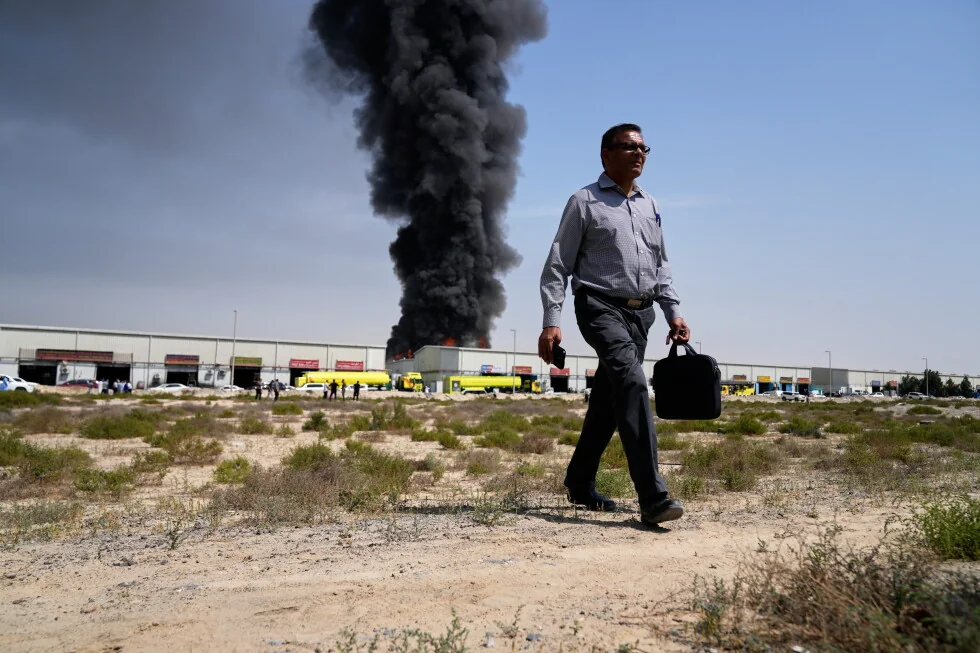
Irán se afana por sostener su comercio mientras Washington amenaza con sanciones contra las naciones que se nieguen a romper lazos.
August 27th, 2026
Irán se afana por sostener su comercio mientras Washington amenaza con sanciones contra las naciones que se nieguen a romper lazos.
🇪🇸 Español
Iran’s economy, already beleaguered by rampant inflation, decades of Western sanctions, and a conflict that has precipitously curtailed oil revenues, stands on the precipice of further volatility as the Trump administration endeavors to compel other nations to sever all financial ties with the Islamic Republic.
The United Arab Emirates' decision last week to sever commercial ties with Iran precipitated the White House's latest endeavor to coerce Tehran into capitulation through isolation.
Iran entered the conflict with its external trade concentrated among a comparatively limited cohort of nations, thereby affording it scant alternative avenues to which it might now redirect its commerce.
The efficacy of the U.S. strategy will be contingent, to a considerable degree, upon China—the principal purchaser of Iranian crude and its foremost commercial partner.
Russia, itself a target of the comprehensive sanctions regime spearheaded by Washington, is beset by its own military entanglements and economic turmoil, rendering it largely incapable of extending substantial financial succor to its longstanding ally, Iran.
Regional partners such as Turkey, Pakistan, and Iraq sustain pivotal relationships with both Tehran and Washington, affording them compelling grounds to eschew exposure to the secondary sanctions that Treasury Secretary Scott Bessent cautioned would befall nations failing to sever economic ties with Iran.
“Those who align themselves with the United States shall reap the dividends of our partnership,” Bessent declared on Monday while delineating the initiative he termed “Operation Economic Outcast.”
“Those who bind their fortunes to the Iranian regime ought to anticipate partaking in its ostracism.”
Notwithstanding the imposition of Western sanctions, Iran conducted approximately $125 billion in global trade during 2024, as reported by Trade Data Monitor, a private research firm; notably, the Islamic Republic remains outside the framework of the World Trade Organization.
The preponderance of its declared international commerce, however, was concentrated among a select cohort of partners.
The UAE, China, and Turkey furnished nearly three-quarters of Iran's merchandise imports.
Four nations—China, Iraq, the UAE, and Turkey—accounted for upwards of two-thirds of its non-oil exports.
On the supply side, the UAE occupied a position of singular significance.
It constituted Iran’s foremost source of imported commodities and served as a conduit to financial networks that enabled Iranian enterprises to execute and receive international transactions.
These dual functions collectively sustained Iran’s integration into the global economic system.
As a pivotal re-export entrepôt, the UAE facilitated the transshipment of consignments originating from foreign suppliers who evinced reluctance to engage directly with Iranian clientele.
From Iran’s vantage point, the UAE is eminently substitutable, yet Tehran openly concedes that such a transition cannot be effected overnight, observed Alex Vatanka, a senior fellow at the Middle East Institute in Washington.
Beijing's strategic equities in the Persian Gulf extend well beyond its commercial engagement with Iran, and to date it has prudently refrained from being embroiled in the hostilities instigated by Washington and Tel Aviv.
The overwhelming preponderance of Iranian crude is procured by China through opaque, sanctions-evading trading conduits.
Its manufacturing preeminence and its stranglehold over critical mineral supplies nonetheless afford Beijing considerably greater latitude than Iran’s other partners to withstand U.S. pressure, observed David Lubin, a senior research fellow at Chatham House.
Aggressive measures directed at major Chinese banks and enterprises could reignite trade frictions as Chinese leader Xi Jinping prepares to convene with President Donald Trump in Washington next month.
"I fail to perceive China acquiescing under any circumstances whatsoever," Lubin remarked.
According to WTO and U.N. data, China constitutes both Iran's preeminent reported export market and a purveyor of indispensable components and commodities.
During the Obama administration, Beijing did acquiesce to curtailing energy imports from Iran, as noted by Daniel Fried, a fellow at the Atlantic Council and former United States ambassador to Poland.
“We shall expect the Chinese to venture considerably further than they have heretofore,” Fried remarked.
“Yet the undertaking has grown appreciably more arduous.”
China possesses a proven capacity for sustaining allied states through sanctions regimes: it has long constituted North Korea’s economic lifeline and principal diplomatic patron.
Analysts contend that Beijing has deliberately refrained from rigorous enforcement of United Nations sanctions against Pyongyang, instead channeling covert assistance to ensure its impoverished neighbor’s continued viability.
Iranian Parliament Speaker Mohammad Bagher Qalibaf, who has served as his country’s principal negotiator over the preceding six months, was in Iraq on the day the UAE imposed its trade suspension.
The stated purpose of his visit, he remarked, was “speeding up efforts to expand joint cooperation among all countries in the region, without foreign interference.”
The U.S. dollar's preeminence in international trade and finance, however, signifies that none of Iran's trading partners would lightly provoke Washington, Vatanka observed.
"We remain at a juncture where if the U.S. intends to inflict harm, its impact will be consequential," he remarked.
Underscoring the attendant ramifications, in July Turkey resolved a protracted dispute with the United States concerning the role of a state-owned bank in facilitating Iran's circumvention of sanctions through an oil-for-gold arrangement.
Concurrently, Trump moved to rescind sanctions imposed on its fellow NATO member, sanctions that had arisen from Turkey's acquisition of a sophisticated Russian missile system.
“Turkey would scarcely relish the prospect of becoming the next nation to facilitate Iran’s circumvention of sanctions at this juncture,” remarked Riccardo Gasco, an analyst at the IstanPol think tank in Istanbul.
Iran constitutes a pivotal import source for Iraq and wields considerable sway there through allied political factions and armed militias.
Baghdad has pursued deeper economic and security rapprochement with Washington.
Since its 2003 invasion of Iraq, the United States has maintained substantial control over the nation's foreign currency reserves, given their custody within the Federal Reserve Bank in New York.
Oman, a perennial intermediary between Washington and Tehran, finds its diplomatic balancing act suddenly precarious.
Last week, Trump issued a threat against Oman concerning its ongoing negotiations with Iran over the future stewardship of the Strait of Hormuz.
One expedient conduit for circumventing sanctions on Iran would be ports such as Gwadar, situated near the Persian Gulf in Pakistan, according to Peter Harrell, a visiting scholar at Georgetown University.
"Dispatch an intermodal container of drone components to a designated port in western Pakistan, offload the consignment onto a truck, and orchestrate its overland conveyance across the border into Iran," he articulated.
While Pakistan, a preeminent ally and economic partner of China within the region, aspires to expand its commercial engagement with Iran, it finds itself beset by contending pressures.
It currently serves as a pivotal interlocutor between Tehran and Washington, while simultaneously maintaining profound security ties with Saudi Arabia, Iran’s longstanding regional adversary.
With the Strait of Hormuz largely impassable and Russia’s conflict with Ukraine imperiling maritime traffic in the Black Sea, Iran has sought to establish a “road of life” across the Caspian Sea, according to Nikita Smagin, an independent analyst and former correspondent for Russia’s state news agency in Tehran.
Reportedly, Russia dispatched drones to Iran earlier this year, thereby discharging its debt of gratitude to Tehran in the wake of Moscow's full-scale incursion into Ukraine.
Concurrently, it redirected exports to Iran through Caspian Sea ports, including Astrakhan.
Agricultural commodities constitute approximately 80% of the bilateral trade volume between Russia and Iran, as reported.
"Both economies are exporting natural resources and have little to offer each other," Smagin observed, his remark underscoring the structural redundancy of their trade profiles.
The other littoral states bordering the Caspian — Azerbaijan, Turkmenistan, and Kazakhstan — are improbable to expedite their accession, as Umud Shokri, a fellow at George Mason University, observed.
Yet Russia and Iran already constitute an “axis of the sanctioned,” according to Mark Galeotti, executive director of the Mayak Intelligence firm.
For decades, the two have collaborated to circumvent trade restrictions, and the expansion of bilateral commerce in both “strategic goods” and contraband—ranging from military technology and microchips to Gucci handbags—could represent the next phase.
"Pomegranates and tomatoes can only carry one so far," he observed.
August 27th, 2026
Trending Articles
Warren Buffett cede la presidencia de Berkshire Hathaway y avanza su plan de sucesión
Warren Buffett relinquishes Berkshire Hathaway chairmanship, advancing his succession plan
Warren Buffett cede la presidencia de Berkshire Hathaway y avanza su plan de sucesión
Warren Buffett relinquishes Berkshire Hathaway chairmanship, advancing his succession plan
Trump intensifica su ofensiva contra los medios y promete vetar a CNN, MS NOW y Politico en la Casa Blanca
Trump escalates media offensive, vowing to bar CNN, MS NOW and Politico from the White House
Trump intensifica su ofensiva contra los medios y promete vetar a CNN, MS NOW y Politico en la Casa Blanca
Trump escalates media offensive, vowing to bar CNN, MS NOW and Politico from the White House
El Banco de Japón eleva su tasa de referencia al 1,25 %, un máximo de 31 años
Bank of Japan Lifts Benchmark Rate to 1.25%, a 31-Year Peak
El Banco de Japón eleva su tasa de referencia al 1,25 %, un máximo de 31 años
Bank of Japan Lifts Benchmark Rate to 1.25%, a 31-Year Peak

Anthropic afirma que Claude es fundamental para desarrollar su propio sucesor
Anthropic claims Claude is instrumental in developing its own successor
Anthropic afirma que Claude es fundamental para desarrollar su propio sucesor
Anthropic claims Claude is instrumental in developing its own successor
Por qué la Reserva Federal sube los tipos ahora — y qué augura
Why the Federal Reserve is raising rates now — and what it portends
Por qué la Reserva Federal sube los tipos ahora — y qué augura
Why the Federal Reserve is raising rates now — and what it portends
Las acciones estadounidenses se disparan hasta máximos de seis semanas mientras el petróleo y los rendimientos de los bonos retroceden
US equities surge to six-week peak as oil and bond yields retreat
Las acciones estadounidenses se disparan hasta máximos de seis semanas mientras el petróleo y los rendimientos de los bonos retroceden
US equities surge to six-week peak as oil and bond yields retreat
La Fed sube los tipos de interés por primera vez en 3 años, desafiando las exigencias de recorte de Trump
Fed hikes key rate for 1st time in 3 years, flouting Trump's cut demands
La Fed sube los tipos de interés por primera vez en 3 años, desafiando las exigencias de recorte de Trump
Fed hikes key rate for 1st time in 3 years, flouting Trump's cut demands
Las solicitudes de desempleo se desploman a 196.000, la cifra más baja desde mediados de julio en medio de mínimos sostenidos de despidos
Unemployment Claims Plummet to 196,000, Lowest Since Mid-July Amid Sustained Layoff Lows
Las solicitudes de desempleo se desploman a 196.000, la cifra más baja desde mediados de julio en medio de mínimos sostenidos de despidos
Unemployment Claims Plummet to 196,000, Lowest Since Mid-July Amid Sustained Layoff Lows
Trump denuncia los riesgos de la IA como una «farsa» y alega una «ENFERMIZA conspiración» contra la IA y los centros de datos
Trump denounces AI risks as ‘hoax,’ alleges ‘SICK conspiracy’ against AI and data centers
Trump denuncia los riesgos de la IA como una «farsa» y alega una «ENFERMIZA conspiración» contra la IA y los centros de datos
Trump denounces AI risks as ‘hoax,’ alleges ‘SICK conspiracy’ against AI and data centers

El Tribunal Supremo decidirá si admite el recurso de un pescador de langostas de Maine contra el mandato de rastreo por GPS en embarcaciones
Supreme Court to Determine Whether to Hear Maine Lobsterman’s Challenge to GPS Boat Tracker Mandate
El Tribunal Supremo decidirá si admite el recurso de un pescador de langostas de Maine contra el mandato de rastreo por GPS en embarcaciones
Supreme Court to Determine Whether to Hear Maine Lobsterman’s Challenge to GPS Boat Tracker Mandate