Canadá fortalece su sector de defensa en medio del deterioro de las relaciones con Washington, lo que impulsa un auge para los contratistas nacionales.
August 27th, 2026
Canadá fortalece su sector de defensa en medio del deterioro de las relaciones con Washington, lo que impulsa un auge para los contratistas nacionales.
🇪🇸 Español
As Canada endeavors to diminish its reliance on American military suppliers, this strategic pivot is conspicuously manifest within the confines of a Toronto garment factory.
Bent over their sewing machines, two operatives rapidly stitch together swaths of camouflage-patterned fabric and hook-and-loop fasteners.
In the adjoining chamber, workers excise stray threads as they scrutinize the finished article: helmet covers destined for the Canadian Armed Forces.
The factory is assembling uniforms for Wuxly, a luxury parka maker that is among a flurry of Canadian companies branching into defense contracting.
As Canadian military spending surges, others are developing remote sensors for the country’s vast Arctic region, making drones to resupply soldiers, and building autonomous robots.
The surge in the defense sector reflects Canadian Prime Minister Mark Carney’s commitment to fortifying the nation’s economic autonomy amidst deteriorating relations with Washington, including a fresh escalation this week through additional rounds of tariffs.
Canadian startups and established enterprises, alongside their European counterparts, are poised to reap the benefits of tens of billions of dollars in supplementary defense appropriations, a development driven in part by pressure from U.S. President Donald Trump to augment contributions to NATO.
While Canada's investment remains negligible relative to the Pentagon's budget, its strategic approach is designed to fortify indigenous defense capabilities, rather than merely serving the interests of American contractors.
A defense industrial strategy promulgated earlier this year by Carney constitutes a generational paradigm shift for Canada, a nation that pioneered modern peacekeeping and had long been acquiescent in remaining ensconced within the geopolitical shadow of its southern neighbor regarding matters of defense.
The defense blueprint earmarks an additional $60 billion in funding over the ensuing quinquennium, with the government pledging to facilitate the integration of domestic enterprises into defense and security supply chains.
Concurrently, Canada's annual defense outlay fluctuates between approximately $36 billion and $43 billion.
The sheer magnitude of capital outlay entailed is considerable by Canadian benchmarks, particularly in times of peace," remarked Philippe Lagassé, a professor at Carleton University whose expertise lies in defense policy.
The defense boom is "quite evident at all the events we’re at. Every defense show (is) sold out. Lots of new companies and (other) industries coming into the (defense) industry, getting involved," said Wuxly founder and CEO James Yurichuk.
Wuxly's helmet covers, intended for the Canadian Armed Forces, empower soldiers to affix call sign patches or ancillary apparatus such as illumination devices, cameras, and beacons.
The enterprise further fabricates military parkas and tank coverings, and has been equipping Ukraine's military forces with matériel, including 40,000 female uniforms—a domain in which the company excels.
Carney has advocated for the enhancement of the Canadian military’s Arctic capabilities, proposing an outlay of tens of billions of dollars to assert sovereignty over this vast, sparsely inhabited, and increasingly contested expanse.
“The North presents a wealth of innovation capable of generating strategic advantage, and given the Arctic’s paramount significance, we must ensure our soldiers are properly equipped,” Yurichuk stated.
A cornerstone of the strategy lies in diminishing reliance on U.S. defense contractors, pivoting instead toward the cultivation of a more expansive global network of military hardware suppliers—while simultaneously nurturing indigenous defense supply chains.
The strategy envisions investments exceeding half a trillion dollars, generating 125,000 jobs and tripling the scale of the nation’s defense industry over the ensuing decade by channeling contracts toward Canadian enterprises.
It advocates for the acceleration of research and development, with a pronounced emphasis on cultivating pivotal “sovereign capabilities” encompassing aerospace, robotics, and unmanned systems.
As Canada cultivates strategic partnerships with allied nations beyond the United States, Ottawa has this year concluded procurement agreements for radar surveillance aircraft from Sweden's Saab, thereby outmaneuvering American competitors, and for submarines from Germany's ThyssenKrupp.
Canadian startups, with New Frontier Robotics at the vanguard, are equally poised to inscribe their mark upon this burgeoning domain.
"There is unquestionably capital at stake," said Nikhil Malhotra, co-founder of the two-person company.
"We perceive it. Naturally, we are pursuing it."
The enterprise is developing a mobile manipulator robot — essentially a robotic arm mounted on a mobile platform — driven by artificial intelligence, with potential applications spanning both military and civilian domains, a paradigm commonly referred to as dual-use technology.
The initial blueprint was predicated on manufacturing, with robots operating autonomously between assembly lines, yet prospective clients intimated that the defense sector harbored an escalating demand as well.
Robots could likewise fulfill ancillary roles at military installations, Malhotra observed.
“When you have infrastructure situated in the Arctic that requires upkeep, the climate there is, self-evidently, exceedingly hazardous.
Are you genuinely prepared to jeopardize an operator’s life?
The answer is unequivocally no.
It is far more prudent to deploy this apparatus,” remarked Malhotra, whose enterprise is presently headquartered at a robotics laboratory at the University of Waterloo, approximately 60 miles (100 kilometers) west of Toronto.
Canada’s endeavours to modernise its military apparatus continue to confront formidable prospective impediments, not least the peril that opposition factions may exploit Carney’s fiscal outlays as a target during subsequent electoral contests.
Enterprises engaged in the development of nascent technologies could be enticed to the United States by the sheer magnitude of its defense procurement market.
Moreover, Canadian firms will find it exceedingly arduous to compete with their American counterparts, whose substantially more extensive research and development expenditures ensure they are "always going to be a bit more at the edge of the technological capability," Lagassé observed.
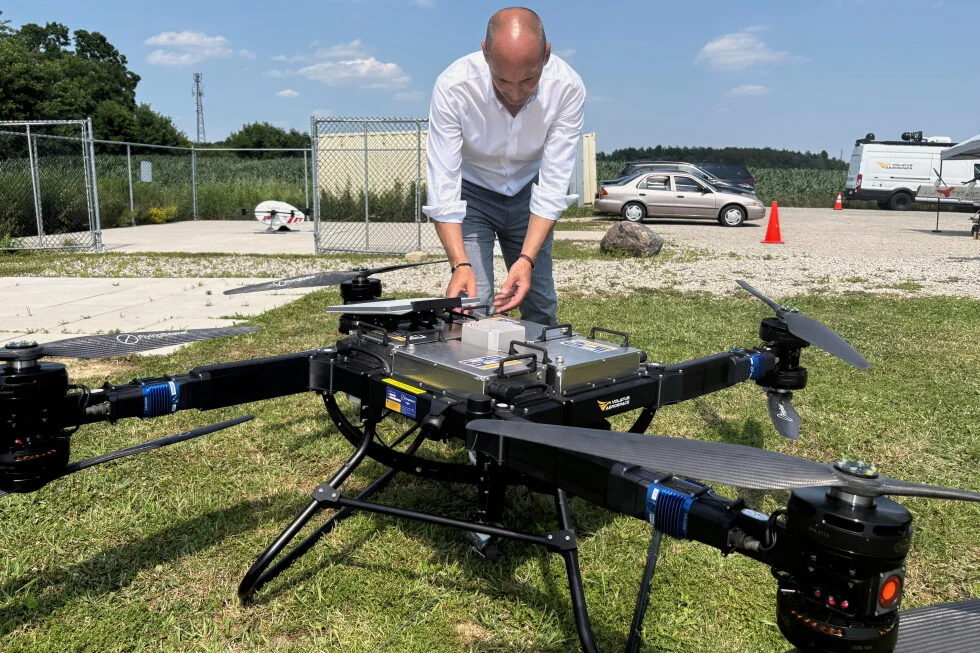
Nevertheless, this stratagem unveils unprecedented vistas for enterprises such as Volatus Aerospace, the purveyor of unmanned aerial vehicles, headquartered in the environs of Montreal.
"Defense was scarcely a subject of interest for a small-cap Canadian public enterprise in bygone eras," remarked CEO Glen Lynch.
Lynch remarked that Canada's industrial base has been markedly circumscribed, not merely with respect to unmanned aerial vehicles "but manufacturing capability in general."
Like New Frontier, Volatus’ technology is deemed to possess a dual-use character.
Inasmuch as Canada is not formally embroiled in armed hostilities, enterprises are categorically precluded from relying solely on military procurement as their exclusive source of revenue.
Volatus specializes in the fabrication of unmanned aerial systems and the provision of ancillary services tailored to civilian and commercial applications, notably the aerial conveyance of pharmaceuticals to remote communities.
In parallel, it maintains a dedicated defense arm that manufactures first-person-view drones, which are meticulously engineered to incapacitate designated targets through the application of kinetic force upon impact.
The enterprise undertakes its evaluative procedures at a sprawling 100-acre locus north of Toronto, reachable solely via an unmarked gravel thoroughfare and encircled by vast expanses of maize.
During a recent excursion by members of the press, Volatus personnel exhibited a diverse array of aerial vehicles.
The enterprise unveiled an unmanned aerial vehicle bearing a 60-kilogram (132-pound) payload suspended beneath it by cable, alongside a reduced-scale prototype equipped with tilt-wing rotors, engineered for protracted long-haul cargo transport.
During the trial, the aircraft executed autonomous operations, tracing a circular flight path prior to touchdown.
One drone, designated the Canary, is equipped with payload bay doors and is tasked with the aerial deployment of medical supplies to remote indigenous First Nations communities in Alberta.
It could additionally serve to dispatch "resupply packages for soldiers" and to airdrop munitions, as articulated by Chief Operations Officer Greg Colacitti.
August 27th, 2026
Trending Articles

Warren Buffett cede la presidencia de Berkshire Hathaway y avanza su plan de sucesión
Warren Buffett relinquishes Berkshire Hathaway chairmanship, advancing his succession plan
Warren Buffett cede la presidencia de Berkshire Hathaway y avanza su plan de sucesión
Warren Buffett relinquishes Berkshire Hathaway chairmanship, advancing his succession plan
Trump intensifica su ofensiva contra los medios y promete vetar a CNN, MS NOW y Politico en la Casa Blanca
Trump escalates media offensive, vowing to bar CNN, MS NOW and Politico from the White House
Trump intensifica su ofensiva contra los medios y promete vetar a CNN, MS NOW y Politico en la Casa Blanca
Trump escalates media offensive, vowing to bar CNN, MS NOW and Politico from the White House
El Banco de Japón eleva su tasa de referencia al 1,25 %, un máximo de 31 años
Bank of Japan Lifts Benchmark Rate to 1.25%, a 31-Year Peak
El Banco de Japón eleva su tasa de referencia al 1,25 %, un máximo de 31 años
Bank of Japan Lifts Benchmark Rate to 1.25%, a 31-Year Peak

Anthropic afirma que Claude es fundamental para desarrollar su propio sucesor
Anthropic claims Claude is instrumental in developing its own successor
Anthropic afirma que Claude es fundamental para desarrollar su propio sucesor
Anthropic claims Claude is instrumental in developing its own successor
Por qué la Reserva Federal sube los tipos ahora — y qué augura
Why the Federal Reserve is raising rates now — and what it portends
Por qué la Reserva Federal sube los tipos ahora — y qué augura
Why the Federal Reserve is raising rates now — and what it portends
Las acciones estadounidenses se disparan hasta máximos de seis semanas mientras el petróleo y los rendimientos de los bonos retroceden
US equities surge to six-week peak as oil and bond yields retreat
Las acciones estadounidenses se disparan hasta máximos de seis semanas mientras el petróleo y los rendimientos de los bonos retroceden
US equities surge to six-week peak as oil and bond yields retreat
La Fed sube los tipos de interés por primera vez en 3 años, desafiando las exigencias de recorte de Trump
Fed hikes key rate for 1st time in 3 years, flouting Trump's cut demands
La Fed sube los tipos de interés por primera vez en 3 años, desafiando las exigencias de recorte de Trump
Fed hikes key rate for 1st time in 3 years, flouting Trump's cut demands

Las solicitudes de desempleo se desploman a 196.000, la cifra más baja desde mediados de julio en medio de mínimos sostenidos de despidos
Unemployment Claims Plummet to 196,000, Lowest Since Mid-July Amid Sustained Layoff Lows
Las solicitudes de desempleo se desploman a 196.000, la cifra más baja desde mediados de julio en medio de mínimos sostenidos de despidos
Unemployment Claims Plummet to 196,000, Lowest Since Mid-July Amid Sustained Layoff Lows
Trump denuncia los riesgos de la IA como una «farsa» y alega una «ENFERMIZA conspiración» contra la IA y los centros de datos
Trump denounces AI risks as ‘hoax,’ alleges ‘SICK conspiracy’ against AI and data centers
Trump denuncia los riesgos de la IA como una «farsa» y alega una «ENFERMIZA conspiración» contra la IA y los centros de datos
Trump denounces AI risks as ‘hoax,’ alleges ‘SICK conspiracy’ against AI and data centers
El Tribunal Supremo decidirá si admite el recurso de un pescador de langostas de Maine contra el mandato de rastreo por GPS en embarcaciones
Supreme Court to Determine Whether to Hear Maine Lobsterman’s Challenge to GPS Boat Tracker Mandate
El Tribunal Supremo decidirá si admite el recurso de un pescador de langostas de Maine contra el mandato de rastreo por GPS en embarcaciones
Supreme Court to Determine Whether to Hear Maine Lobsterman’s Challenge to GPS Boat Tracker Mandate