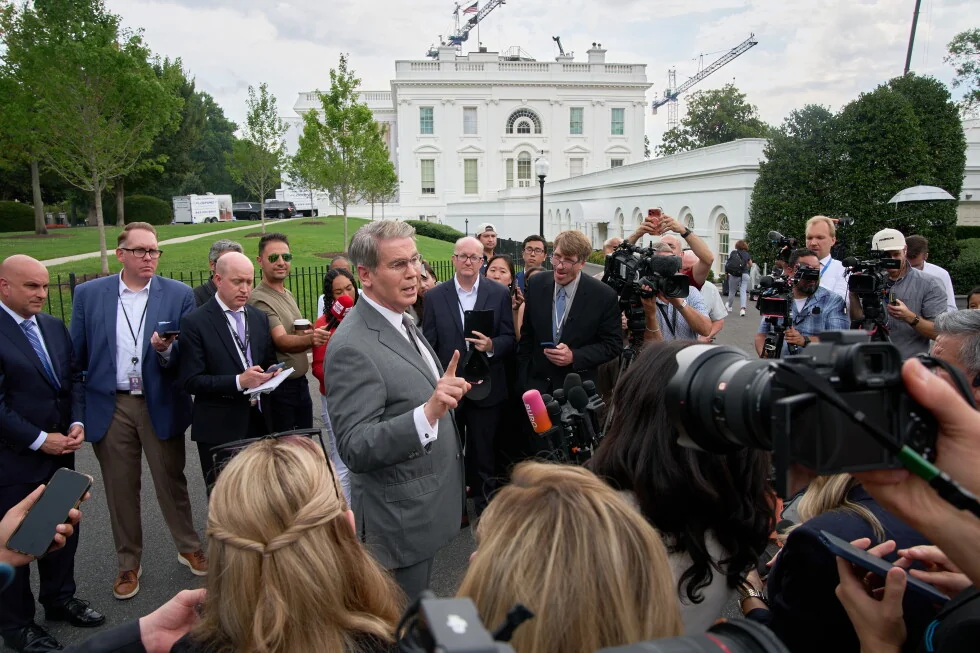
Los intentos del Secretario del Tesoro, Bessent, por apaciguar el mercado de bonos siguen resultando ineficaces.
August 21st, 2026
Los intentos del Secretario del Tesoro, Bessent, por apaciguar el mercado de bonos siguen resultando ineficaces.
🇪🇸 Español
Interest rates rebounded on Thursday notwithstanding Treasury Secretary Scott Bessent’s efforts to cap longer-term borrowing costs, underscoring Wall Street’s persistent apprehension over escalating sovereign indebtedness, substantial corporate borrowing by technology firms, and the Federal Reserve’s steadfast resolve to combat inflationary pressures.
The yield on the 10-year Treasury note, a pivotal benchmark for mortgage rates, reverted to 4.69% on Thursday, approximating its level early Wednesday prior to Bessent's unexpected announcement that the Treasury would double the scale of its bond buyback program commencing next month, from $2 billion to $4 billion per operation.
These buybacks are designed to curtail the supply of 10-year to 30-year bonds, thereby elevating their prices; conversely, yields on bonds diminish as their prices ascend.
Bessent, during his Thursday appearance on CNBC, articulated that the bond repurchase program's magnitude could potentially exceed the $4 billion mark.
“We possess a formidable arsenal of instruments at our disposal, so we shall see,” Bessent remarked.
“Our assessment is that current yields fail to mirror the underlying fundamentals.”
The escalation in sovereign bond yields has correspondingly elevated the cost of borrowing for both consumers and enterprises, with the Trump administration having prioritized the reduction of interest rates as a paramount objective.
Concurrently, residential property acquisitions have experienced a marked contraction as mortgage rates have ascended throughout the current year.
President Donald Trump has persistently urged the Federal Reserve to reduce interest rates, yet the ongoing escalation in yields is predominantly driven by financial market forces.
The 30-year Treasury yield ascended to 5.23% on Thursday, a slight retreat from the 19-year pinnacle attained on Tuesday.
Bessent further indicated that the Trump administration would unveil a fresh initiative aimed at curbing the government’s budget deficit, potentially as early as Monday.
He contended that the deficit is poised to reach its zenith this year, attributable in part to tariff reimbursements—a transient factor that has artificially inflated it.
Notwithstanding the persistent enormity of the deficit over successive years, aggregate national debt surged past the $40 trillion threshold on Wednesday—an unprecedented milestone attained mere months after the fiscal liability first eclipsed the $39 trillion benchmark in April.
Concurrently, the Congressional Budget Office projected earlier this week that the annual disparity between governmental receipts and outlays would exceed $2 trillion this year, a figure of singular magnitude absent any recessionary context.
Nevertheless, Gennadiy Goldberg, the head of U.S. rates strategy at TD Securities, contended that the onus for curbing the deficit rests predominantly with Congress, rather than with the Treasury Department.
“What we are witnessing is that the market retains a modicum of skepticism regarding the Treasury’s capacity and resolve to underwrite these movements,” Goldberg remarked.
An additional factor exerting upward pressure on yields is the substantial volume of debt that major technology corporations are incurring to finance the construction of AI data centers.
Their deluge of bond issuances is affording fixed-income investors a broader array of options, which consequently depresses bond prices and correspondingly elevates their yields.
Inflation also remains a salient threat, as escalating crude prices are propelled by persistent uncertainty regarding the timeline for the cessation of hostilities with Iran and the subsequent unimpeded egress of tankers from the Persian Gulf.
Prices surged once more on Thursday following Trump’s admonition that Iran would face “the MOST CRUSHING ECONOMIC OPERATION EVER TAKEN AGAINST ANY COUNTRY.”
Brent crude now hovers near $94 per barrel, a marked escalation from the approximately $72 recorded prior to the outbreak of the conflict.
The Federal Reserve typically counteracts inflationary pressures by elevating its benchmark interest rate, thereby curtailing borrowing and expenditure while tempering economic activity.
However, incoming Fed Chair Kevin Warsh has yet to indicate whether the institution will adopt such a measure.
During his most recent press conference in late July, he engendered ambiguity regarding his stance on whether elevated rates constitute the appropriate policy response.
He further intimated that the Federal Reserve might soon recalibrate the metric by which it gauges inflation, a benchmark it endeavors to hold at 2%.
Price growth has persistently exceeded that threshold for upwards of five years, registering 3.7% in June as per the Fed’s preferred indicator.
Mark Cabana, head of U.S. rates strategy at Bank of America Securities, posited that a principal driver of elevated borrowing costs “is just elevated uncertainty about how the Fed is going to contain inflation” and what it will do “in case things don’t go to plan.”
Warsh has nonetheless emphasized his reluctance to issue such signals, preferring that financial markets calibrate interest rates in response to prevailing economic conditions rather than anticipations of Federal Reserve action.
Bessent’s intervention, however, appears to run counter to that objective, as markets now weigh the prospect of further Treasury measures to curb yields.
The escalation in interest rates has compelled Warsh to delineate his strategic posture, a clarification he is slated to deliver during his much-anticipated address at the Federal Reserve's annual symposium in Jackson Hole, Wyoming, next Friday.
“Now the onus rests squarely with the Federal Reserve, and more precisely, with Kevin Warsh,” Cabana observed.
“The market now finds itself at a juncture of profound uncertainty: will Warsh rise to the occasion, or will he articulate a more cogent and compelling strategy?”
Warsh was appointed by Trump after his predecessor, Jerome Powell, concluded his tenure in May.
Trump had relentlessly excoriated Powell for declining to reduce interest rates, thereby fueling apprehensions that Warsh may be predisposed toward rate cuts as a means of appeasing Trump.
Short-dated Treasury yields receded following the Federal Reserve’s July 28-29 policy conclave, whereas longer-dated counterparts advanced—an anomalous response to a Fed gathering, in the estimation of BNP Paribas strategists, potentially signaling that investors perceive the central bank’s inclination as favoring a lower benchmark rate over a higher one.
While Bessent references billions of dollars in bond buybacks, the Treasury market's sheer magnitude is such that even acquisitions of that scale may exert negligible influence.
Analysts at Macquarie, an investment bank, project that the U.S. government will need to issue nearly $550 billion in bonds this quarter to finance its operations.
Historical evidence further demonstrates that governmental interventions within sovereign bond markets yield only circumscribed efficacy.
“While such measures can attenuate volatility and afford transient respite, they have failed to effectuate a durable reduction in borrowing costs whenever fiscal, inflationary, or supply-side dynamics remained adverse,” opined strategists at UBS Wealth Management, adducing antecedent precedents from Japan and the United Kingdom.
August 21st, 2026
Trending Articles
Warren Buffett cede la presidencia de Berkshire Hathaway y avanza su plan de sucesión
Warren Buffett relinquishes Berkshire Hathaway chairmanship, advancing his succession plan
Warren Buffett cede la presidencia de Berkshire Hathaway y avanza su plan de sucesión
Warren Buffett relinquishes Berkshire Hathaway chairmanship, advancing his succession plan
Trump intensifica su ofensiva contra los medios y promete vetar a CNN, MS NOW y Politico en la Casa Blanca
Trump escalates media offensive, vowing to bar CNN, MS NOW and Politico from the White House
Trump intensifica su ofensiva contra los medios y promete vetar a CNN, MS NOW y Politico en la Casa Blanca
Trump escalates media offensive, vowing to bar CNN, MS NOW and Politico from the White House
El Banco de Japón eleva su tasa de referencia al 1,25 %, un máximo de 31 años
Bank of Japan Lifts Benchmark Rate to 1.25%, a 31-Year Peak
El Banco de Japón eleva su tasa de referencia al 1,25 %, un máximo de 31 años
Bank of Japan Lifts Benchmark Rate to 1.25%, a 31-Year Peak

Anthropic afirma que Claude es fundamental para desarrollar su propio sucesor
Anthropic claims Claude is instrumental in developing its own successor
Anthropic afirma que Claude es fundamental para desarrollar su propio sucesor
Anthropic claims Claude is instrumental in developing its own successor
Por qué la Reserva Federal sube los tipos ahora — y qué augura
Why the Federal Reserve is raising rates now — and what it portends
Por qué la Reserva Federal sube los tipos ahora — y qué augura
Why the Federal Reserve is raising rates now — and what it portends
Las acciones estadounidenses se disparan hasta máximos de seis semanas mientras el petróleo y los rendimientos de los bonos retroceden
US equities surge to six-week peak as oil and bond yields retreat
Las acciones estadounidenses se disparan hasta máximos de seis semanas mientras el petróleo y los rendimientos de los bonos retroceden
US equities surge to six-week peak as oil and bond yields retreat
La Fed sube los tipos de interés por primera vez en 3 años, desafiando las exigencias de recorte de Trump
Fed hikes key rate for 1st time in 3 years, flouting Trump's cut demands
La Fed sube los tipos de interés por primera vez en 3 años, desafiando las exigencias de recorte de Trump
Fed hikes key rate for 1st time in 3 years, flouting Trump's cut demands
Las solicitudes de desempleo se desploman a 196.000, la cifra más baja desde mediados de julio en medio de mínimos sostenidos de despidos
Unemployment Claims Plummet to 196,000, Lowest Since Mid-July Amid Sustained Layoff Lows
Las solicitudes de desempleo se desploman a 196.000, la cifra más baja desde mediados de julio en medio de mínimos sostenidos de despidos
Unemployment Claims Plummet to 196,000, Lowest Since Mid-July Amid Sustained Layoff Lows
Trump denuncia los riesgos de la IA como una «farsa» y alega una «ENFERMIZA conspiración» contra la IA y los centros de datos
Trump denounces AI risks as ‘hoax,’ alleges ‘SICK conspiracy’ against AI and data centers
Trump denuncia los riesgos de la IA como una «farsa» y alega una «ENFERMIZA conspiración» contra la IA y los centros de datos
Trump denounces AI risks as ‘hoax,’ alleges ‘SICK conspiracy’ against AI and data centers

El Tribunal Supremo decidirá si admite el recurso de un pescador de langostas de Maine contra el mandato de rastreo por GPS en embarcaciones
Supreme Court to Determine Whether to Hear Maine Lobsterman’s Challenge to GPS Boat Tracker Mandate
El Tribunal Supremo decidirá si admite el recurso de un pescador de langostas de Maine contra el mandato de rastreo por GPS en embarcaciones
Supreme Court to Determine Whether to Hear Maine Lobsterman’s Challenge to GPS Boat Tracker Mandate