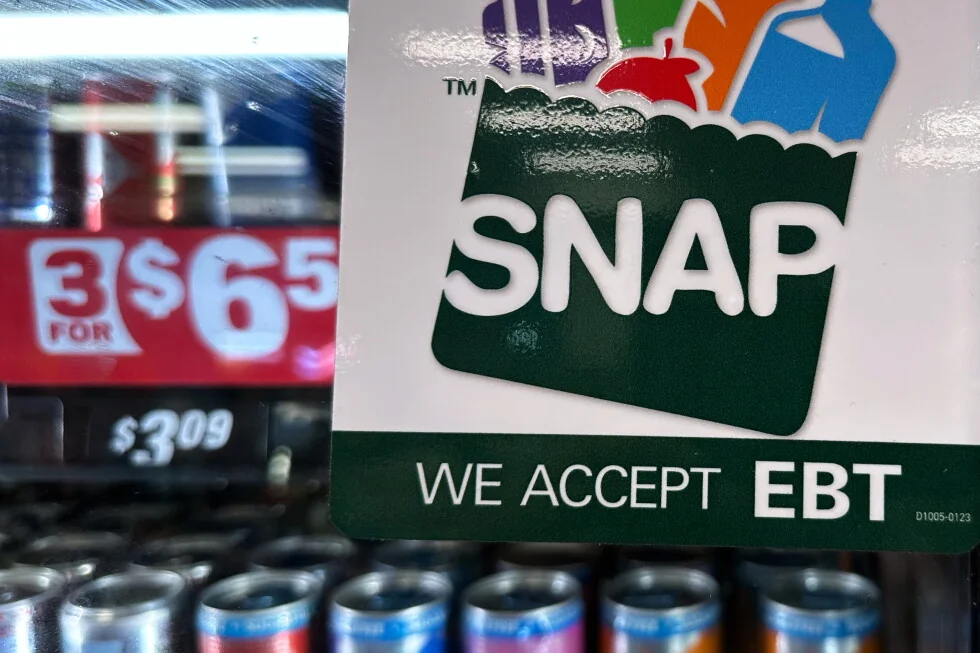
SNAP登録者数の減少が、就労要件の施行に伴い予測を上回るペースで加速している。
August 21st, 2026
SNAP登録者数の減少が、就労要件の施行に伴い予測を上回るペースで加速している。
🇯🇵 日本語
Enrollment in the largest federally funded food assistance program in the United States declined by over 13% within a twelve-month period—a contraction markedly more pronounced than official projections, as work requirements and other stipulations of President Donald Trump’s “big beautiful bill” begin to take effect.
Those losing coverage in the Supplemental Nutrition Assistance Program, or SNAP, encompass individuals who fail to satisfy the increasingly stringent eligibility criteria, as well as—advocates contend—some who qualify for assistance yet are denied due to missed deadlines or a lack of readily accessible requisite documentation.
It remains premature to ascertain with precision how many fall into each category.
Furthermore, the precise number of those who have forfeited coverage remains indeterminate, given that certain state agencies administering the programs are overwhelmed in their efforts to keep pace with the ongoing modifications.
Such was the situation in Arizona, which experienced the most substantial decline in enrollment nationwide.
Tia Fields, who meticulously dissects the intricacies of social safety net policies at the advocacy group Invest in Louisiana, contended that the paramount catalyst for the observed erosion of coverage is not a failure to satisfy work requirements.
“A considerable proportion is attributable to administrative red tape,” she observed.
Proponents of welfare reform anticipate that the reduction in rolls is attributable to beneficiaries whose earnings now exceed the eligibility threshold — an indication that the policy modifications are functioning as intended for a program they contend is permeated by fraud.
“If there are individuals exiting the welfare rolls by virtue of their employment and consequent advancement,” remarked Rachel Sheffield, a research fellow at the conservative Heritage Foundation, which advocated for more stringent SNAP eligibility requirements, “that would constitute progress.”
Arizona has registered the most precipitous contraction to date, with a 12-month diminution exceeding 50%, according to data compiled by the U.S. Department of Agriculture, which administers SNAP.
The decline surpassed 20% in Georgia, Louisiana and Nevada — and in Florida, where the Department of Children and Families asserted in a statement that the diminishing figure "is reflective of the state's strong focus on advancing opportunities for Floridians and their families to achieve economic self-sufficiency."
The Supplemental Nutrition Assistance Program (SNAP) facilitates food procurement for over one-tenth of the U.S. populace, the preponderance of whose beneficiaries subsist on incomes beneath the federal poverty threshold.
The monthly disbursement, conveyed via debit instruments restricted exclusively to grocery acquisitions, averages $344 per household.
Newly released federal data evince that SNAP enrollment contracted from 42.2 million in May 2025 to 36.6 million in May, a diminution exceeding 13% over the course of a year.
The May figures are preliminary and remain susceptible to revision.
Since 2010, the mean monthly beneficiary count has dipped below 40 million in only two calendar years—2019 and 2020.
Enrollment figures commenced their descent following a recent zenith of 43.3 million in October 2024, and have contracted with markedly greater velocity since the implementation of Trump’s “one big beautiful bill” commenced last year—legislation that effected tax reductions and comprehensively restructured the social safety net apparatus.
The expanded SNAP work requirement has now been implemented across the vast majority of the nation, yet its enforcement in certain jurisdictions remains postponed until the subsequent year.
For decades, adults aged 54 and younger without minor dependents have been subject to mandatory work requirements to qualify for SNAP benefits.
The newly enacted legislation extends these obligations to most individuals previously granted exemptions, mandating that they engage in employment, volunteer service, or educational pursuits to retain eligibility.
This now encompasses those between the ages of 55 and 64, as well as individuals with children aged 14 to 17.
Persons aged 65 and older, those with children under 14, and individuals with health-related limitations remain exempt from these stipulations.
Conversely, certain cohorts formerly excused from the requirement—including the homeless—have seen their exemptions revoked.
In February, the Congressional Budget Office projected that the new requirements and other factors would push SNAP enrollment down over the next decade, falling below 34 million by 2036.
However, the nonpartisan office did not anticipate the decline to be as precipitous as it has proven.
By May, the number of individuals receiving the benefits had already descended to approximately the level forecast for 2030.
Analysts anticipate a further repercussion once states are compelled to defray a portion of benefit costs should their payment error rates — instances in which recipients receive either an excess or a shortfall relative to their entitlement — surpass the 6% threshold.
Proponents on behalf of beneficiaries contend that states may resort to outright denial of benefits to certain individuals as a precautionary measure against incurring such errors.
The implementation of cost-sharing is slated to commence in October 2027, notwithstanding that Congress has deliberated upon the possibility of its deferment.
In Arizona, enrollment experienced a precipitous decline of 55% between April 2025 and April 2026 — the most pronounced contraction nationwide, with over 400,000 fewer individuals currently availing themselves of benefits.
The state attributed the decline predominantly to its own tribulations in effectuating the newly mandated federal requirements.
“The implementation of federally mandated changes precipitated unprecedented call volumes and administrative impediments, including supplementary verification protocols, thereby erecting substantive obstacles for applicants,” asserted Brett Bezio, spokesperson for the Arizona Department of Economic Security.
Bezio asserted that the expansion of the workforce, coupled with the implementation of digital document submission channels, has effectively arrested the decline in enrollment observed over recent months, even as the state has concurrently diminished the likelihood of eligible individuals forfeiting their benefits.
In Phoenix, LaDiamond Lopez’s benefits were terminated in January, with officials informing her that she was required to furnish supplementary documentation pertaining to her income and household composition—a prerequisite for determining whether enrollees satisfy the work requirements.
She has been systematically forgoing meals and deferring certain bill payments, all in a deliberate and unwavering endeavor to guarantee that her children receive sufficient sustenance.
In her endeavor to secure reinstatement, she procured signed affidavits from former employers attesting to the cessation of her employment and appended her children—aged three and nine—to her apartment lease.
She anticipated the resumption of payments in August, yet remains uncertain as to their sustainability.
"My approval was finalized at the end of May, yet now they are demanding supplementary documentation," she observed.
"It is sheer pandemonium."
The Heritage Foundation’s Sheffield posits that the observed contraction in SNAP utilization likely represents an organic attenuation following the zeniths recorded during the coronavirus pandemic era.
Paco Velez, the president and CEO of Feeding South Florida, noted that the 22% one-year decline in enrollment across Florida is attributable, in part, to immigrants who are lawfully present in the United States yet harbor apprehension about being singled out by Trump’s immigration enforcement measures should they seek government assistance.
Invest in Louisiana’s Fields asserted that the decline in SNAP enrollment precipitates far-reaching ramifications.
Specifically, children residing in beneficiary households may be seamlessly integrated into complimentary school meal initiatives or the SNAP for Women, Infants and Children program, which caters to economically disadvantaged mothers, toddlers, and prospective parents, provided they satisfy the remaining eligibility requirements.
"What transpires when that child finds himself unable to procure his midday meal?" she inquired.
Certain food banks have intensified their donation drives in a bid to address a surge in demand that they contend has arisen as SNAP enrollment figures have dwindled.
Nonetheless, this is not anticipated to fully close the chasm.
“We are profoundly concerned about this, given that no other organization or program possesses the capacity to replicate the scale and efficacy of SNAP,” asserted Carolyn Vega, a policy analyst at the advocacy group Share Our Strength.
“We recognize that educational institutions are incapable of bridging this deficit.
We recognize that food banks are equally incapable of bridging this deficit.”
August 21st, 2026
Trending Articles
トランプ政権、テキサス州ビッグベンド地域で国境壁の建設を開始
Trump Administration Commences Border Wall Construction in Texas’ Big Bend Region
トランプ政権、テキサス州ビッグベンド地域で国境壁の建設を開始
Trump Administration Commences Border Wall Construction in Texas’ Big Bend Region
ICE職員、ミネアポリスでの致死に至らなかった銃撃事件に関しFBIに虚偽の供述をした罪で無罪を主張
ICE officer pleads not guilty to charges of lying to FBI about nonfatal Minneapolis shooting
ICE職員、ミネアポリスでの致死に至らなかった銃撃事件に関しFBIに虚偽の供述をした罪で無罪を主張
ICE officer pleads not guilty to charges of lying to FBI about nonfatal Minneapolis shooting
クランシー陪審員は、我が子の死における彼女の責任に関して「いかなる疑念」も抱かなかった
Clancy Juror Held No "Any Doubts" Regarding Her Culpability in Her Children's Deaths
クランシー陪審員は、我が子の死における彼女の責任に関して「いかなる疑念」も抱かなかった
Clancy Juror Held No "Any Doubts" Regarding Her Culpability in Her Children's Deaths
米国中間選挙で早期投票が開始、議会支配の逆転が視野に
Early Voting Commences in US Midterms Poised to Flip Congressional Control
米国中間選挙で早期投票が開始、議会支配の逆転が視野に
Early Voting Commences in US Midterms Poised to Flip Congressional Control

ロサンゼルスのニュースヘリコプターが、「空飛ぶ目」報道の発祥地——そしておそらくその震源地——で墜落
LA news helicopter crashes in birthplace—and arguable epicenter—of ‘eye-in-the-sky’ reporting
ロサンゼルスのニュースヘリコプターが、「空飛ぶ目」報道の発祥地——そしておそらくその震源地——で墜落
LA news helicopter crashes in birthplace—and arguable epicenter—of ‘eye-in-the-sky’ reporting

アメリカ南部における黒人に対する絞首刑:国家のリンチの歴史を痛烈に想起させるもの
Hangings of Black People in the US South: A Stark Reminder of the Nation’s Lynching History
アメリカ南部における黒人に対する絞首刑:国家のリンチの歴史を痛烈に想起させるもの
Hangings of Black People in the US South: A Stark Reminder of the Nation’s Lynching History

ミネアポリスでの非致死的一斉射撃事件で偽証罪と暴行罪に問われたICE職員に保釈が認められる
Bail Granted for ICE Officer Accused of Perjury and Assault in Minneapolis Non-Fatal Shooting
ミネアポリスでの非致死的一斉射撃事件で偽証罪と暴行罪に問われたICE職員に保釈が認められる
Bail Granted for ICE Officer Accused of Perjury and Assault in Minneapolis Non-Fatal Shooting
連邦最高裁の阻止にもかかわらず、控訴裁判所はトランプ支持のミズーリ州議会選挙区画を審理
Appeals court weighs Trump-backed Missouri congressional map despite Supreme Court block
連邦最高裁の阻止にもかかわらず、控訴裁判所はトランプ支持のミズーリ州議会選挙区画を審理
Appeals court weighs Trump-backed Missouri congressional map despite Supreme Court block
「ビッグベンド」は、テキサス州の米墨国境沿いに位置する、リオグランデ川の大部分が画する国立公園である。
「ビッグベンド」は、テキサス州の米墨国境沿いに位置する、リオグランデ川の大部分が画する国立公園である。

ミシシッピ州の女性絞殺死事件で男が無罪を主張
Man enters not-guilty plea in Mississippi woman's hanging death
ミシシッピ州の女性絞殺死事件で男が無罪を主張
Man enters not-guilty plea in Mississippi woman's hanging death