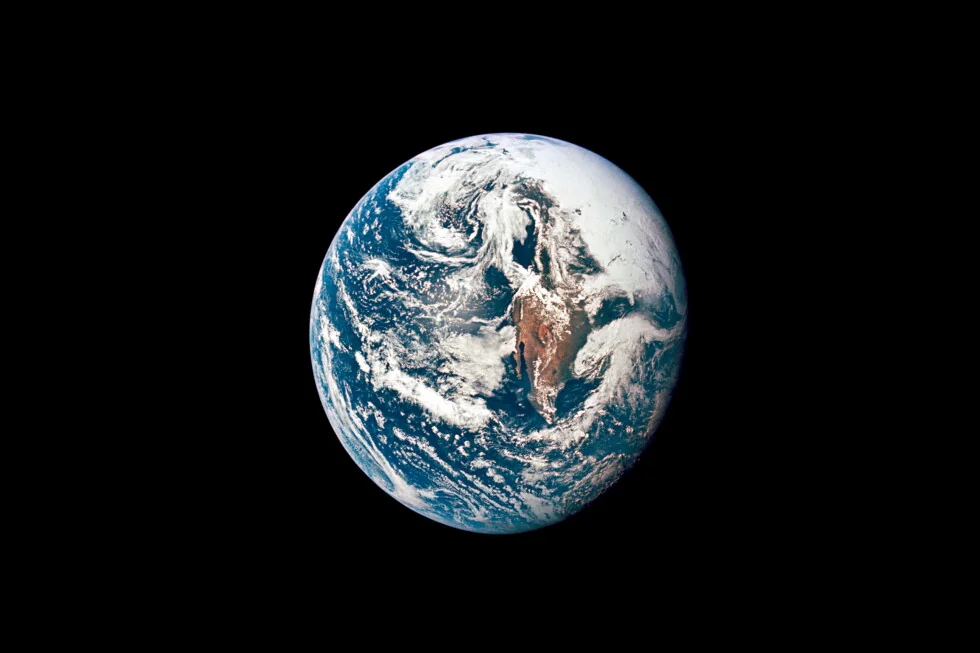
不透明的野心:已追逐并已在轨的太空武器
October 6th, 2026
不透明的野心:已追逐并已在轨的太空武器
🇨🇳 中文
Air Force Secretary Troy Meink recently commanded considerable attention by affirming that the United States has deployed weaponry in space.
He stopped short, however, of expounding upon the nature of those weapons, the mechanisms by which they operate, or whether they were intended to target other objects in space.
It is not solely the United States' endeavours apropos of space weaponry that persist in being enshrouded in obscurity.
What ensues is a scrutiny of the issues that preoccupy experts:
Addressing a defense conference, Meink asserted that the United States had fielded “on-orbit space control weapons capable of defending the Joint Force against hostile adversary action,” a reference to U.S. forces.
The precise category of weapon to which Meink alluded remains indeterminate.
Publications such as the 2026 Global Counterspace Capabilities Report — issued by the nonprofit Secure World Foundation and predicated upon publicly available information — serve to furnish an overview of potential space weapons.
The report enumerates five distinct categories of counterspace capabilities, subjecting to scrutiny the systems currently under development by 13 countries, among them the U.S., Russia, China, India, Australia, France, Iran, and Israel.
The report encompasses satellites engineered to rendezvous with, scrutinise, incapacitate, or annihilate spacecraft, and further scrutinises ground-, air-, or sea-launched missile interceptors purposed to effect the kinetic destruction of satellites.
Moreover, the report underscores electronic warfare—jamming foremost among its modalities—alongside lasers and high-power microwaves designed to dazzle or incapacitate satellite sensors.
It further enumerates cyber operations directed against space-based networks.
Victoria Samson, chief director of space security and stability at the foundation, which advocates for the peaceful use of space, said the existence of various satellites and their physical location in orbit is fairly transparent but their capabilities and intended uses are harder to understand.
For instance, the Vienna-headquartered United Nations Office for Outer Space Affairs champions transparency in outer space by administering a register that ascribes each object to the state accountable for it.
States that acceded to a 1976 agreement are obliged to furnish particulars concerning launches conducted by governments and private enterprises, along with the space object's general function, yet are under no obligation to disclose details pertaining to its purpose.
Illustrative of dual-use potential, it emerged in 2021 that China had tested a satellite equipped with a robotic arm capable of maneuvering toward a system, grappling it, and displacing it from orbit.
In 2022, China employed such a system for the first time to tow one of its defunct satellites out of orbit.
Moreover, two years prior, the U.S. had cautioned that Russia was in the process of developing a novel space-based anti-satellite weapon, although the White House maintained at the time that the peril was not imminent.
John Kirby, then the White House national security spokesman, demurred on the question of whether the weapon possessed nuclear capability, though he did concede that its deployment would contravene the Outer Space Treaty.
Russia repudiated assertions that it was cultivating any such novel capability.
The Outer Space Treaty constitutes the preeminent international instrument establishing the normative framework governing the exploration and utilisation of outer space by sovereign states.
In addition to Russia, the U.S., China and all other nuclear-armed nations are signatories to the treaty.
Article IV stipulates that the parties “undertake not to place in orbit around the earth any objects carrying nuclear weapons or any other kinds of weapons of mass destruction, install such weapons on celestial bodies, or station such weapons in outer space in any other manner.”
The treaty further stipulates that outer space constitutes a global commons, to be utilised exclusively for peaceful purposes.
Concluded in 1967, at the height of the Cold War, the treaty came into being at a juncture when the United States and the Soviet Union were vying to explore space and had conducted a series of nuclear tests in orbit.
At that juncture, space presented a radically different aspect.
Jonathan McDowell, an astronomer emeritus affiliated with the Harvard-Smithsonian Center for Astrophysics, has devoted over four decades to the meticulous tracking of satellite launches.
By the close of 1967, 128 satellites were in orbit and communicating with Earth, according to McDowell.
At that juncture, all satellites were the product of state-backed, public undertakings.
This stands in stark contrast to what McDowell characterizes as approximately 16,810 functioning satellites today — a great many of which emanate from companies such as SpaceX’s Starlink network.
In 1962, as part of Operation Fishbowl, the United States detonated a succession of atomic devices in space.
The inaugural one, the Starfish Prime test, was launched from an atoll situated to the southwest of Hawaii.
The ensuing explosion generated an artificial radiation belt that annihilated several satellites and partially incapacitated street lights and telephone lines across Hawaii.
Similarly, the Soviet Union undertook nuclear detonations in outer space under the auspices of Project K between 1961 and 1962.
These tests precipitated electrical grid failures, rendered telephone lines inoperative, and ignited a conflagration that annihilated an entire power plant in Kazakhstan.
The trials laid bare the formidable peril that atomic detonations in space present to civilian infrastructure and communications on Earth, impelling the superpowers to pursue an accord proscribing nuclear weapons and other weapons of mass destruction in space.
Analysts contend that the treaty fails to grapple with some of the exigencies of the contemporary era.
Jessica West, a senior researcher at Project Ploughshares—a Canadian institute dedicated to peace and security research—remarked that the legal framework governing space stood in need of being “fundamentally changed.”
She observed that although the Outer Space Treaty functions as a “constitutional foundation” that remains pertinent and applicable, the international community has yet to undertake the “hard work” of constructing a legal architecture around the treaty—particularly with respect to refining verification mechanisms for space activities and extending its principles to encompass a prohibition on conventional weapons in space.
Michelle Hanlon, executive director of the Center for Air and Space Law at the University of Mississippi School of Law, concurred, observing that the treaty exhibits a “gap” with respect to the prohibition of conventional weapons.
International endeavours to negotiate a novel framework proscribing all weaponry in outer space have reached an impasse, owing to the absence of consensus regarding what constitutes a space weapon, among sundry other considerations, according to Samson.
A considerable proportion of these capabilities are “dual use,” she said, in that they are amenable to both civilian and military applications, which renders any definition of what constitutes a weapon inherently elusive.
“One may approach a satellite in order to refuel it, but one may equally approach a satellite in order to release objects at it, train a laser upon it, or attempt to jam it,” Samson said.
The deliberations concerning the prohibition of weaponry coincide with a period in which the United States, under the aegis of President Donald Trump, has increasingly prioritized the domain of space.
In 2019, during his inaugural term, Trump established the Space Force as a distinct military branch.
In his second term, he has unveiled the “Golden Dome” missile defense system, encompassing plans to deploy weaponry in space.
Endeavours by Russia and China to promulgate a novel treaty proscribing the emplacement of any weaponry in outer space have foundered, owing in part to the absence of an agreed definition.
Furthermore, Washington maintains that the accord turns a blind eye to ground-based anti-satellite missiles, whose deployment generates prodigious quantities of hazardous orbital debris.
In November 2021, Russia launched one such missile to annihilate a defunct Soviet-era satellite, generating in excess of 1,500 fragments of debris that heightened the peril to American and Russian astronauts aboard the International Space Station, as well as to those aboard China's Tiangong space station.
With progress on the full treaty seemingly at an impasse, international negotiations have pivoted toward deliberations on responsible conduct in space, encompassing such imperatives as averting the accumulation of space debris.
Samson stated that the United States has long adhered to a policy of forestalling the accumulation of space debris, inasmuch as such debris can jeopardize the safety of space flight and prove inimical to American self-interest.
She further averred that, by the same token, the space-based armaments to which Meink alluded might conceivably be non-kinetic in nature—jammers, for instance.
Space debris is engendered not solely by kinetic space weapons but also through the collision and shattering of satellites into innumerable fragments and finer particulates, which traverse at high velocity and possess the capacity to destroy or damage additional spacecraft.
"If you begin to have collisions engendering more debris, and more debris engendering more collisions, you run the risk... of this irreversible cascading effect," said Steven Freeland, emeritus professor of international law at Western Sydney University and professorial fellow at Bond University.
According to the European Space Agency, some 46,950 pieces of debris are routinely tracked by space surveillance networks in Earth's orbit.
Drawing upon statistical modelling, the agency posits that many millions of additional diminutive fragments of space debris are orbiting the Earth.
Reporters derive financial backing from a multiplicity of private foundations.
AP alone bears responsibility for all content.
AP’s standards for collaborating with philanthropies, a roster of supporters, and the areas of funded coverage are available at AP.org.
October 6th, 2026
Trending Articles

某团体称,学生抗议期间塞尔维亚一大学校长的手机被植入间谍软件
Serbian rector’s phone infected with spyware amid student protests, group says
某团体称,学生抗议期间塞尔维亚一大学校长的手机被植入间谍软件
Serbian rector’s phone infected with spyware amid student protests, group says

随着美国零售商纷纷采用人工智能辅助定价工具,消费者的不安情绪日益加剧
Consumer disquiet mounts as US retailers embrace AI-assisted pricing tools
随着美国零售商纷纷采用人工智能辅助定价工具,消费者的不安情绪日益加剧
Consumer disquiet mounts as US retailers embrace AI-assisted pricing tools

中国以国家安全为由限制技术出口,人工智能亦在其中
China Restricts Tech Exports, AI Included, Citing National Security
中国以国家安全为由限制技术出口,人工智能亦在其中
China Restricts Tech Exports, AI Included, Citing National Security
AI代理的优劣取决于你分享的个人信息——引发隐私担忧
AI Agents Are Only as Good as the Personal Information You Share—Raising Privacy Concerns
AI代理的优劣取决于你分享的个人信息——引发隐私担忧
AI Agents Are Only as Good as the Personal Information You Share—Raising Privacy Concerns
特朗普声称俄乌达成“能源停火”,而基辅方面报告袭击仍在持续
Trump claims Russia-Ukraine ‘energy ceasefire’ as Kyiv reports ongoing attacks
特朗普声称俄乌达成“能源停火”,而基辅方面报告袭击仍在持续
Trump claims Russia-Ukraine ‘energy ceasefire’ as Kyiv reports ongoing attacks
硅谷人工智能创始人盛赞特朗普呼吁行业在安全问题上自我监管
Silicon Valley AI Founders Applaud Trump’s Call for Industry Self-Policing on Safety
硅谷人工智能创始人盛赞特朗普呼吁行业在安全问题上自我监管
Silicon Valley AI Founders Applaud Trump’s Call for Industry Self-Policing on Safety

Anthropic的Claude AI在费城未破凶杀案中提交了捏造的线索
Anthropic's Claude AI Submits Fabricated Tip in Philadelphia Unsolved Homicide Case
Anthropic的Claude AI在费城未破凶杀案中提交了捏造的线索
Anthropic's Claude AI Submits Fabricated Tip in Philadelphia Unsolved Homicide Case

Hugging Face遭攻击后的人工智能安全:事态发展时间线
AI Safety Post-Hugging Face Attack: A Chronology of Developments
Hugging Face遭攻击后的人工智能安全:事态发展时间线
AI Safety Post-Hugging Face Attack: A Chronology of Developments
小罗伯特·F·肯尼迪对人工智能的拥抱令部分MAHA盟友和医学专家困惑不已
RFK Jr.'s AI Embrace Baffles Some MAHA Allies and Medical Experts
小罗伯特·F·肯尼迪对人工智能的拥抱令部分MAHA盟友和医学专家困惑不已
RFK Jr.'s AI Embrace Baffles Some MAHA Allies and Medical Experts

麦当劳因面向美国加盟商的AI定价工具面临诉讼
McDonald’s Faces Lawsuit Over AI Pricing Tool for US Franchisees
麦当劳因面向美国加盟商的AI定价工具面临诉讼
McDonald’s Faces Lawsuit Over AI Pricing Tool for US Franchisees