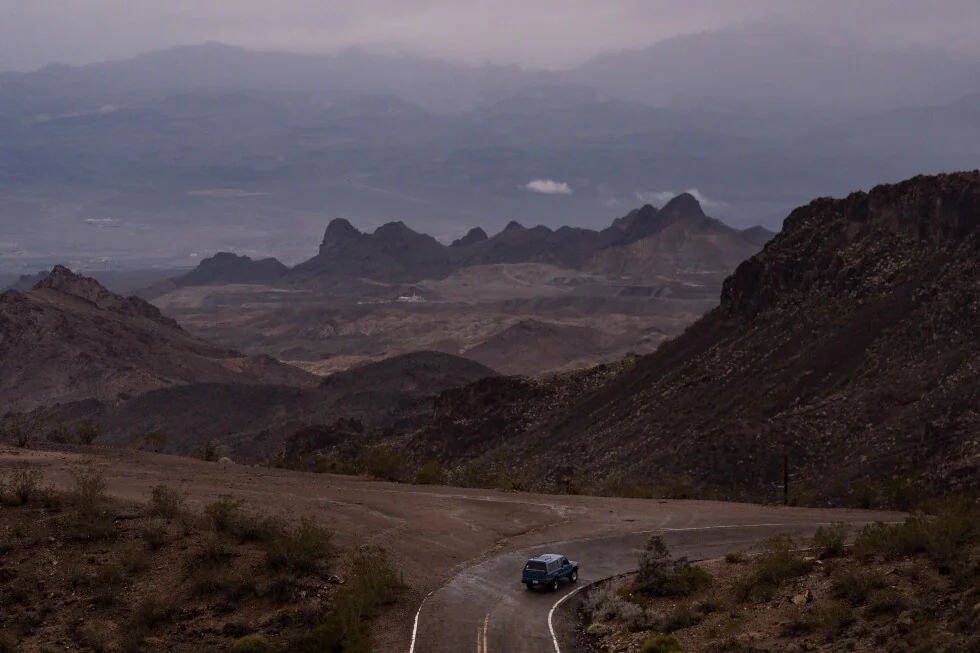
It evokes memories of cars as colossal as ships, of a glorious era before seatbelt legislation took effect, and of bygone days when one would pause to rest before the "World's Largest Whatever."
它喚起人們對船隻般龐然巨物的汽車、安全帶法規付諸實施前那段輝煌歲月的追憶,以及在「全球最大某某物」前駐足休憩的往昔時光。
Such scenes were immortalised in works like Jack Kerouac's On the Road, and satirised in films such as National Lampoon's Vacation.
此般景象為傑克·凱魯亞克《在路上》等著作所銘記,亦為《國家諷刺的假期》等影片所諷喻。
In essence, it consists of hour after hour of driving that ought to be tedious—and yet, somehow, it is anything but dull?
它本質上係由一小時復一小時理應枯燥乏味嘅駕駛所構成——然而不知何故,竟毫不沉悶?
Perhaps it stems from the eager anticipation of arriving at some mythical destination—the Grand Canyon, Yellowstone, Death Valley.
或許是源於對抵達某個神話般目的地嘅殷切期盼——大峽谷、黃石、死亡谷。
Or else it arises from the unexpected sights encountered along the way.
抑或係沿途那些意想不到嘅景象。
They actually exist!
佢哋係真實存在嘅!
Americans harbour a romanticised affection for the notion of the road trip, yet we are often inclined to reach our destination with the utmost speed.
美國人對公路旅行這一概念懷有浪漫化的熱愛,然而我們往往傾向於以最快速度抵達目的地。
The rise of budget airfares has rendered travel effortless, sparing us the manifold vexations of driving.
廉價機票的興起使旅行變得輕而易舉,省卻了駕駛的諸多煩擾。
When we do take to the road, we tend to confine ourselves to the interstates, hurtling past the very small towns we have idealised at speeds upwards of seventy miles per hour.
當我們果真駕車出行時,多半會侷限於州際公路上,以七十餘英里的時速呼嘯掠過那些我們所理想化的小鎮。
These choices are more expeditious and, for some, safer as well.
這些選擇更為迅捷,對某些人而言亦更為安全。
As early as 1921, Cornelius Vanderbilt Jr. had already chronicled the road trip he took with his newlywed wife, driving from New York City to Hot Springs, Virginia.
早在1921年,小科尼利厄斯·范德比爾特便已記述了他與新婚妻子自紐約市驅車前往維吉尼亞州溫泉鎮的公路旅程。
"We had heard people murmur that the roads would surely prove impassable, and some even deemed the undertaking utterly foolish," he wrote.
「我們曾耳聞人們低聲議論,謂道路勢必無法通行,甚或以為此舉純屬愚不可及,」他寫道。
"Yet scarcely four days after leaving New York, we had already arrived at Hot Springs, unscathed and all the more delighted for the experience."
「然而,離開紐約不過四日,我們便已抵達溫泉鎮,毫髮無傷,且因這段經歷而倍感欣喜。」
In her book Are We There Yet? The Golden Age of American Family Vacations, historian Susan Rugh argues that the period from the end of World War II until the eve of the 1970s oil crisis constituted the heyday of the family road trip.
在《我們到了嗎?美國家庭度假的黃金時代》一書中,歷史學家蘇珊·魯格主張,第二次世界大戰後迄至1970年代石油危機爆發前夕,乃家庭公路旅行之鼎盛時期。
At that time, the ranks of middle-class Americans swelled steadily, and many enjoyed paid vacation for the first time; car ownership soared, and the federal government poured money into building highways, rendering long-distance travel ever more comfortable and convenient.
其時,躋身中產階級的美國人與日俱增,許多人首度得以享有帶薪休假;汽車持有量急遽攀升,聯邦政府復斥資興築高速公路,遂使長途旅行益臻舒適便捷。
Numerous veterans who had once been dispatched to the battlefields of Europe were eager to show their children the very things they had fought and bled to defend.
眾多曾遠赴歐洲戰場的退伍軍人,亟欲向子女展示其當年浴血捍衛之物。
Washington, D.C., was a highly sought-after destination, and the Allies' triumph further consolidated the city's pivotal standing as the capital of the free world.
華盛頓特區乃炙手可熱之目的地,盟軍之凱旋,更鞏固了該城作為自由世界首都之舉足輕重地位。
Families would likewise visit historical monuments, former residences, and battlefields.
闔家亦會造訪歷史紀念碑、故居及戰場。
In the West, the majestic national parks, which belong to the people, serve both as tourist destinations and as emblems of American democracy.
在西部,隸屬於人民的巍峨國家公園,既是遊覽勝地,亦為美國民主之表徵。
Ruger writes that, as the government poured more than a billion dollars into upgrading facilities, visitation surged, rising by over 650 percent between 1946 and 1966.
魯格寫道,伴隨政府斥資逾十億美元升級設施,入園人次急遽攀升,於1946年至1966年間增幅逾650%。
"The experience can be starkly different," says Ellen Pietrobon, who teaches a course on road trips at Trinity Washington University in Washington, D.C.
「箇中體驗可謂截然不同,」於華盛頓特區三一大學講授公路旅行課程之艾倫·皮耶特羅邦如是說道。
"It is by no means carefree and untroubled.
「箇中絕非逍遙無憂。
For when you need to refuel, you cannot simply stop wherever you please, since a gas station may well refuse to serve you."
蓋當需加油之際,汝無法隨意於任何地點停駐,蓋加油站或有不為汝提供服務之虞。」
National parks run by the federal government should, in principle, have been free of discrimination, yet several of them were not — for instance, by setting aside segregated campsites specifically for Black families.
由聯邦政府經營的國家公園,按理本不應存在歧視之弊,然則若干園區仍不免於此——譬如為黑人家庭特設隔離露營地之舉。
So systemic was this problem that guidebooks were compiled specifically for Black travelers, such as the widely celebrated Green Book, which listed the hotels and restaurants where they could expect to be treated with courtesy.
此一問題之系統性,乃至於有專為黑人旅行者編纂之指南書問世,如膾炙人口的《綠皮書》,臚列彼等得以受到禮遇的酒店與餐廳。
Rugh argues that the formidable obstacles black families encountered in their pursuit of leisure even played a role in the passage of the Civil Rights Act of 1964.
魯格論述道,黑人家庭度假所面臨的重重阻礙,甚至於1964年《民權法案》之通過歷程中亦發揮了作用。
To this day, the student protesters who participated in the Freedom Rides and orchestrated the lunch counter sit-ins are widely acknowledged as the driving force behind the Act's abolition of racial segregation in public accommodations.
時至今日,參與大學自由乘車運動及籌劃午餐櫃檯靜坐之學生抗議者,已被公認為推動該法案廢除公共場所種族隔離之驅動力。
Yet in Congress at the time, the Senate Commerce Committee was hearing testimony to the effect that a black businessman had been turned away from a motel in St. Petersburg, Florida, even though he had offered to pay double the standard rate.
然而,於當時之國會,參議院商業委員會正聽取如此陳述:一位黑人企業主在佛羅里達州聖彼得堡的一家汽車旅館遭到拒之門外,縱使他提出支付雙倍於正常價格之費用。
The exhausted family, including two young children, could do no more than make do by sleeping in their car.
這個疲憊不堪的家庭,包括兩名孩童,僅能盡其所能地在車中棲身。
As Americans took to the road in droves, not only did national parks urgently require additional facilities, but vacationers also depended along the way on a supporting infrastructure of lodging, dining, and service stations.
隨著美國人紛紛啟程上路,不僅國家公園亟需增設更多設施,度假者沿途亦需仰賴住宿、餐飲及服務站等配套。
A number of entrepreneurs vied with one another in an effort to make their accommodations stand out from the crowd, as at Wigwam Village, where the motel rooms are gargantuan concrete teepees.
若干企業家競相角逐,力圖使其住宿設施卓爾不群,諸如維格瓦姆村,其汽車旅館客房乃碩大無朋的混凝土圓錐帳篷。
Others, meanwhile, seized the opportunity to develop roadside spectacles, such as the world's largest nutcracker.
亦有人覷準開發路邊奇觀之契機,譬如世上最巨型的胡桃鉗。
"Americans are veritable virtuosos of hawking their wares," Ruger remarked.
「美國人堪稱叫賣之翹楚,」魯格說道。
"Wherever someone carves out an attraction, there will invariably be someone alongside it peddling lemonade or hamburgers."
「但凡有人闢得一處景點,必有人於其側販售檸檬水或漢堡。」
This highway, spanning the distance between Chicago and Los Angeles, was inaugurated in 1926 and completed along its entire length by the late 1930s, thereby catering to the mid-century fervour for a romanticised vision of the Old West of the 1880s.
這條貫通芝加哥與洛杉磯之間的高速公路,肇建於1926年,並於1930年代末全線竣工,順應了世紀中葉對1880年代舊西部的狂熱想像。
A coterie of entrepreneurs trumpeted the route as 'Main Street of America', yet the far-reaching influence of Bobby Troup's 1946 hit '(Get Your Kicks on) Route 66', first recorded by Nat King Cole, was such that no advertising campaign could ever hope to rival it.
一群企業主為這條路大肆宣傳,譽之為「美國大街」,然而鮑比·特魯普1946年的熱門歌曲《(在)66號公路上馳騁》,由納京高首度錄製,其影響力之深遠,遠非任何廣告所能企及。
The construction of the interstate highways diverted the bulk of traffic away from the community, and numerous businesses promptly collapsed.
州際公路的闢建致使大部分交通自社區分流而出,眾多企業應聲倒閉。
Thus the entire town faded into oblivion.
整座小鎮遂告消亡。
Nevertheless, a movement quietly gathering momentum seeks to preserve stretches of this iconic highway, and people continue to flock from all corners of the globe precisely to experience firsthand its neon signage and its kitschy Western-themed attractions.
然而,一場旨在保存這條標誌性公路局部路段的運動正悄然興起,人們依然自世界各地紛至沓來,只為親身體驗其霓虹燈飾與媚俗的西部主題景點。
His book, Don't Make Me Stop This Car!: An Informal History of the Family Road Trip, opens with a harrowing scene: as a child, he awoke in the back seat of the family sedan to discover that the car was spinning off an icy road and down an embankment.
他的著作《別讓我停車!家庭公路旅行的非正式歷史》以一幕驚心動魄的情景揭開序幕:童年時分,他在家庭轎車後座甦醒,赫然發覺車身正自結冰路面旋轉著衝落路堤。
The car, stranded along with dozens of others, left the whole family waiting for hours in the bitter cold before they could finally be towed to safety.
座車與數十輛其他車輛一同受困,闔家在嚴寒中苦候數小時,方得拖離險境。
"After the passage of several years," he writes, "we would all come to agree that it was, without question, the most splendid of overtures to a family road trip."
「歷經數載之後,」他寫道,「我們終將一致認同,那無疑是家庭公路旅行最為璀璨的序章。」
"It was a Saturday afternoon, and everything had shut down.
「那是個週六午後,萬物皆已歇業。
No rental car could be had until Tuesday.
直至週二之前,租車皆不可得。
So they found themselves stranded there.
於是他們便受困於彼地。
Yet, against all expectation, it turned out to be an utterly wonderful experience," he remarked.
孰料他們竟因此度過了一段極其美好的經歷,」他表示。
"Nowadays the ultimate aim of high-end travel is nothing other than the elimination of all friction.
「如今高端旅行的終極旨趣,無非在於消弭一切摩擦。
I rather think we have genuinely forfeited something in the process."
我以為我們著實為此喪失了些許事物。」
Before the advent of the interstate highway system, what passed for a road network was, in reality, nothing more than a succession of main streets strung through towns, linked to one another by highways; and anyone who paused to stay the night, or even merely to stop for a bite to eat, invariably became absorbed into the life of that town.
在州際公路問世以前,所謂公路系統,實則不過是串聯城鎮的一條條主街,藉由公路彼此銜接;凡駐足留宿,甚或僅為果腹而稍事停留者,無不融入該城鎮的生活之中。
"When they encounter so many people from different regions, it enables families traveling by car to realize that people from various parts of America may speak a little differently, may dress a little differently, may eat somewhat different things, yet when all is said and done, we are ultimately not all that different," Ratay said in an interview.
「當他們邂逅如此眾多來自不同地域的人們時,這讓驅車旅行的家庭得以體認到,美國各區域的人們說話方式或許略有差異,穿著打扮或許略有差異,所食之物或許有所不同,然而當一切塵埃落定,我們終究並非那般迥異,」拉泰於受訪時如是說道。
Nowadays, interstate highways largely bypass these towns, offering only chain-operated fuel, food, and lodging near the interchanges.
當今的州際公路多半繞行於這些城鎮之外,僅於交流道附近提供連鎖體系的燃油、餐飲與住宿。
While this undoubtedly makes driving faster and more convenient, it also renders the experience increasingly homogenized and devoid of character.
此舉固然令駕駛更為迅捷便利,卻也使其愈發千篇一律、了無特色。
Air travel, moreover, has erased the last vestige of even the most negligible local interaction that the interstate highway system still afforded.
而航空旅行更進一步抹除了州際公路尚且殘存的那一絲微不足道的在地互動。
"We trade away the chance encounters, the unexpected discoveries, the opportunities to interact with small-town America," Latey said.
「我們以意外發現、邂逅並與美國小鎮互動的機緣作為交換,」拉泰說道。
"And what we get in return is speed and convenience in reaching our final destination."
「而我們換取的,則是抵達最終目的地的速度與便利。」
Although numerous roadside motels, diners, and tourist attractions successively closed down upon the completion of the interstate highways, a number of them have nonetheless managed to survive to this day.
儘管眾多路邊汽車旅館、餐館與觀光勝地在州際公路竣工之際相繼歇業,仍有若干得以存續至今。
People can still take the more circuitous routes, pause to strike up conversations with locals, and immerse themselves wholly in the experience, embracing along with it all its minor inconveniences.
人們依舊可取道較為迂緩的路線,駐足與當地人攀談,全然沉浸於這份體驗之中,連同其種種微末不便亦一併領受。
"Wherever you are, you just get on those old highways," Rugg said, "and you cross Illinois on the Lincoln Highway, and you go across the Midwest, and you're just driving on the Lincoln Highway.
「無論置身何處,只要踏上那些舊公路,」魯格說道,「穿越伊利諾州,循林肯公路而行,橫貫中西部,一路馳騁於林肯公路上。
From Arizona all the way up to Canada, you take Route 89; and through California, you take Route 1."
自亞利桑那州直抵加拿大,取道89號公路;行經加州,則循1號公路。」
Pietrobung points out that in earlier travel narratives, the destination was almost inconsequential.
皮耶特羅邦指出,在較早的旅行敘述中,目的地幾乎無足輕重。
"I wonder who the next Jack Kerouac will be — you know, someone who writes about the journey itself, and not merely snapshots of stopping somewhere for the night."
「我尋思著誰會是下一個傑克·凱魯亞克,你知道,他所書寫的是旅程本身,而不僅僅是停下來過夜的快照。」
This constitutes one instalment in a series of narratives commemorating the two hundred and fiftieth anniversary of the founding of the United States of America.
此乃紀念美利堅合眾國建國二百五十週年系列敘事之一章。
To peruse further content, kindly click here.
欲覽更多內容,請點此。
For a display of those artefacts that transformed the nation, please click here.
關於那些改變國家的物品之展示,請點此。
For additional anniversary stories, please click here.
更多週年紀念故事,請點此。