De la conducción «sin manos» a la «sin ojos»: el camino simulado de General Motors hacia la conducción autónoma
October 12th, 2026
De la conducción «sin manos» a la «sin ojos»: el camino simulado de General Motors hacia la conducción autónoma
🇪🇸 Español
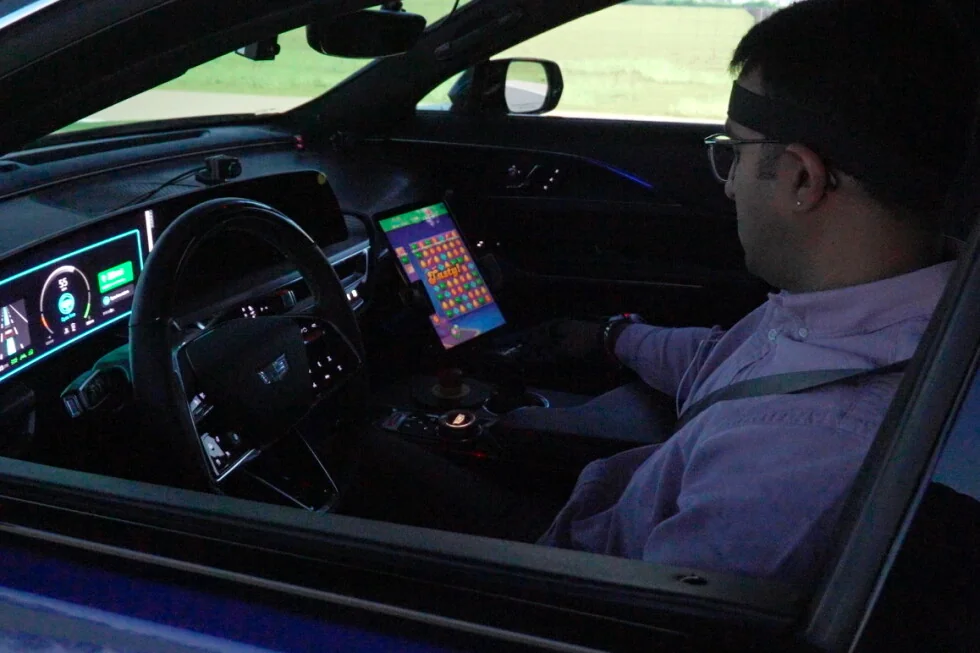
At the General Motors Global Technical Center in Warren, Michigan—situated in suburban Detroit—hundreds of volunteer, real-world drivers have ensconced themselves within a Cadillac Lyriq electric vehicle or other popular GM models, there to undergo a panoply of experiences: routine roadway driving, ascents and descents, construction zones, inclement rain, proximate traffic and sundry other scenarios.
Yet whereas the vehicle itself is genuine, the world the drivers inhabit is anything but.
They are, in fact, ensconced within a simulator: a 360-degree, immersive environment in which their every ocular movement, cardiac stress, perspiration and other physiological responses are gauged against innumerable driving tests.
Here, GM is assessing a human driver's reactions to vehicles quite as much as it is assessing the vehicle technology itself.
That simulation constitutes the means by which GM — as well as other automakers — are evaluating forthcoming iterations of their advanced driver assistance systems.
Designated ADAS, this technology has thus far encompassed such well-established vehicular features as automatic emergency braking, blind spot warnings, lane departure warnings, lane-centering assist, surround-view cameras, driver attention monitors and numerous others besides.
These functionalities afford drivers the capacity to operate "hands-free" on select occasions, most notably whilst traversing the highway.
Automakers envisage that these systems will ultimately attain such a degree of sophistication that drivers will be permitted to safely relinquish both their grip on the wheel and their gaze upon the road.
Yet the contest is not solely a matter of the technology itself, but of the payoff—and that payoff is a considerable one.
Manufacturers boasting the most superior technology will induce a greater number of consumers to subscribe to those capabilities, rendering automated driving a lucrative venture for the industry.
“The moment one disengages one’s gaze from the road is truly the inflection point at which consumers will prove more disposed to pay for this feature, for once one’s eyes are off the road, one is, in effect, potentially restoring a measure of time to the driver, inasmuch as they are no longer obliged to devote their attention to the road,” said Sam Abuelsamid, vice president of market research at firm Telemetry.
“That is precisely where they perceive the genuine value proposition.”
GM avers that its iteration will be realizable come 2028, when it unveils the next Super Cruise aboard the Cadillac Escalade IQ luxury electric sport utility vehicle.
Others are nipping at its heels.
“2028 constitutes the broad timeline within which an entire cohort of companies is collectively targeting the launch of systems of this ilk—systems capable of operating at highway speeds,” Abuelsamid appended, “across a more expansive array of roads than is the case with many of the systems we observe today.”
Since 2017, GM has marketed vehicles equipped with Super Cruise—a hands-free, assisted driving system, emphatically not autonomous—whose operational domain encompasses in excess of 630,000 roads across the U.S. and Canada, with further coverage elsewhere in the world.
“One may relinquish one’s grasp upon the steering wheel whilst maintaining one’s gaze fixed upon the road ahead, yet still partake, in a manner altogether free from duress, of a drive rendered conspicuously devoid of stress along those selfsame thoroughfares during one’s customary, quotidian commutes,” said Tyson Becker, GM executive director for autonomous vehicle strategy and product.
There now exist in excess of 20 distinct GM models spanning its four marques — Cadillac, GMC, Buick and Chevrolet — that come equipped with the technology.
The automaker intends to broaden the roster of models offered with Super Cruise in the years ahead, with the ultimate objective of debuting the next generation of Super Cruise, a technology that permits safe, “eyes-off” driving.
"What we are discussing is, in essence, a technology of such a degree of safety that it permits you to avert your gaze from the road whilst it is engaged, and to occupy yourself with other pursuits within the cabin — be that consulting your phone, attending to your laptop, participating in a meeting, or watching a film," Becker added.
Among the most formidable hurdles in the development of autonomous technology is the imperative to anticipate—and to compel a vehicle to react to—a myriad of unforeseeable scenarios encountered on the road.
This could signify a dog, a deer, or even a child, hurtling onto a roadway; a detour unanticipated by a navigation app, or a construction zone abruptly come to life.
A driver — or, in this instance, the technology — must be capable of discerning that the immediate environment has undergone alteration, and of responding in a manner that is safe.
It is precisely at this juncture that simulation, conjoined with data collection and artificial intelligence, proves indispensable.
Within the context of GM simulations, drivers spanning the entire spectrum of experience assume control and confront a plethora of computer-generated scenarios set upon highways or urban landscapes replete with other “humans” and roadway signage.
"We aspire to be truly capable of replicating whatsoever our clientele might encounter upon the open road," remarked Maureen August, senior manager at GM Research & Development.
As participants navigate the simulator, GM scrutinises pivotal data points—heart rate, stress levels, ocular fixation patterns, the duration of gaze directed at particular stretches of road, and their attentiveness to the roadway—all from an adjacent control room.
One of the most efficacious means of gauging driver attentiveness in this day and age: inviting drivers to play Candy Crush.
“We ascertained that it is exceedingly efficacious in fostering engagement and instilling a desire to attain the highest possible score,” August remarked.
“It constitutes an excellent mechanism by which we may secure your engagement, only to find ourselves compelled to extricate you from a task.”
Once participants have completed the drive, they are solicited for their subjective impressions, their comprehension of the system, and their assessment of its intuitiveness.
Additional dimensions scrutinised by GM encompass comfort, the convenience with which particular features may be operated, whether a driver deems the system worthy of trust, and the number of seconds requisite for a driver to assume full command of a vehicle in motion.
“Our objective is to ascertain that your interventions are efficacious and that the alert has been issued with sufficient lead time to permit you to assume control should circumstances necessitate it,” August said.
“Conversely, we are equally concerned with ensuring that, provided you are at ease and the vehicle is operating within its capabilities, you refrain from intervening—that you allow the vehicle to perform to the full extent of its capacity.”
Hands-off technology is being progressively adopted by numerous automakers; Ford’s BlueCruise ranks among the more conspicuous exemplars.
BlueCruise is available in suitably equipped Ford vehicles for operation across in excess of 130,000 miles of certain North American roads.
Tesla designates the technology integrated into its vehicles as “Full Self-Driving,” yet it nonetheless necessitates human oversight.
As regards more sophisticated systems, no passenger vehicles featuring eyes-off technology currently exist in production; certain technology enterprises, however, proffer autonomous commercial robotaxi services in select cities.
Considerably more modest deployments of sophisticated light-duty driving systems, proffered by a disparate array of automotive manufacturers, have, in recent years, been made accessible within narrowly circumscribed markets, only to be subsequently withdrawn.
Beyond the technological impediments, there exist, experts contend, formidable regulatory obstacles.
“There is, in truth, a paucity of substantive regulation governing these systems as they stand today,” Telemetry’s Abuelsamid said.
“Consequently, the automakers are, in essence, proceeding state by state to secure approvals for where they may deploy these systems.”
In consequence, he observed, “it remains to be seen where GM will be in a position to offer their eyes off system come 2028.”
In the final analysis, automakers are engaged in a relentless pursuit of ever more sophisticated technology — not merely to render their vehicles more alluring, but equally to capitalise on the subscription fees customers will remit in order to have that technology onboard.
Abuelsamid averred that the crux of the matter is “to provide enough convenience and safety, the consumers will be willing to pay a recurring fee to use it... so drivers can do things like watch a video, read a book, text — without having to watch the road all the time.”
Alexa St. John is a climate reporter.
Follow her on X: @alexa_stjohn.
Reach her at [email protected].
October 12th, 2026
Trending Articles
El Partido Republicano se apoya en el voto agrícola mientras una cosecha costosa suscita preocupación; Trump se dirige a Kansas
GOP Relying on Farmers' Votes as Costly Harvest Stirs Concern; Trump Heads to Kansas
El Partido Republicano se apoya en el voto agrícola mientras una cosecha costosa suscita preocupación; Trump se dirige a Kansas
GOP Relying on Farmers' Votes as Costly Harvest Stirs Concern; Trump Heads to Kansas
Musk promete asignar una participación en SpaceX a «todos los niños de Estados Unidos»
Musk vows to allocate a stake in SpaceX to ‘every kid in America’
Musk promete asignar una participación en SpaceX a «todos los niños de Estados Unidos»
Musk vows to allocate a stake in SpaceX to ‘every kid in America’
La economía de China se acelera en el trimestre julio-septiembre gracias a unas exportaciones robustas
China’s Economy Accelerates in July–September Quarter on Robust Exports
La economía de China se acelera en el trimestre julio-septiembre gracias a unas exportaciones robustas
China’s Economy Accelerates in July–September Quarter on Robust Exports

Las acciones de IA impulsan el repunte de Wall Street mientras los mercados europeos se desploman en medio de protestas
AI Stocks Propel Wall Street Rebound as European Markets Slump Amid Protests
Las acciones de IA impulsan el repunte de Wall Street mientras los mercados europeos se desploman en medio de protestas
AI Stocks Propel Wall Street Rebound as European Markets Slump Amid Protests
Las acciones estadounidenses se mantienen cerca de máximos históricos en medio de un comercio mixto en Wall Street
US equities linger near record highs amid mixed Wall Street trading
Las acciones estadounidenses se mantienen cerca de máximos históricos en medio de un comercio mixto en Wall Street
US equities linger near record highs amid mixed Wall Street trading

La UE sanciona a casi 1.600 entidades rusas por componentes de drones y misiles
EU Sanctions Nearly 1,600 Russian Entities Over Drone and Missile Components
La UE sanciona a casi 1.600 entidades rusas por componentes de drones y misiles
EU Sanctions Nearly 1,600 Russian Entities Over Drone and Missile Components
Dos economistas estadounidenses galardonados con el Premio Nobel por sus investigaciones sobre la gestión de las conmociones económicas
Two US economists awarded Nobel Prize for research on economic shock management
Dos economistas estadounidenses galardonados con el Premio Nobel por sus investigaciones sobre la gestión de las conmociones económicas
Two US economists awarded Nobel Prize for research on economic shock management
Wall Street se acerca a un septiembre victorioso gracias a un alentador dato de inflación
Wall Street Nears Winning September on Encouraging Inflation Update
Wall Street se acerca a un septiembre victorioso gracias a un alentador dato de inflación
Wall Street Nears Winning September on Encouraging Inflation Update
Trump desvelará una inversión surcoreana de 54.000 millones de dólares en Alaska, epicentro de una reñida contienda por el Senado
Trump to Unveil $54 Billion South Korean Investment in Alaska, Nexus of Tight Senate Race
Trump desvelará una inversión surcoreana de 54.000 millones de dólares en Alaska, epicentro de una reñida contienda por el Senado
Trump to Unveil $54 Billion South Korean Investment in Alaska, Nexus of Tight Senate Race