KFC ouvre un avant-poste au Texas pour reconquérir sa couronne de poulet frit
September 24th, 2026
KFC ouvre un avant-poste au Texas pour reconquérir sa couronne de poulet frit
🇫🇷 Français
KFC has sustained a thorough drubbing at the hands of fried chicken competitors such as Raising Cane’s, yet the global fast-food behemoth harbours a stratagem to reclaim its perch atop the U.S. pecking order.
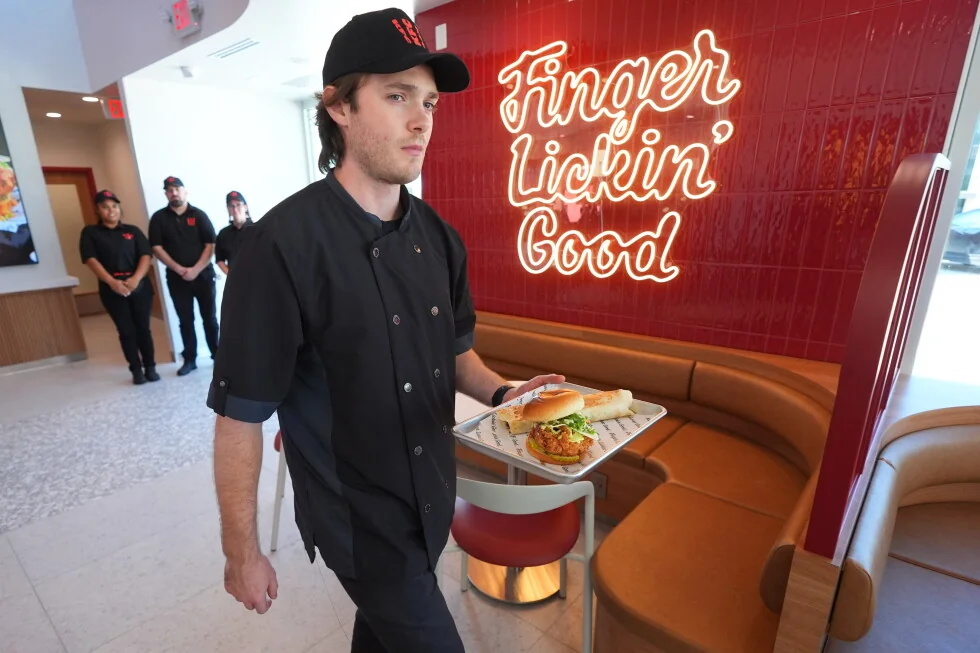
The Kentucky-born brand inaugurated a new restaurant in McKinney, Texas, on Thursday, intended to function as a test lab within its home market.
Designated Open House, it proffers breakfast — a first for KFC in the United States — and remains open into the late hours.
The menu is to showcase novel beverages such as boba-filled refreshers and milkshakes crowned with crunchy toppings, an expanded array of tenders and sauces, and new accompaniments including fried green beans and spicy pickles.
The restaurant boasts dual drive-thru lanes and a mobile order pickup station, yet KFC engineered it so as to entice patrons into lingering awhile.
Having placed their orders at a digital kiosk, they may seat themselves and await employees bearing the food to their table.
A photo booth, alongside a counter purveying branded merchandise, is likewise on offer.
KFC declined to specify what proportion of Open House’s design or menu will ultimately be rolled out across its remaining 3,424 U.S. restaurants.
The new beverages, however, are poised for broader dissemination; the company has already unveiled a comparable drink menu in the United Kingdom, Canada, Australia, Turkey and other markets.
The Texas concept, alongside resplendent, multi-storey flagship outlets slated to debut in Dubai, Seoul and London, betokens KFC's endeavour to render the procurement of fast food a rather more experiential affair.
“What lingers in people’s memory is not what they consumed, but rather the sentiments they experienced whilst doing so,” observed Christophe Poirier, Chief Concept Officer at KFC, the individual spearheading the design of new restaurants.
Poirier asserted that KFC is automating such functions as ordering, thereby enabling employees to devote themselves to hospitality.
In an ideal scenario, he remarked, KFC would operate more in the manner of an Apple Store or a purveyor of luxury goods, unencumbered by the harrowing queues or the sullen cashiers that beset the fast-food sector.
“One departs from the retailer and exclaims, ‘Wow. The product is remarkable, but over and above that, the service was extraordinary. For 10 or 15 minutes I felt like a king,’” he said.
KFC was the quintessential pioneer of fast-food fried chicken.
The brand had its genesis in 1930, when Harland Sanders acquired a roadside motel in Corbin, Kentucky, and began purveying fried chicken to travelers.
In 1952, the inaugural Kentucky Fried Chicken franchise was inaugurated in Utah.
Presently under the aegis of Louisville, Kentucky-headquartered Yum Brands, KFC has burgeoned into one of the globe's preeminent fast-food conglomerates.
As of June, the brand encompassed upwards of 34,000 establishments across more than 150 nations.
A nascent outlet is inaugurated somewhere on earth every 3 1/2 hours, according to Poirier.
International sales remain robust; China alone constitutes nearly 40% of KFC's global restaurant footprint.
Domestically, however, U.S. sales have faltered, as rapidly expanding rivals scrambled to satisfy Americans' escalating appetite for chicken as a leaner protein source.
Throughout the 2010s, Chick-fil-A and Popeyes embarked upon a phase of rapid expansion; both brands now command nearly as many U.S. locations as KFC.
Newer chains such as Raising Cane’s, Dave’s Hot Chicken and Wingstop, having trained their focus upon chicken tenders and sauces, have rendered KFC’s buckets of bone-in chicken seemingly anachronistic.
McDonald’s disclosed this week that it is bringing hand-breaded chicken—a staple that KFC has long proffered—to the United States and other markets.
Even Long John Silver’s has of late appended fried chicken wings to its bill of fare.
In 2015, KFC commanded a 20% share of the $21.8 billion in U.S. chicken-chain sales, according to Technomic, a restaurant market research company.
By 2025, KFC’s share had dwindled to 8%, notwithstanding that sales at chicken chains had more than doubled to $57.7 billion.
To the younger demographic of diners, the brand registers as antiquated and enervated, observed Neil Saunders, a managing director at the market research firm GlobalData.
"Certain of their locales are, to be candid, less than salubrious—decidedly down-at-heel and squalid.
They scarcely evince any sense of contemporaneity," Saunders said.
KFC has for some time been engaged in a turnaround endeavor, divesting itself of underperforming U.S. locations even as it pursued expansion overseas.
Since the outset of 2022, 529 KFC restaurants in the U.S. have shuttered, according to company filings.
The brand has likewise engaged in menu experimentation.
Endeavours to cultivate KFC’s portfolio of 20 sauces and to refine its chicken tenders progressed at a diminutive concept store in Florida, Saucy by KFC, which inaugurated in 2024, according to Dhiren Karnani, KFC’s global head of food and experience.
Beverages assumed prominence once research indicated that younger consumers frequently determine their dining destination on the basis of drink selections, he said.
Karnani asserted that KFC must ensure any alterations to its menu both align with the brand and exalt its chicken, which continues to employ Sanders’ original recipe.
According to him, KFC seeks to cater to consumer demand for a broader array of beverages and tenders, yet it will persist in offering bone-in chicken alongside accompaniments such as gravy.
“We are merely affording a greater array of options and avenues through which a consumer might partake of KFC, rather than bidding adieu to the past as we cast our gaze toward the future,” he said.
“For what are we, if not fundamentally beholden to our heritage?
I should think we celebrate it.”
Phil Kafarakis, chief executive of IFMA The Food Away from Home Association, which represents restaurant suppliers and manufacturers, remarked that KFC had struggled to command attention from Yum Brands while the parent company contended with difficulties at Pizza Hut.
Yum, which likewise owns Taco Bell, divested Pizza Hut for $2.7 billion earlier this year.
"I personally think it’s going to be an exciting time for KFC," Kafarakis said.
September 24th, 2026
Trending Articles

Le GOP compte sur le vote des agriculteurs alors qu'une récolte coûteuse suscite l'inquiétude ; Trump se rend au Kansas
GOP Relying on Farmers' Votes as Costly Harvest Stirs Concern; Trump Heads to Kansas
Le GOP compte sur le vote des agriculteurs alors qu'une récolte coûteuse suscite l'inquiétude ; Trump se rend au Kansas
GOP Relying on Farmers' Votes as Costly Harvest Stirs Concern; Trump Heads to Kansas
Musk promet d’attribuer une part de SpaceX à « chaque enfant en Amérique »
Musk vows to allocate a stake in SpaceX to ‘every kid in America’
Musk promet d’attribuer une part de SpaceX à « chaque enfant en Amérique »
Musk vows to allocate a stake in SpaceX to ‘every kid in America’
L’économie chinoise s’accélère au trimestre juillet-septembre grâce à de solides exportations
China’s Economy Accelerates in July–September Quarter on Robust Exports
L’économie chinoise s’accélère au trimestre juillet-septembre grâce à de solides exportations
China’s Economy Accelerates in July–September Quarter on Robust Exports
Les actions liées à l’IA propulsent le rebond de Wall Street tandis que les marchés européens chutent en pleine contestation
AI Stocks Propel Wall Street Rebound as European Markets Slump Amid Protests
Les actions liées à l’IA propulsent le rebond de Wall Street tandis que les marchés européens chutent en pleine contestation
AI Stocks Propel Wall Street Rebound as European Markets Slump Amid Protests
Les actions américaines stagnent près de leurs sommets historiques au sein d'une séance mitigée à Wall Street
US equities linger near record highs amid mixed Wall Street trading
Les actions américaines stagnent près de leurs sommets historiques au sein d'une séance mitigée à Wall Street
US equities linger near record highs amid mixed Wall Street trading
Du « mains libres » au « regard détourné » : le parcours simulé de General Motors vers la conduite autonome
From ‘hands-free’ to ‘eyes-off’: General Motors’ simulated path to autonomous driving
Du « mains libres » au « regard détourné » : le parcours simulé de General Motors vers la conduite autonome
From ‘hands-free’ to ‘eyes-off’: General Motors’ simulated path to autonomous driving
L'UE sanctionne près de 1 600 entités russes pour des composants de drones et de missiles
EU Sanctions Nearly 1,600 Russian Entities Over Drone and Missile Components
L'UE sanctionne près de 1 600 entités russes pour des composants de drones et de missiles
EU Sanctions Nearly 1,600 Russian Entities Over Drone and Missile Components
Deux économistes américains reçoivent le prix Nobel pour leurs recherches sur la gestion des chocs économiques
Two US economists awarded Nobel Prize for research on economic shock management
Deux économistes américains reçoivent le prix Nobel pour leurs recherches sur la gestion des chocs économiques
Two US economists awarded Nobel Prize for research on economic shock management
Wall Street en passe de signer un septembre gagnant grâce à des chiffres d’inflation encourageants
Wall Street Nears Winning September on Encouraging Inflation Update
Wall Street en passe de signer un septembre gagnant grâce à des chiffres d’inflation encourageants
Wall Street Nears Winning September on Encouraging Inflation Update

Trump va dévoiler un investissement sud-coréen de 54 milliards de dollars en Alaska, au cœur d'une course sénatoriale serrée
Trump to Unveil $54 Billion South Korean Investment in Alaska, Nexus of Tight Senate Race
Trump va dévoiler un investissement sud-coréen de 54 milliards de dollars en Alaska, au cœur d'une course sénatoriale serrée
Trump to Unveil $54 Billion South Korean Investment in Alaska, Nexus of Tight Senate Race