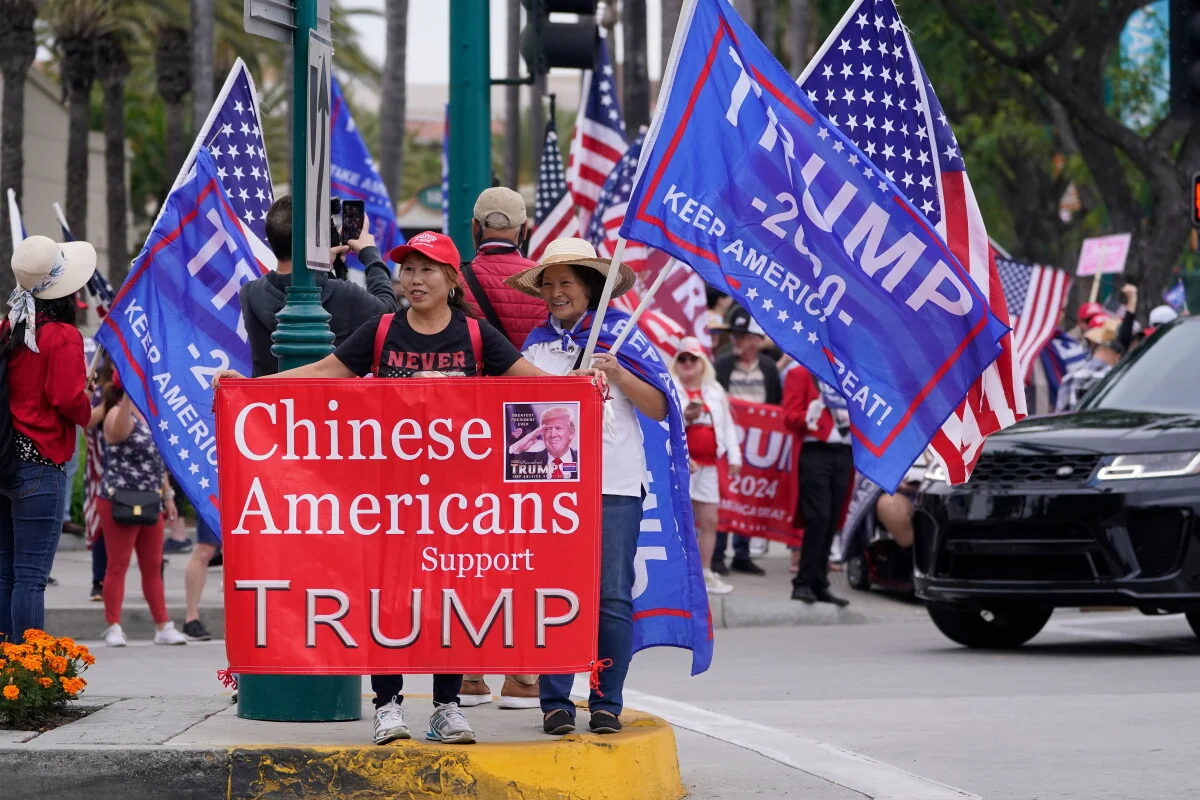
Los demócratas ganan terreno entre los adultos AAPI mientras la confianza en los republicanos se erosiona, según una encuesta de datos de AP-NORC/AAPI
October 19th, 2026
Los demócratas ganan terreno entre los adultos AAPI mientras la confianza en los republicanos se erosiona, según una encuesta de datos de AP-NORC/AAPI
🇪🇸 Español
According to a new AP-NORC/AAPI Data poll, Asian Americans, Native Hawaiians and Pacific Islander adults have grown increasingly disillusioned with President Donald Trump and Republicans as the Nov. 3 midterm elections draw near, affording Democrats a considerable advantage on major issues such as the economy and health care.
The survey, conducted from Sept. 8–15 by AAPI Data and the NORC Center for Public Affairs Research, reveals that Trump's standing on the economy has declined among AAPI adults over the course of his second term.
Approximately one-quarter of AAPI adults endorse the manner in which Trump is discharging his duties as president overall.
Only about 2 in 10 approve of his performance on the economy, which the vast majority of AAPI adults regard as one of the most salient issues for the forthcoming election.
Yet notwithstanding that AAPI adults repose greater trust in Democrats than in Republicans across a broad spectrum of issues, perceptions of the Democratic Party per se remain divided.
Rebecca Larocco, a 45-year-old Korean American residing in Corning, Iowa, cast her ballot for Trump in 2016 and is inclining toward the Republican Party in the midterm elections.
She endorses his immigration policies yet remains uncertain about Trump's stewardship of the economy as the ongoing war with Iran continues to compound gas prices.
“Where I’m at, it’s went up almost $1.50 (a gallon),” she said.
“I didn’t expect to go into war at all; that has been decidedly unforeseen, and I’m not sure...
I’m simply hoping they’ll do what they’re saying and get our economy back on track, get immigration and crime lowered.”
For an overwhelming majority of the AAPI adult population, the economy remains foremost in their considerations as they contemplate the midterms.
With the ongoing Iran war exerting upward pressure on gas prices and other costs persisting at elevated levels, Americans overall harbour profound pessimism regarding the state of the economy and regard it as a high priority for the midterms.
This encompasses AAPI adults — according to the poll, roughly 9 in 10 rank the economy among the most important issues for the upcoming election, and approximately 8 in 10 say the same of the cost of living.
For AAPI adults, the economy, the cost of living and healthcare so overshadow all other issues that roughly seven in ten identify healthcare as among the election's most consequential concerns, whereas only about half say the same of foreign policy, crime, immigration, election fairness or climate change.
Concurrently, Trump's economic approval among AAPI adults has declined by approximately 10 percentage points over the course of the year, and further indications suggest that his popularity has waned within this demographic.
In late 2024, shortly after the election, roughly 4 in 10 AAPI adults held a "somewhat" or "very" favorable view of Trump.
That figure has now fallen to about 3 in 10.
“What the data show is that any gains he made — not only during the 2024 election, when there was a bit of a honeymoon period that Trump enjoyed after the election before Inauguration Day — have now largely disappeared,” said Karthick Ramakrishnan, founder and executive director of AAPI Data.
Len Takahashi, 57, of Universal City, Texas, characterizes himself as conservative, yet he cast his ballot for Democrats in the last three presidential elections and for Republicans in midterm elections.
For this midterm election, he remains merely receptive to candidates who prioritize the economy.
“I would like policies that look in the best interest of the American public,” said Takahashi, who is Japanese American.
“That could be bringing down spending, a balanced budget of U.S. spending, bringing down inflation, working towards a more stable economy and, lastly, just a better atmosphere between the far left and far right.”
Since Trump's return to the White House, Democrats have made gains at Republicans' expense with respect to AAPI adults' trust in the handling of many key issues.
Whereas in a March 2025 poll AAPI adults were evenly divided over which political party would better handle the economy and immigration, Democrats now enjoy a roughly 20-percentage-point advantage on both issues.
Concurrently, approximately two-thirds of AAPI adults harbour a “somewhat” or “very” unfavourable opinion of the GOP, whereas only about one-quarter espouse a “somewhat” or “very” favourable one.
Yet although confidence in the Democrats on discrete issues has risen, AAPI adults remain ambivalent toward the party in its entirety.
Roughly half—48%—of AAPI adults hold a “somewhat” or “very” unfavorable impression of the Democratic Party, whereas 44% hold a “somewhat” or “very” favorable impression.
A separate AP-NORC survey of registered voters conducted in September likewise found that, while the electorate at large is profoundly disenchanted with Trump and the GOP, few believe either party is capable of resolving the significant problems at hand.
Louise Rider, 40, is a Chicago-residing Democrat who, while convinced of her party's across-the-board superiority to the Republicans, nonetheless professes dissatisfaction with how the party has governed.
“I don’t believe the Democrats are faring particularly well; I think they require substantial change as a party,” she said.
“It’s a rather helpless feeling—that nothing will get done with both parties unless there are major changes.”
Some Republicans continue to stand behind Trump.
James Finley, 74, of Lenox, Massachusetts, remarked that Trump merits a degree of forbearance, given that he cannot bring down high prices overnight.
When it comes to Republicans in general, however, Finley is somewhat more critical.
“They’ve commanded the majority for a couple of years,” said Finley, whose ancestry includes Japanese heritage.
“I think they could have done a little bit more—or perhaps a great deal more—when it comes to passing certain things that I wanted to pass.”
Nonetheless, he remains unwavering in his fidelity to the party line, and because “all I ever hear from Democrats is to get Trump,” Finley said.
With the election looming, a substantial proportion of AAPI adults harbour concerns regarding misinformation, legal challenges to the results, and voter suppression.
Roughly half of AAPI adults characterise as a “major problem” in U.S. elections the circumstance that eligible individuals are denied the franchise, while approximately two-thirds regard attempts by foreign governments to influence results as a “major” problem.
With a view to the November election, roughly half of AAPI adults express being “extremely” or “very” concerned about fake or false information regarding the candidates, and approximately half harbor comparable concerns about legal challenges to the election results.
Finley remains uncertain whether the voting process can be sufficiently tightly monitored to preclude undocumented or unregistered individuals from attempting to vote.
Yet Takahashi, the Texan conservative, harbours apprehensions lest Trump endeavour to manipulate the election.
He is apprehensive, he said, that Trump would amplify allegations of “fraud in the election system” should the midterms not go in his favor.
“(He’ll) make that a point to distract the American public,” he said.
The poll of 1,023 U.S. adults who are Asian American, Native Hawaiian and Pacific Islander was conducted Sept. 8-15, drawing upon a sample from NORC's probability-based Amplify AAPI Panel, which is designed to be representative of the Asian American, Native Hawaiian and Pacific Islander population.
The margin of sampling error for all respondents stands at ±4.7 percentage points.
This poll constitutes part of an ongoing project examining the views of Asian Americans, Native Hawaiians and Pacific Islanders—perspectives that are typically underrepresented in other surveys owing to small sample sizes and a dearth of linguistic representation.
October 19th, 2026
Trending Articles

Investigadores abandonan EE. UU. en medio de los recortes de financiación de Trump y la politización de la ciencia
Researchers Departing the US Amid Trump’s Funding Cuts and Politicization of Science
Investigadores abandonan EE. UU. en medio de los recortes de financiación de Trump y la politización de la ciencia
Researchers Departing the US Amid Trump’s Funding Cuts and Politicization of Science

El Departamento de Justicia presenta cargos contra más de dos docenas de personas en una operación en California dirigida contra presuntos votantes no ciudadanos
Justice Department Levels Charges Against Over Two Dozen in California Operation Targeting Alleged Noncitizen Voters
El Departamento de Justicia presenta cargos contra más de dos docenas de personas en una operación en California dirigida contra presuntos votantes no ciudadanos
Justice Department Levels Charges Against Over Two Dozen in California Operation Targeting Alleged Noncitizen Voters

Florida presenta cargos adicionales contra el expresidente cubano Raúl Castro
Florida Files Additional Charges Against Former Cuban President Raúl Castro
Florida presenta cargos adicionales contra el expresidente cubano Raúl Castro
Florida Files Additional Charges Against Former Cuban President Raúl Castro

Día de los Pueblos Indígenas: Celebración, Protesta y la Reivindicación de la Historia
Indigenous Peoples' Day: Celebration, Protest, and the Reclamation of History
Día de los Pueblos Indígenas: Celebración, Protesta y la Reivindicación de la Historia
Indigenous Peoples' Day: Celebration, Protest, and the Reclamation of History

Día de los Pueblos Indígenas: Se honra al atleta nativo Shiyazh Pete
Indigenous Peoples Day: Native Athlete Shiyazh Pete Honored
Día de los Pueblos Indígenas: Se honra al atleta nativo Shiyazh Pete
Indigenous Peoples Day: Native Athlete Shiyazh Pete Honored

Musk emerge como el donante preeminente de las elecciones de medio mandato en una maniobra encubierta para rescatar a los republicanos
Musk Emerges as Midterms' Preeminent Donor in Covert Bid to Salvage Republicans
Musk emerge como el donante preeminente de las elecciones de medio mandato en una maniobra encubierta para rescatar a los republicanos
Musk Emerges as Midterms' Preeminent Donor in Covert Bid to Salvage Republicans

Arzobispo militar de EE. UU.: los soldados católicos no deben formar parte de los pelotones de fusilamiento
U.S. Military Archbishop: Catholic Soldiers Must Not Serve on Firing Squads
Arzobispo militar de EE. UU.: los soldados católicos no deben formar parte de los pelotones de fusilamiento
U.S. Military Archbishop: Catholic Soldiers Must Not Serve on Firing Squads

Hochul exige una investigación sobre la gestión de la denuncia de violación en grupo en Cornell en 2024
Hochul Demands Inquiry into Cornell’s 2024 Gang Rape Allegation Handling
Hochul exige una investigación sobre la gestión de la denuncia de violación en grupo en Cornell en 2024
Hochul Demands Inquiry into Cornell’s 2024 Gang Rape Allegation Handling

El huracán Rachel se materializa en el Pacífico, aunque los meteorólogos afirman que no amenaza ninguna masa continental
Hurricane Rachel materializes in the Pacific, yet forecasters aver it menaces no landmass
El huracán Rachel se materializa en el Pacífico, aunque los meteorólogos afirman que no amenaza ninguna masa continental
Hurricane Rachel materializes in the Pacific, yet forecasters aver it menaces no landmass