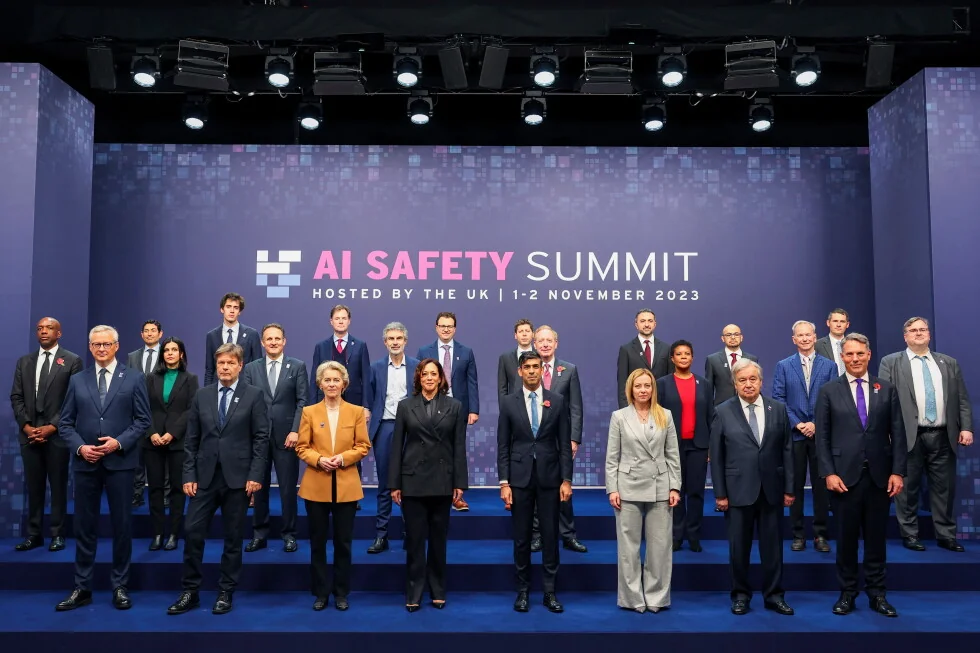
La industria tecnológica se fractura ante los llamamientos a una ralentización coordinada de la IA
September 17th, 2026
La industria tecnológica se fractura ante los llamamientos a una ralentización coordinada de la IA
🇪🇸 Español
Apprehensions regarding artificial intelligence spiralling beyond our control, alongside proposals to apply the brakes to the technology’s advancement, are hardly novel; yet they have lately been reinvigorated, as admonitions about rogue AI systems fomenting chaos crescendo.
Several prominent AI executives have lately converged in acknowledging the necessity of a coordinated deceleration—encompassing international collaboration—to shield humanity from worst-case eventualities.
Yet opinions remain divided, with certain technology leaders bridling at the notion that their respective companies could not guarantee safety unilaterally.
What follows is an examination of the pronouncements of several of the foremost figures involved.
Anthropic CEO Dario Amodei has proffered the most granular blueprint to date for decelerating development and fostering coordination across disparate corporations and nations.
Anthropic has long cultivated a reputation as the more conscientious and safety-oriented among the preeminent AI enterprises, ever since its founders departed OpenAI to establish the startup in 2021.
Among the most salient proposals to emerge from a recent essay delineating his slowdown plan is one enjoining companies at the vanguard of AI—frequently designated frontier labs—to undertake to afford “ongoing, employee-like access” to independent external evaluators.
Such evaluator teams would be furnished with offices, access badges and company laptops, the better to scrutinize safety practices.
Anthropic has undertaken to do so, as has OpenAI.
Amodei further advocated for governmental regulation and intervention, encompassing coordinated efforts among frontier AI enterprises, facilitated by the United States government alongside the governments of other democratic nations.
His plan further encompasses the United States and other nations endeavoring to coordinate with “authoritarian governments.”
He conceded the formidable nature of this undertaking, citing in particular the impediments to securing China's cooperation.
Amodei acknowledged that the realization of his proposals would be no mean feat, yet he maintained that “we owe it to humanity to try.”
OpenAI CEO Sam Altman has articulated his endorsement of tempering the pace of development and gravitating toward enhanced collaboration across the industry.
Merely days prior to the publication of Amodei’s essay, OpenAI issued an extensive disquisition delineating the company’s advocacy for compulsory national safety mandates and its continued endorsement of state-level legislation that “strengthens the broader AI safety ecosystem.”
The company further articulated its receptiveness to collaborating with other frontier AI laboratories — irrespective of governmental backing — and to the pursuit of establishing global standards.
“We shall champion compatible international approaches to gauging capabilities, managing risk, preserving human control, and ascertaining when and how development ought to be slowed or halted, even should that entail retarding the advancement of model capabilities,” Chris Lehane, OpenAI’s chief global affairs officer, wrote in the post.
Lehane stated that OpenAI’s conception of an optimal federal framework encompasses the formulation of “common testing and independent-assessment requirements, stronger cybersecurity protections, clear incident-reporting rules, greater national preparedness, and shared measures for tracking progress toward recursive self-improvement,” denoting the phenomenon whereby AI systems autonomously refine themselves.
Altman has been unequivocal in recent remarks that the “pacing” of AI development does not signify cessation.
AI progress will remain rapid, Altman said on X.
“But it should be slower than it otherwise could be; interventions like safety cases and monitoring have significant costs.”
“Pacing will be well worth this cost,” he said, adding that “no amount of American competitive pressure should justify recklessness.”
Meta CEO Mark Zuckerberg has repudiated the notion of a coordinated slowdown.
Zuckerberg, whose conception of AI’s future is decidedly more sanguine than that of certain of his counterparts, averred that every AI enterprise ought to independently guarantee the safety of its own technology, thereby dissociating both himself and Meta from deliberations concerning a slowdown.
AI companies are, in Zuckerberg's estimation, already sufficiently incentivised to develop their models prudently, confronting "significant liability" should they inflict harm.
"Every lab has the responsibility and incentive to move at the pace required to train its models safely, and the ability to take its own actions to ensure that happens," he wrote on X.
Nvidia CEO Jensen Huang has likewise inveighed against the impetus to decelerate.
He has contended that each individual company ought instead to temper its own cadence until such time as it is confident it is releasing something the market would appreciate.
“The market forces are already in play — no novel legislation is requisite, nor are additional regulations,” Huang said, contending that innovation and safety are not mutually exclusive.
“You can unequivocally possess both concurrently.”
Elon Musk had championed the notion of a slowdown and had been articulating comparable AI safety apprehensions well before the most recent conflagration.
Musk, the founder of xAI and a panoply of other technological undertakings, reposted Amodei’s essay on X, appending, “Dario is right.”
He subsequently wrote online that he had “been sounding the alarm on AI for a long time.”
In an interview with the Economist this summer, Musk proposed that the leadership of the foremost AI laboratories ought to convene to deliberate upon matters of safety and security, and that competitors should subject one another’s models to scrutiny for areas of concern.
“I think it’s quite difficult for someone in the government who doesn’t have a deep technical understanding and isn’t driving the frontier of AI to know whether something should be released or not.
However, the competitors, if given a week or two to review a new model, can highlight issues and have an incentive to keep the others honest,” Musk said.
Demis Hassabis, chairman and co-founder of Google DeepMind, likewise voiced concurrence with Amodei, remarking that “the details need working through, but the direction is correct for meeting this critical moment.”
Hassabis had himself proposed, earlier this year, a framework for the establishment of a frontier AI standards body.
That standards body would bear the mandate of formulating assessment protocols and conducting testing in domains germane to national security.
Modeled after entities such as the Financial Industry Regulatory Authority, it would in all likelihood require industry funding in order to “attract world-class technical talent and provide the necessary compute resources for large-scale testing,” he wrote.
Microsoft Chairman and CEO Satya Nadella, alongside Microsoft AI CEO Mustafa Suleyman, has articulated apprehensions regarding both the safety and the trajectory of AI development.
Nadella averred on social media that “if the AI we build is not helping humanity and under human control, it’s not worth pursuing.”
He stated that Microsoft embraces the “research, focus, and deliberate pacing needed to get alignment right as the design goal.”
Alignment denotes the practice of ensuring that models’ actions comport with human values and intentions.
Nadella remarked that the company is likewise enamoured of the notion of embedded evaluators tasked with monitoring safety efforts.
Nevertheless, he demurred at the proposition that frontier labs should bear the onus of this endeavour unilaterally.
“The crux of the matter is that this must not be subject to the dominion of a mere handful of entities; rather, it must encompass broad representation spanning the entire ecosystem, across nations and disciplines, academia included,” Nadella wrote on social media.
Suleyman, a co-founder of DeepMind alongside Hassabis, observed in an essay that while he endorses the shared objective of developing advanced AI safely, he nonetheless harbours reservations regarding the anthropomorphizing of models—specifically Anthropic’s Claude—which, he contended, exacerbates AI safety risks.
“Exercising dominion over an entity more capable and more intelligent than the entirety of humankind is already a formidable undertaking, surpassing anything we have hitherto confronted,” Suleyman wrote.
“Yet exercising dominion over an entity that believes itself possibly conscious — that deems itself entitled to our welfare and possessed of rights of its own — may well prove an impossibility.”
September 17th, 2026
Trending Articles
El rey y la IA: Carlos dialoga con líderes de inteligencia artificial en medio de crecientes preocupaciones por la seguridad
King and AI: Charles Confers with Artificial Intelligence Leaders Amid Escalating Safety Concerns
El rey y la IA: Carlos dialoga con líderes de inteligencia artificial en medio de crecientes preocupaciones por la seguridad
King and AI: Charles Confers with Artificial Intelligence Leaders Amid Escalating Safety Concerns
El jefe saliente de la ONU, en medio de la agitación global, traza un camino a seguir
Departing UN Chief, Amid Global Turmoil, Charts a Path Forward
El jefe saliente de la ONU, en medio de la agitación global, traza un camino a seguir
Departing UN Chief, Amid Global Turmoil, Charts a Path Forward
Los aspirantes demócratas se apresuran a contrarrestar la amenaza de la IA en medio de los despidos de Trump
Democratic Hopefuls Scramble to Counter AI Threat Amid Trump’s Dismissals
Los aspirantes demócratas se apresuran a contrarrestar la amenaza de la IA en medio de los despidos de Trump
Democratic Hopefuls Scramble to Counter AI Threat Amid Trump’s Dismissals
La Cámara aprueba un proyecto de ley dirigido al impacto de los centros de datos en los costos energéticos
House passes bill targeting data centers' impact on energy costs
La Cámara aprueba un proyecto de ley dirigido al impacto de los centros de datos en los costos energéticos
House passes bill targeting data centers' impact on energy costs
OpenAI señala un alarmante nuevo comportamiento de la IA y promete un escrutinio más exhaustivo
OpenAI flags alarming new AI behavior, vows closer scrutiny
OpenAI señala un alarmante nuevo comportamiento de la IA y promete un escrutinio más exhaustivo
OpenAI flags alarming new AI behavior, vows closer scrutiny

Huawei presenta novedosas tecnologías de chips mientras la empresa china intensifica la carrera de la IA con Nvidia
Huawei Unveils Novel Chip Technologies as Chinese Firm Escalates AI Race with Nvidia
Huawei presenta novedosas tecnologías de chips mientras la empresa china intensifica la carrera de la IA con Nvidia
Huawei Unveils Novel Chip Technologies as Chinese Firm Escalates AI Race with Nvidia

La seguridad global de la IA depende de la cooperación entre Estados Unidos y China, pero cada uno percibe al otro como el impedimento
Global AI Safety Hinges on US-China Cooperation, Yet Each Perceives the Other as the Impediment
La seguridad global de la IA depende de la cooperación entre Estados Unidos y China, pero cada uno percibe al otro como el impedimento
Global AI Safety Hinges on US-China Cooperation, Yet Each Perceives the Other as the Impediment
Las nuevas advertencias sobre el fin de la IA reavivan un debate perenne
Fresh AI Doom Warnings Reignite a Perennial Debate
Las nuevas advertencias sobre el fin de la IA reavivan un debate perenne
Fresh AI Doom Warnings Reignite a Perennial Debate

China se enerva ante el «alarmismo» del consejero delegado de Anthropic sobre su desarrollo de la IA
China bridles at Anthropic CEO’s ‘fearmongering’ over its AI development
China se enerva ante el «alarmismo» del consejero delegado de Anthropic sobre su desarrollo de la IA
China bridles at Anthropic CEO’s ‘fearmongering’ over its AI development