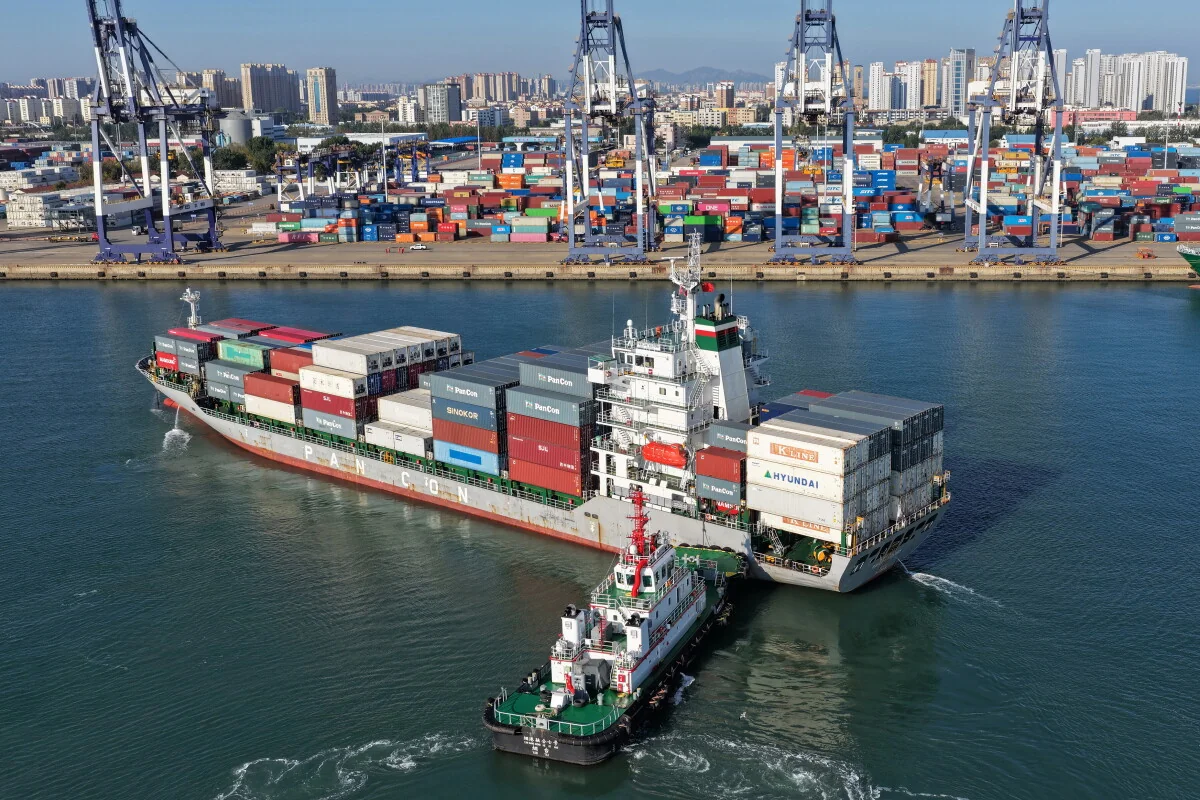
中国经济在7月至9月这一季度增长势头增强,主要受强劲出口的推动。
October 19th, 2026
中国经济在7月至9月这一季度增长势头增强,主要受强劲出口的推动。
🇨🇳 中文
China said Monday that its economy grew 4.5% in the July-September quarter compared with a year earlier, supported by strong exports, bringing it closer to its official annual growth target as trading partners seek to balance their trade deficits with the country.
Economic growth accelerated from the 4.3% year-on-year rate recorded in the April-June quarter, the slowest expansion in more than three years.
Its economy expanded 4.6% in the first three quarters.
Throughout the year, Chinese leaders have maintained a growth target of 4.5% to 5%, a reduction from last year’s 5% expansion.
Earlier this month, the International Monetary Fund revised its forecast for China’s 2026 economic growth downward to 4.5%, the lower bound of Beijing’s objective.
“Domestic demand was weak, while trade grew strongly,” said Dave Chia, an economist at Moody’s Analytics.
Exports will likely remain strong, but global trade barriers continue to pose a risk, he said.
China’s domestic demand has been burdened by a protracted downturn in its property market.
Max Zenglein, Asia Pacific senior economist at The Conference Board, said the headline official growth figure was becoming "an increasingly poor indicator of how the broader economy is performing."
That is because it masks “widening disparities across industries, regions, and households,” Zenglein said.
Beijing faces difficult trade-offs, and managing domestic imbalances may prove more challenging than dealing with external pressures, he added.
On Monday, Mao Shengyong, deputy head of China’s National Bureau of Statistics, cautioned of the economic challenges ahead.
“The international environment is complex and volatile, the problem of insufficient domestic demand remains relatively prominent and the foundation for a stable, improving economy still needs consolidation,” he told a news conference.
With exports among the few bright spots, China is on course to exceed last year's record global trade surplus of $1.2 trillion, having recorded 36% export growth last month and already a $938 billion surplus between January and September.
Elevated U.S. tariffs have disrupted certain aspects of U.S.-China bilateral trade, compelling China to seek alternatives elsewhere, including Southeast Asia, Latin America and Europe.
High-tech exports such as semiconductors and automobiles, including hybrid and electric vehicles, are among the sectors driving its export growth this year.
China, seeking self-sufficiency to shield itself from Western export controls and trade uncertainties, has built up massive domestic manufacturing capacities in industries such as solar and EVs, which are heavily subsidized by the government.
However, output was scaled up rapidly at a time of weakened domestic consumption, so many of these goods are shipped to overseas markets at competitive prices.
Ecaterina Bigos, senior market strategist at BNP Paribas Asset Management, said that a highly tech-driven, export-reliant growth model has yielded only limited job creation and broad income gains, while the risks of labor displacement driven by artificial intelligence continue to mount.
Numerous trade partners fear that their domestic industries and economies are increasingly threatened by lower-cost Chinese manufactured imports.
“It is untenable and unsustainable for the world’s second largest economy to rely on foreign demand to prop up its own growth,” said Eswar Prasad, a professor of economics and trade policy at Cornell University.
Prasad said that China, through its persistent and substantial trade surpluses, "has become a drag on world growth rather than an engine that pulls the rest of the world along."
The European Union is among those eager to redress its trade imbalance with China.
The 27-nation bloc sustains a trade deficit with China exceeding $1.1 billion a day.
For the first nine months of the year, Chinese exports to the EU rose by 16%.
EU countries are contemplating further curbs on China after the EU reached an agreement with China this month to roughly halve the number of Chinese hybrid vehicle imports over the next few years.
China can work with other countries on disputes and wants to keep its market access, said Gary Ng, a senior economist for Asia Pacific at French bank Natixis.
With a deal with the EU on hybrid cars, for example, China can likely still sell more made-by-China products in the longer run while avoiding a broad tariff hike.
Even with the agreements reached between China and the EU, "trade imbalances will be difficult to resolve quickly," said Lynn Song, chief economist for Greater China at the Dutch bank ING.
Policymakers argue that an undervalued yuan—China's currency—against the dollar and the euro has contributed to China's growing trade surplus, even though China's central bank has dismissed these claims.
“We are likely to witness continued resistance, rising protectionism, and persistent pressure from economies worldwide to protect their industries and jobs, particularly in high-value sectors,” noted Bigos.
China maintains that it does not pursue a large trade surplus.
Pan Gongsheng, the central bank governor, stated on Friday that countries running trade deficits and those running trade surpluses ought to collaborate, and that China, as a responsible nation, is committed to expanding domestic demand.
October 19th, 2026
Trending Articles
共和党依赖农民的选票;特朗普前往堪萨斯州之际,高昂的收成成本引发担忧
GOP Relies on Farmers' Votes; Costly Harvest Raises Concerns as Trump Heads to Kansas
共和党依赖农民的选票;特朗普前往堪萨斯州之际,高昂的收成成本引发担忧
GOP Relies on Farmers' Votes; Costly Harvest Raises Concerns as Trump Heads to Kansas
马斯克承诺将SpaceX的一部分股份送给“美国每一个孩子”
Musk pledges to give a share of SpaceX to ‘every kid in America’
马斯克承诺将SpaceX的一部分股份送给“美国每一个孩子”
Musk pledges to give a share of SpaceX to ‘every kid in America’
AI股票推动华尔街反弹,欧洲市场则在抗议中下跌
AI stocks drive Wall Street rebound as European markets fall amid protests
AI股票推动华尔街反弹,欧洲市场则在抗议中下跌
AI stocks drive Wall Street rebound as European markets fall amid protests
美国股市在华尔街涨跌互现的交易中徘徊于历史高点附近
US stocks linger near record highs amid mixed Wall Street trading
美国股市在华尔街涨跌互现的交易中徘徊于历史高点附近
US stocks linger near record highs amid mixed Wall Street trading

从“解放双手”到“解放双眼”:通用汽车基于仿真的自动驾驶之路
From ‘hands-free’ to ‘eyes-off’: General Motors’ simulation-based path to autonomous driving
从“解放双手”到“解放双眼”:通用汽车基于仿真的自动驾驶之路
From ‘hands-free’ to ‘eyes-off’: General Motors’ simulation-based path to autonomous driving

欧盟就无人机和导弹零部件问题对近1600名俄罗斯人和企业实施制裁
EU sanctions almost 1,600 Russians and companies over drone and missile components
欧盟就无人机和导弹零部件问题对近1600名俄罗斯人和企业实施制裁
EU sanctions almost 1,600 Russians and companies over drone and missile components
两名美国经济学家因经济冲击管理研究获诺贝尔奖
Two American economists awarded Nobel Prize for research on economic shock management
两名美国经济学家因经济冲击管理研究获诺贝尔奖
Two American economists awarded Nobel Prize for research on economic shock management
华尔街在令人鼓舞的通胀数据更新后有望迎来胜利的九月
Wall Street Nears Winning September After Encouraging Inflation Update
华尔街在令人鼓舞的通胀数据更新后有望迎来胜利的九月
Wall Street Nears Winning September After Encouraging Inflation Update
特朗普将在阿拉斯加公布韩国540亿美元的投资,而该州参议院选情胶着
Trump to unveil $54 billion in South Korean investment in Alaska, where a Senate race is tight
特朗普将在阿拉斯加公布韩国540亿美元的投资,而该州参议院选情胶着
Trump to unveil $54 billion in South Korean investment in Alaska, where a Senate race is tight