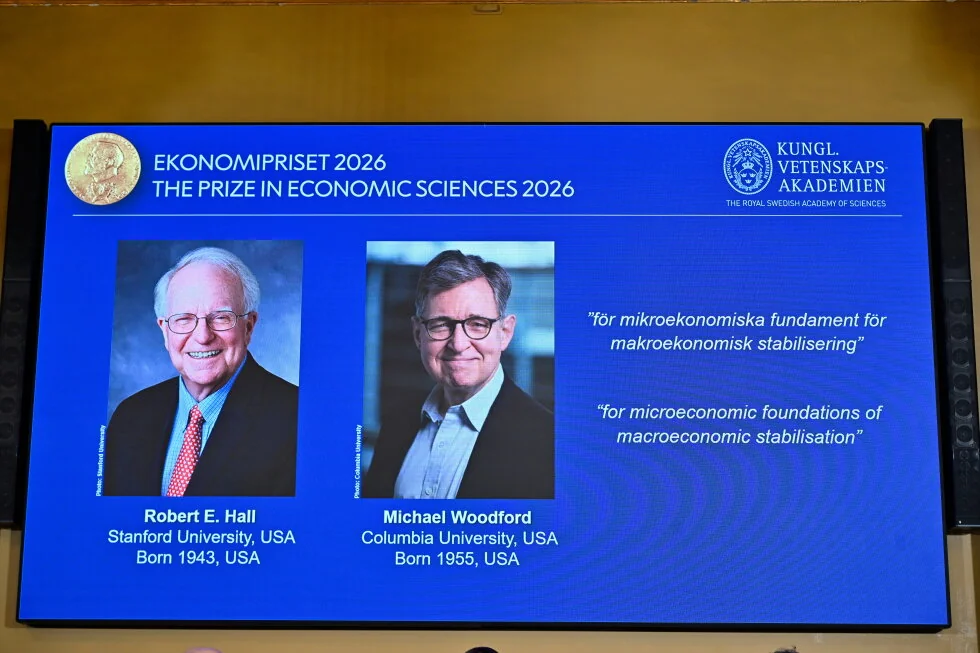
两名美国经济学家因经济冲击管理研究获诺贝尔奖
October 12th, 2026
两名美国经济学家因经济冲击管理研究获诺贝尔奖
🇨🇳 中文
American economists Robert E. Hall and Michael Woodford were awarded the Nobel Memorial Prize in economics on Monday for their development of models that have assisted governments and central banks in managing economic shocks, such as energy crises and inflation.
The Royal Swedish Academy of Sciences announced the winners in Stockholm, noting that their work laid the theoretical foundation for a better understanding of how consumers decide whether to save or spend — insights that help policymakers worldwide stabilize economies after fluctuations.
“The laureates’ research has made it possible to manage major macroeconomic crises far more effectively than before,” the Nobel committee wrote in a paper explaining the economists’ work.
“It has been hugely beneficial during the pandemic and the energy crises of recent years.”
Hall, aged 83, is affiliated with Stanford University in California, whilst Woodford, born in 1955, is affiliated with Columbia University in New York.
Addressing the committee by telephone from New York, Woodford observed: “It’s a tremendous honor. It’s a surprise.”
Hall additionally characterised the award as a “wonderful surprise.”
"I've spent my career trying to understand how the economy works, following interesting questions wherever they led.
When I thought I had a new idea, the next step was to find out whether it was actually new, whether it was right, and whether it mattered," he said in a statement released by Stanford.
For decades, governments responded to economic shocks by following the Depression-era prescriptions of the British economist John Maynard Keynes: intervene in the economy by lowering interest rates and taxes and hiking government spending, thereby encouraging consumers and businesses to spend and invest and help restart growth.
“This is the Keynesian recipe, and it worked well — until it didn’t,” remarked Timo Boppart of the Nobel economics committee.
Policymakers had assumed that economic management involved straightforward trade-offs — unemployment, for instance, would remain low during periods of high inflation and would rise when inflation fell.
However, the "stagflation" of the 1970s — when the world economy experienced high inflation and high unemployment simultaneously — showed that this formula was too simplistic.
Some economists contended that government attempts to intervene in the economy were bound to fail.
But Hall and Woodford, in separate contributions, set about refining the Keynesian model to take into account how consumers and businesses actually make decisions about whether to invest and spend.
“Economic outcomes are the result of millions of decisions made at the microlevel by households and businesses,’’ the Nobel committee wrote.
“Using models based upon this approach, rather than simply studying the economy from a macro perspective, like a bird’s eye view,” Hall and Woodford’s research “generated a paradigm shift in the theory of stabilization policy.”
Hall studied how consumers' decisions about whether and how much to spend depend on what they expect their future income to be.
“If they are optimistic, they will consume more than if they are pessimistic,’’ the committee wrote.
But consumer expectations can change unexpectedly as new information about the economy comes in.
Hall found that forecasting future consumer spending is virtually impossible.
The notion that consumption is largely unpredictable “is not good news for forecasters, or policymakers,” Olivier Blanchard, who served as chief economist at the International Monetary Fund during the 2008 financial crisis, said by email.
“But it is news they must take into account when considering the effects of policy.”
Hall also explored the possibility that certain households are so financially constrained that they are unable to borrow or draw on their savings in response to economic changes.
In a 1982 paper with the economist Fredric Mishkin, Hall found that around 80% of households made spending decisions based on their expectations for the future “while the rest lived hand to mouth,” the committee wrote.
“The prize is for research that pushes our understanding of macroeconomics from the bottom up, from families and firms making decisions over time, while looking ahead,” Ivan Werning, an economist at the Massachusetts Institute of Technology, said in an email.
Woodford’s research showed that firms set prices according to where they expect interest rates to go in the future.
“If a business thinks that its competitors’ prices and its own costs will go up, it is best to set a higher price than it would if it expected the opposite,” the Nobel committee wrote.
“So businesses’ decisions are also shaped by their expectations.”
Therefore, central banks such as the U.S. Federal Reserve, which set short-term interest rates, should provide “clear and credible communication about how they reason and what they plan to do.”
Central banks have responded to this insight by working harder to explain what they are doing.
The new Fed chair, Kevin Warsh, has said the trend toward such “forward guidance” went too far.
He is trying to reduce how much the U.S. central bank talks about its thinking and its intentions.
Woodford’s research also offered guidance on how central banks should respond to energy price shocks — such as the one that followed the U.S. and Israeli attack on Iran in February — which can both drive inflation and push unemployment higher.
“Unlike traditional Keynesian models, Woodford’s model recommends a cooling measure, such as increased interest rates, to avoid uncontrolled inflation,” the Nobel committee wrote.
“His insight has made it possible to respond to recent supply shocks more effectively than during the oil crises of the 1970s.”
During the telephone call broadcast at a news conference, Woodford stated that his work has emphasized “the understanding of the people who are in the markets and making decisions about spending.”
The economics prize is formally known as the Bank of Sweden Prize in Economic Sciences in Memory of Alfred Nobel.
It was established in 1968 by the central bank as a memorial to Nobel, the 19th-century Swedish businessman and chemist who invented dynamite and established the five Nobel Prizes.
Nobel purists stress that the economics prize is technically not a Nobel Prize, but it is always presented together with the others on Dec. 10, the anniversary of Nobel's death in 1896.
The previous week witnessed the announcement of Nobel honors in the fields of medicine, physics, chemistry, literature, and peace.
Monday’s award was the second Nobel Prize won by a Stanford University professor this year.
Dr. Karl Deisseroth shared the medicine prize with Peter Hegemann and Georg Nagel for their work, which led to a tool that uses light to help reveal how the brain works.
The prize money this year amounts to 12 million Swedish kronor (approximately $1.2 million), irrespective of whether it is awarded to an individual, a small group of laureates, or an organization.
October 12th, 2026
Trending Articles
共和党依赖农民的选票;特朗普前往堪萨斯州之际,高昂的收成成本引发担忧
GOP Relies on Farmers' Votes; Costly Harvest Raises Concerns as Trump Heads to Kansas
共和党依赖农民的选票;特朗普前往堪萨斯州之际,高昂的收成成本引发担忧
GOP Relies on Farmers' Votes; Costly Harvest Raises Concerns as Trump Heads to Kansas
马斯克承诺将SpaceX的一部分股份送给“美国每一个孩子”
Musk pledges to give a share of SpaceX to ‘every kid in America’
马斯克承诺将SpaceX的一部分股份送给“美国每一个孩子”
Musk pledges to give a share of SpaceX to ‘every kid in America’
中国经济在7月至9月这一季度增长势头增强,主要受强劲出口的推动。
China’s economy gained momentum in the July-September quarter, driven by robust exports
中国经济在7月至9月这一季度增长势头增强,主要受强劲出口的推动。
China’s economy gained momentum in the July-September quarter, driven by robust exports
AI股票推动华尔街反弹,欧洲市场则在抗议中下跌
AI stocks drive Wall Street rebound as European markets fall amid protests
AI股票推动华尔街反弹,欧洲市场则在抗议中下跌
AI stocks drive Wall Street rebound as European markets fall amid protests
美国股市在华尔街涨跌互现的交易中徘徊于历史高点附近
US stocks linger near record highs amid mixed Wall Street trading
美国股市在华尔街涨跌互现的交易中徘徊于历史高点附近
US stocks linger near record highs amid mixed Wall Street trading

从“解放双手”到“解放双眼”:通用汽车基于仿真的自动驾驶之路
From ‘hands-free’ to ‘eyes-off’: General Motors’ simulation-based path to autonomous driving
从“解放双手”到“解放双眼”:通用汽车基于仿真的自动驾驶之路
From ‘hands-free’ to ‘eyes-off’: General Motors’ simulation-based path to autonomous driving
欧盟就无人机和导弹零部件问题对近1600名俄罗斯人和企业实施制裁
EU sanctions almost 1,600 Russians and companies over drone and missile components
欧盟就无人机和导弹零部件问题对近1600名俄罗斯人和企业实施制裁
EU sanctions almost 1,600 Russians and companies over drone and missile components
华尔街在令人鼓舞的通胀数据更新后有望迎来胜利的九月
Wall Street Nears Winning September After Encouraging Inflation Update
华尔街在令人鼓舞的通胀数据更新后有望迎来胜利的九月
Wall Street Nears Winning September After Encouraging Inflation Update
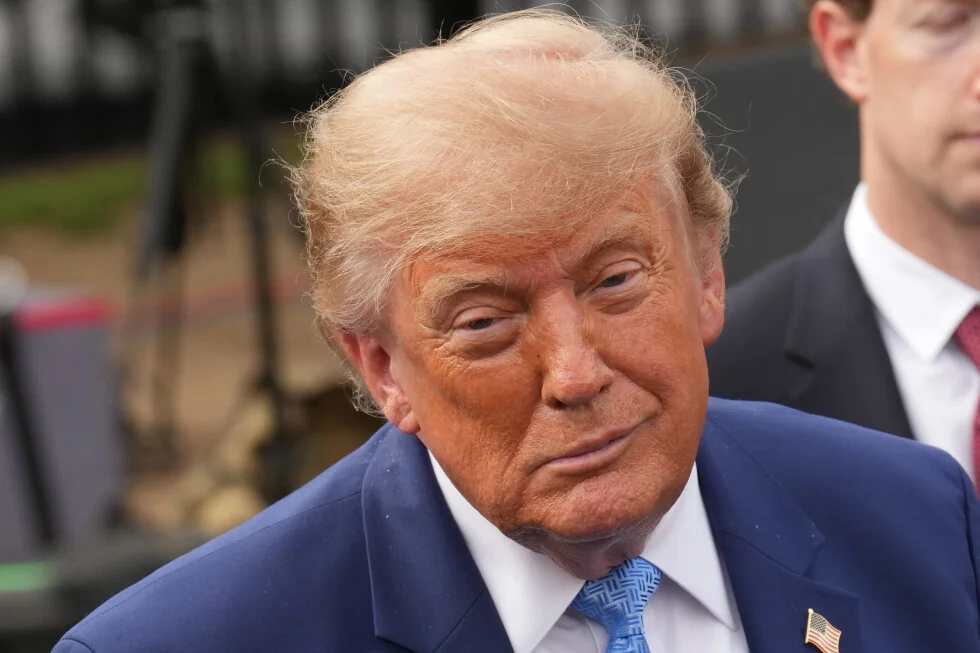
特朗普将在阿拉斯加公布韩国540亿美元的投资,而该州参议院选情胶着
Trump to unveil $54 billion in South Korean investment in Alaska, where a Senate race is tight
特朗普将在阿拉斯加公布韩国540亿美元的投资,而该州参议院选情胶着
Trump to unveil $54 billion in South Korean investment in Alaska, where a Senate race is tight