从“解放双手”到“解放双眼”:通用汽车基于仿真的自动驾驶之路
October 12th, 2026
从“解放双手”到“解放双眼”:通用汽车基于仿真的自动驾驶之路
🇨🇳 中文
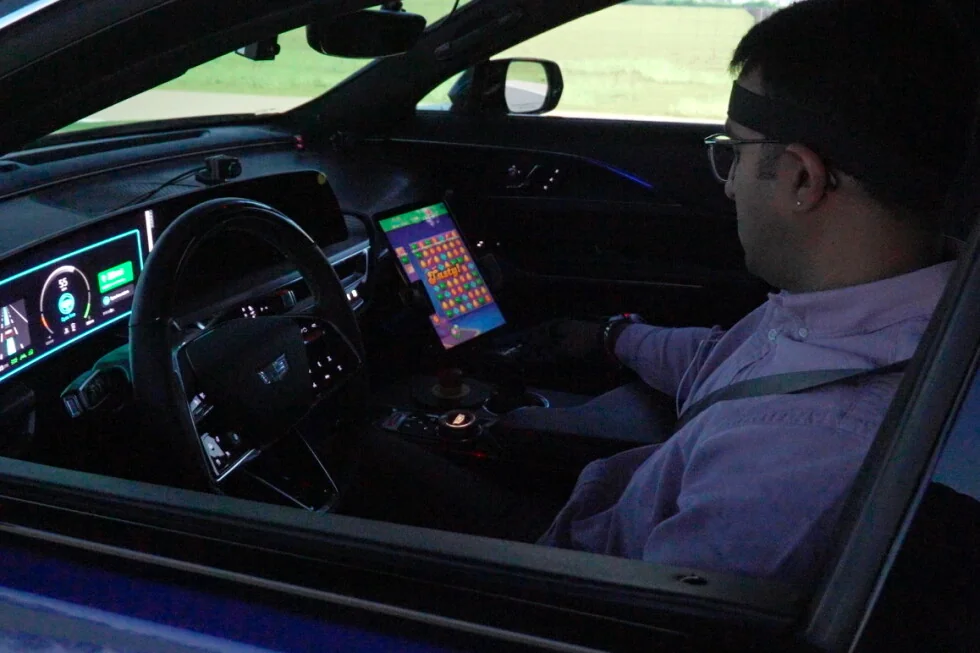
At the General Motors Global Technical Center in Warren, Michigan, in suburban Detroit, hundreds of volunteer, real-world drivers have climbed into a Cadillac Lyriq electric vehicle or other popular GM models and experienced a range of situations inside the car: regular roadway driving, driving up and down hills, construction, rain, nearby traffic and other scenarios.
But while the vehicle is real, the world the drivers are experiencing is not.
Instead, they are inside a simulator: a 360-degree, immersive environment where their every eye movement, heart stress, sweating and other reactions are measured against countless driving tests.
Here, GM is testing a human driver's response in vehicles just as much as it is testing the vehicle tech itself.
That simulation constitutes the method by which GM — along with other automakers — are evaluating forthcoming iterations of their advanced driver assistance systems.
Referred to also as ADAS, this technology has thus far enabled well-established vehicle functionalities such as automatic emergency braking, blind spot warnings, lane departure warnings, lane-centering assist, surround-view cameras, driver attention monitors and numerous others.
These functionalities enable drivers to operate “hands-free” under certain circumstances, particularly whilst travelling on the motorway.
Automakers anticipate that these systems will eventually become so sophisticated that drivers will be permitted to safely remove their hands from the wheel and their eyes from the road.
Yet the race is not solely about the technology itself, but about the payoff, which is a substantial one.
Automakers possessing the most advanced technology will attract more consumers to subscribe to those capabilities, rendering automated driving a lucrative venture for the industry.
“Going eyes off is really the turning point where consumers will be more willing to pay for this feature, because when you go eyes off, now you’re really potentially giving the driver back some time, because they don’t have to be paying attention to the road,” said Sam Abuelsamid, vice president of market research at firm Telemetry.
“That’s where they see the real value proposition.”
GM asserts that its iteration will be feasible by 2028, coinciding with the debut of the next-generation Super Cruise on the Cadillac Escalade IQ luxury electric sport utility vehicle.
Competitors are nipping at its heels.
“2028 is the broad timeline when a whole group of companies are all targeting launching systems like this that can operate at highway speeds,” Abuelsamid added, “on a wider variety of roads than what we see with a lot of the systems today.”
Since 2017, GM has been selling vehicles equipped with Super Cruise, a hands-free assisted driving system — notably not self-driving — that is operable on over 630,000 roads across the U.S. and Canada, and on additional roads worldwide.
“You can take your hands off the wheel and keep your eyes on the roads, but safely enjoy a de-stressed drive on those roads in your normal, everyday commutes,” said Tyson Becker, GM executive director for autonomous vehicle strategy and product.
There are presently in excess of 20 distinct GM models spanning its four marques — Cadillac, GMC, Buick and Chevrolet — that come equipped with the technology.
The automaker intends to broaden the roster of models offered with Super Cruise over the coming years, with the ultimate objective of unveiling the next generation of Super Cruise, a technology that permits safe, “eyes-off” driving.
"What we're talking about is really a technology that's so safe it lets you take your eyes off the road while it's active and do other things in the cabin, whether that's looking at your phone, looking at your laptop, taking a meeting, or watching a movie," Becker added.
One of the hardest parts of developing autonomous technology is predicting the countless unexpected situations that can occur on the road and getting a vehicle to respond to them.
That could mean a dog, a deer, or even a child running onto a road; an unexpected detour on a navigation app, or a construction zone that has suddenly become active.
A driver — or, in this case, the technology — needs to be able to recognise that the immediate environment has changed, and to respond safely.
This is largely where simulation, combined with data collection and artificial intelligence, comes into play.
In GM simulations, drivers of all experience levels get behind the wheel and encounter a range of computer-generated scenarios on highways or in urban landscapes filled with other “humans” and roadway signage.
"We want to be genuinely capable of taking anything that our customers might encounter out on the road," said Maureen August, senior manager at GM Research & Development.
While participants navigate the simulator, GM monitors a range of key metrics from an adjacent control room — heart rate, stress levels, where the driver's gaze is directed, how long they fixate on one section of the road versus another, and how they engage with the road.
One of the most effective means of assessing driver attentiveness nowadays: inviting drivers to play Candy Crush.
"We found it to be remarkably effective in fostering engagement and instilling a desire to achieve the highest score," August said.
"It's an excellent means by which we draw you in and subsequently find ourselves having to pry you away from a task."
Following participants’ driving sessions, they are questioned about their emotional responses, their comprehension of the system, and whether it felt intuitive.
Additional factors GM examines encompass comfort, the convenience with which particular features can be operated, whether a driver perceives the system as trustworthy, and the number of seconds required for a driver to assume full control of a moving vehicle.
"We want to ensure that you're responding effectively and that we've given you the alert sufficiently in advance that you can take over if necessary," August said.
"But we also want to be certain that if you feel comfortable and the vehicle is capable, you don't take over, that you allow the vehicle to do what it's capable of doing."
Hands-off technology is currently being implemented by numerous automakers, with Ford's BlueCruise standing out as one of the more prominent examples.
BlueCruise is offered in equipped Ford vehicles for utilisation across over 130,000 miles of certain North American roads.
Tesla designates the technology incorporated into its vehicles as “Full Self-Driving,” yet it still necessitates human supervision.
Regarding more sophisticated systems, no passenger vehicles featuring eyes-off technology are currently in production; nevertheless, certain technology firms provide autonomous commercial robotaxi services in select cities.
Smaller-scale rollouts of advanced light-duty driving systems from various car companies have been available in limited markets in recent years, but have been discontinued.
Beyond the technological impediments, experts contend that regulatory obstacles also abound.
“There is, in effect, a paucity of genuine regulation governing these systems at present,” Telemetry’s Abuelsamid said.
“Consequently, the automakers are, in essence, proceeding state by state to secure approvals for where they can operate these systems.”
Consequently, he remarked, “it remains to be seen whether GM will be able to offer their eyes off system come 2028.”
Ultimately, automakers are competing to develop more advanced technology, not only to make their vehicles more appealing, but also to profit from the subscription fees customers will pay to have that technology onboard.
Abuelsamid remarked that the crux of the matter is “to provide enough convenience and safety, the consumers will be willing to pay a recurring fee to use it... so drivers can do things like watch a video, read a book, text — without having to watch the road all the time.”
Alexa St. John is a climate reporter.
Follow her on X: @alexa_stjohn.
Reach her at [email protected].
October 12th, 2026
Trending Articles
共和党依赖农民的选票;特朗普前往堪萨斯州之际,高昂的收成成本引发担忧
GOP Relies on Farmers' Votes; Costly Harvest Raises Concerns as Trump Heads to Kansas
共和党依赖农民的选票;特朗普前往堪萨斯州之际,高昂的收成成本引发担忧
GOP Relies on Farmers' Votes; Costly Harvest Raises Concerns as Trump Heads to Kansas

马斯克承诺将SpaceX的一部分股份送给“美国每一个孩子”
Musk pledges to give a share of SpaceX to ‘every kid in America’
马斯克承诺将SpaceX的一部分股份送给“美国每一个孩子”
Musk pledges to give a share of SpaceX to ‘every kid in America’

中国经济在7月至9月这一季度增长势头增强,主要受强劲出口的推动。
China’s economy gained momentum in the July-September quarter, driven by robust exports
中国经济在7月至9月这一季度增长势头增强,主要受强劲出口的推动。
China’s economy gained momentum in the July-September quarter, driven by robust exports

AI股票推动华尔街反弹,欧洲市场则在抗议中下跌
AI stocks drive Wall Street rebound as European markets fall amid protests
AI股票推动华尔街反弹,欧洲市场则在抗议中下跌
AI stocks drive Wall Street rebound as European markets fall amid protests
美国股市在华尔街涨跌互现的交易中徘徊于历史高点附近
US stocks linger near record highs amid mixed Wall Street trading
美国股市在华尔街涨跌互现的交易中徘徊于历史高点附近
US stocks linger near record highs amid mixed Wall Street trading

欧盟就无人机和导弹零部件问题对近1600名俄罗斯人和企业实施制裁
EU sanctions almost 1,600 Russians and companies over drone and missile components
欧盟就无人机和导弹零部件问题对近1600名俄罗斯人和企业实施制裁
EU sanctions almost 1,600 Russians and companies over drone and missile components
两名美国经济学家因经济冲击管理研究获诺贝尔奖
Two American economists awarded Nobel Prize for research on economic shock management
两名美国经济学家因经济冲击管理研究获诺贝尔奖
Two American economists awarded Nobel Prize for research on economic shock management
华尔街在令人鼓舞的通胀数据更新后有望迎来胜利的九月
Wall Street Nears Winning September After Encouraging Inflation Update
华尔街在令人鼓舞的通胀数据更新后有望迎来胜利的九月
Wall Street Nears Winning September After Encouraging Inflation Update

特朗普将在阿拉斯加公布韩国540亿美元的投资,而该州参议院选情胶着
Trump to unveil $54 billion in South Korean investment in Alaska, where a Senate race is tight
特朗普将在阿拉斯加公布韩国540亿美元的投资,而该州参议院选情胶着
Trump to unveil $54 billion in South Korean investment in Alaska, where a Senate race is tight