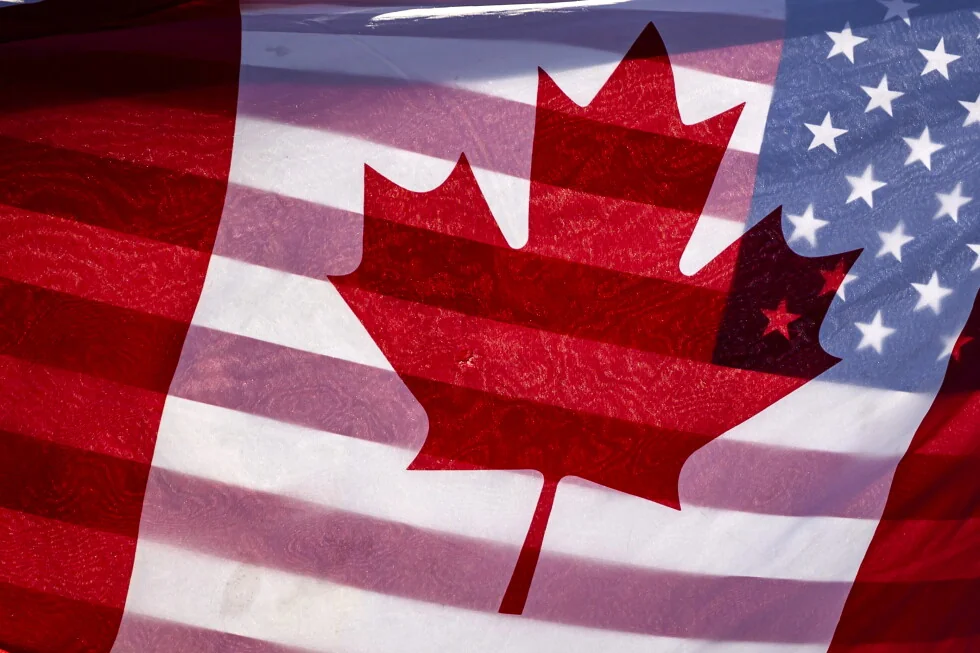
Kanadas eskalierender Handelskrieg mit den USA: Was man wissen sollte, während Carney mit Zöllen zurückschlägt
September 8th, 2026
Kanadas eskalierender Handelskrieg mit den USA: Was man wissen sollte, während Carney mit Zöllen zurückschlägt
🇩🇪 Deutsch
Canada retaliated against U.S. President Donald Trump on Tuesday by imposing tariffs on approximately $20 billion worth of American goods, in response to the most recent wave of tariffs levied on Canada.
The consequences could spread well beyond Canada, testing whether other governments see if a smaller U.S. ally can resist Trump's economic pressure.
Canadian Prime Minister Mark Carney argues that U.S. demands could undermine key domestic industries and limit the country's independence, while Trump's threats to Canadian sovereignty have rallied public support behind him.
"Carney and Canada have come to symbolize resistance to him," Canadian historian Robert Bothwell said.
"And what he will likely want to do is make an example of Carney and Canada, thereby intimidating everyone else while also showing them that they need to distance themselves even further from the United States."
The tariffs affected hundreds of American products—spanning steel, aluminum, cheese, appliances, clothing, cosmetics, and farm equipment—at rates of 15%, 25%, or 50%.
Here is the essential information that you should be aware of.
Canada asserts that its tariffs mirror Washington’s measures on a dollar-for-dollar and rate-for-rate basis.
They come into force at 12:01 a.m. Tuesday pursuant to an executive instrument designated as an order in council, encompassing approximately $20 billion worth of American goods—roughly 6% of the $333.6 billion that the United States exported to Canada over the preceding year.
RBC Economics, the research arm of the Royal Bank of Canada, indicated that while these measures were unlikely to impede overall U.S. growth, they could nonetheless inflict considerable damage on certain businesses.
Canada has already moved beyond tariffs through other measures.
Eight of its ten provinces continue to impose restrictions or outright bans on the sale of American alcohol.
According to the Distilled Spirits Council, U.S. spirits exports to Canada plummeted by more than 70% year over year once those restrictions came into force.
Following the collapse of Canada-U.S. trade negotiations on August 21, Trump and his administration have launched a relentless campaign of tariffs, threats, and personal attacks, framing Canada as weak and reliant on the United States.
On Monday, Trump threatened to impose a ban on the sale of aircraft from Canada's Bombardier, unless the company were to manufacture its planes within the United States.
“NO MORE SELLING BOMBARDIER IN THE UNITED STATES! Their products aren’t good enough!” Trump posted on Truth Social.
“If they want our Market, they must build here, and stop treating America like a ‘piggybank.’”
Flavio Volpe, president of APMA Canada, a manufacturing trade group, responded on X that Bombardier relies on U.S.-made GE and Honeywell jet engines and employs around 3,000 American workers.
Trump had previously cautioned that Canada's economy might collapse if Carney continued to view him as "the enemy," and he threatened repercussions "worse than anything that has ever happened to a Canadian Politician."
U.S. Trade Representative Jamieson Greer has cautioned that Washington could impose an outright ban on certain Canadian goods in retaliation.
Trump went so far as to rename Lake Ontario “Lake America,” a move that Canadians dismissed with derision and outright disregard.
Google and Apple, yielding to Trump’s pressure, adjusted their maps accordingly for users in the United States.
On Monday, he disseminated a depiction of North America draped in the U.S. flag across social media.
“Having renamed a gulf and a lake, perhaps his next move will be to rename a river?” remarked Daniel Béland, a political scientist at McGill University.
Trump's protectionist measures and his persistent talk of making Canada the 51st state have stoked public anger and rallied support for Carney.
Canadians have sharply reduced travel to the U.S. and boycotted American goods.
The current trade war began when Trump returned to office and imposed tariffs on Canadian goods, even though he had negotiated and repeatedly praised the North American trade agreement during his first term.
Many of these tariffs break the rules of that agreement.
The rupture is particularly notable because the two countries have long had one of the world's closest relationships, with deeply integrated economies, close defense and security cooperation, extensive cultural ties, and, before relations worsened, roughly 400,000 people crossing the border daily.
Carney has indicated that negotiations could recommence once the Americans “stop doing memes, stop throwing shade, stop trying to be tough” and adopt a more serious approach.
Thus far, Trump’s coercive tactics have proven counterproductive in Canada, bolstering Carney’s support rather than extracting any concessions.
Nelson Wiseman, professor emeritus of political science at the University of Toronto, stated that Trump's 2024 reelection deepened Canadians' distrust of the United States, extending beyond its government to include doubts about the judgment of the American people.
“Canada-U.S. relations, even absent outright confrontation, will never revert to their pre-Trump state,” he remarked.
During the World Economic Forum in Davos in January, Carney cautioned that major powers are leveraging economic interdependence to exert pressure on smaller nations.
This address helped cement his reputation as the foremost advocate among nations seeking strategies to counter Trump.
A day later, Trump hit back, asserting that Canada “lives because of the United States” and issuing a pointed warning: “Mark, remember that next time you make your statements.”
Carney is set to address the European Parliament next week, affording him yet another prominent platform.
“The Canadian public is behind the Carney government and the world is watching what will happen next,” said Béland, the McGill political scientist.
If Canada’s defiant approach succeeds, he said, it “could be used as a template” for resisting the Trump administration’s trade policies.
Trump has also threatened to impose 50% tariffs on Canadian vehicles, auto parts, and steel next year if Canada does not "fall in line," a potentially devastating escalation for industries built around deeply integrated North American supply chains.
“We want the cars to be manufactured in Detroit, South Carolina, Tennessee, and all of our other production sites.
We have no desire to see them built in Canada,” Trump stated.
A 50% auto tariff could severely disrupt Canadian manufacturing operations and drive up vehicle costs throughout North America, given that components and finished automobiles repeatedly traverse the border during the production process.
Carney asserts that Washington’s terms could leave Canadian industries “gradually wound down in Canada and wiped out.”
Canada begins at a structural disadvantage: the U.S. economy is approximately thirteen times its size, and over 70% of Canadian exports are directed south of the border.
Béland, however, contended that this is no ordinary trade dispute, citing Trump’s domestic unpopularity, the impending midterm elections, and legal challenges that could potentially dismantle additional U.S. tariffs.
“Under normal circumstances, this would be an exceedingly improbable outcome for Canada,” he remarked.
Yet Washington is not without its own points of weakness.
Its refineries depend on roughly four million barrels of oil imported daily from Canada, while American agriculture leans heavily on Canadian potash for fertilizer.
To date, however, Canadian officials have declined to wield such leverage by imposing taxes or curbs on these crucial exports.
Canada entered this round buoyed by considerable economic momentum, with its economy expanding at a 3.2% annualized rate in the second quarter—more than double the 1.5% pace recorded in the United States.
Industry Minister Mélanie Joly articulated the government’s ambition with unequivocal clarity:
I am confident that we will demonstrate to the world Canada’s capacity to prevail in this trade war.
September 8th, 2026
Trending Articles
Warren Buffett gibt den Vorsitz bei Berkshire Hathaway ab und treibt damit seinen Nachfolgeplan voran
Warren Buffett relinquishes chairman role at Berkshire Hathaway, advancing his succession plan
Warren Buffett gibt den Vorsitz bei Berkshire Hathaway ab und treibt damit seinen Nachfolgeplan voran
Warren Buffett relinquishes chairman role at Berkshire Hathaway, advancing his succession plan
Trump nimmt weitere Nachrichtenmedien ins Visier und kündigt an, CNN, MS NOW und Politico vom Weißen Haus ausschließen zu wollen
Trump targets more news outlets, saying he will ban CNN, MS NOW and Politico from the White House
Trump nimmt weitere Nachrichtenmedien ins Visier und kündigt an, CNN, MS NOW und Politico vom Weißen Haus ausschließen zu wollen
Trump targets more news outlets, saying he will ban CNN, MS NOW and Politico from the White House
Die Bank of Japan hebt den Leitzins auf 1,25 % an, den höchsten Stand seit 31 Jahren
Bank of Japan lifts key rate to 1.25%, a 31-year high
Die Bank of Japan hebt den Leitzins auf 1,25 % an, den höchsten Stand seit 31 Jahren
Bank of Japan lifts key rate to 1.25%, a 31-year high

Anthropic sagt, sein Modell Claude helfe dabei, seinen eigenen Nachfolger zu entwickeln
Anthropic says its model Claude is helping to build its own successor
Anthropic sagt, sein Modell Claude helfe dabei, seinen eigenen Nachfolger zu entwickeln
Anthropic says its model Claude is helping to build its own successor
Warum die Federal Reserve jetzt die Zinsen erhöht und was das bedeutet
Why the Federal Reserve is raising rates now, and what it signifies
Warum die Federal Reserve jetzt die Zinsen erhöht und was das bedeutet
Why the Federal Reserve is raising rates now, and what it signifies

US-Aktien steigen auf Sechs-Wochen-Hoch, da Ölpreise und Anleiherenditen fallen
US stocks surge to six-week high as oil prices and bond yields decline
US-Aktien steigen auf Sechs-Wochen-Hoch, da Ölpreise und Anleiherenditen fallen
US stocks surge to six-week high as oil prices and bond yields decline
Die Fed erhöht den Leitzins zum ersten Mal seit drei Jahren und trotzt damit Trumps Forderungen nach einer Senkung.
Fed hikes key rate for 1st time in 3 years, defying Trump's calls for a cut
Die Fed erhöht den Leitzins zum ersten Mal seit drei Jahren und trotzt damit Trumps Forderungen nach einer Senkung.
Fed hikes key rate for 1st time in 3 years, defying Trump's calls for a cut
Die Zahl der Anträge auf Arbeitslosenunterstützung sinkt auf 196.000, den niedrigsten Stand seit Mitte Juli angesichts anhaltend geringer Entlassungen
Unemployment Claims Fall to 196,000, Lowest Since Mid-July Amid Persistent Low Layoffs
Die Zahl der Anträge auf Arbeitslosenunterstützung sinkt auf 196.000, den niedrigsten Stand seit Mitte Juli angesichts anhaltend geringer Entlassungen
Unemployment Claims Fall to 196,000, Lowest Since Mid-July Amid Persistent Low Layoffs
Trump bezeichnet KI-Risiken als „Schwindel“ und behauptet eine „KRANKE Verschwörung“ gegen KI und Rechenzentren
Trump denounces AI risks as a ‘hoax,’ alleging a ‘SICK conspiracy’ against AI and data centers
Trump bezeichnet KI-Risiken als „Schwindel“ und behauptet eine „KRANKE Verschwörung“ gegen KI und Rechenzentren
Trump denounces AI risks as a ‘hoax,’ alleging a ‘SICK conspiracy’ against AI and data centers
Oberster Gerichtshof entscheidet über die Klage eines Hummerfischers aus Maine gegen die GPS-Schiffsverfolgungspflicht
Supreme Court to decide on Maine lobsterman’s challenge to GPS boat tracker requirement
Oberster Gerichtshof entscheidet über die Klage eines Hummerfischers aus Maine gegen die GPS-Schiffsverfolgungspflicht
Supreme Court to decide on Maine lobsterman’s challenge to GPS boat tracker requirement