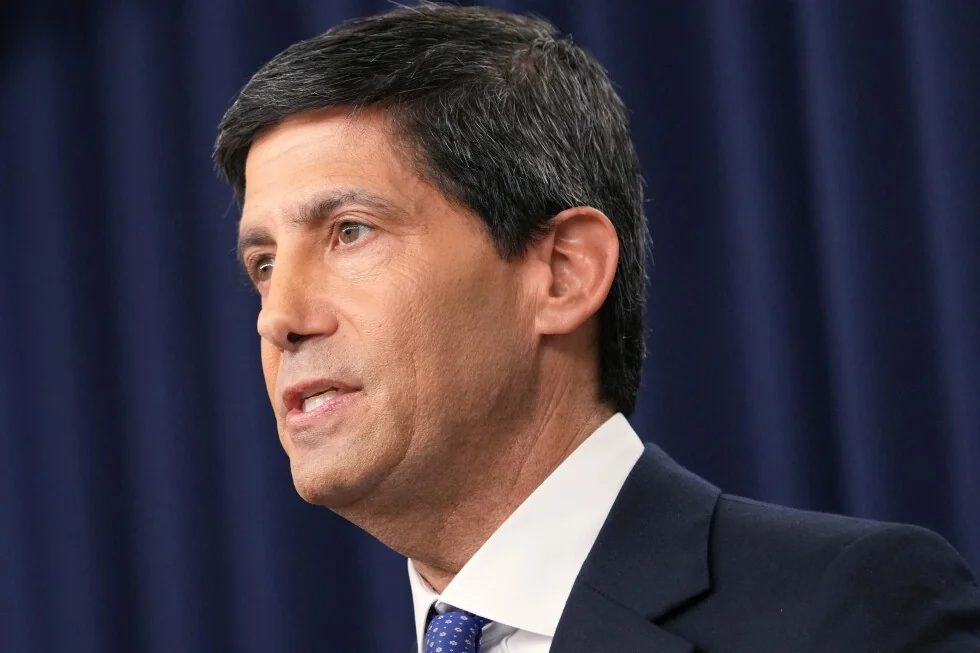
Warum die Federal Reserve jetzt die Zinsen erhöht und was das bedeutet
September 17th, 2026
Warum die Federal Reserve jetzt die Zinsen erhöht und was das bedeutet
🇩🇪 Deutsch
Approximately six weeks ago, Federal Reserve Chairman Kevin Warsh announced that a divided central bank was maintaining its key interest rate at its existing level.
Yet on Wednesday, the Fed's rate-setting committee unanimously endorsed a rate hike, and nearly all policymakers signaled that a second increase later this year would likely be warranted.
What, then, has undergone change?
In essence, the resurgence of hostilities in the Middle East has driven gas prices upward once more.
Moreover, there are indications that the economy continues to expand at a robust rate even as inflation remains persistently elevated.
All three factors appear to have propelled the committee from a wait-and-see stance into decisive action.
Yet the Fed’s action does not necessarily imply that Americans will face substantially elevated costs for mortgages or other borrowing in the near term, since financial markets appear reassured by the Fed’s commitment to combating inflation.
On Thursday, the 10-year Treasury yield even declined slightly, a probable indication of diminished inflation concerns among investors.
The Fed’s rate hike “alleviates concerns around the Fed taking sticky inflation seriously,” remarked Oscar Munoz, head of U.S. economic research at TD Securities.
“And that they’re ready to act, not just talk about it but actually act.”
The Fed raises the short-term rate under its control in order to dampen borrowing and spending and, ideally, to cool inflation.
The Fed’s rate can exert influence over longer-term costs such as mortgage rates, yet the Fed does not directly control them.
For months, Fed officials had been weighing whether higher oil and gas prices resulting from the Iran war would merely amount to a temporary hit to inflation.
If so, raising rates might not make sense: by the time higher borrowing costs started to slow the economy, the gas price shock could be over, and inflation would fall back to the Fed's 2% target on its own.
Yet with the Iran war now entering its seventh month, Fed officials are no longer banking on its being a transient shock.
At the Fed's prior meeting on July 29, its statement asserted that inflation was elevated, "in part reflecting supply shocks that have driven price increases in certain sectors, including energy."
Yet its latest statement on Wednesday omitted any reference to supply shocks, instead observing that consumer and business spending “has been resilient.”
At his news conference on Wednesday afternoon, Warsh remarked, “our judgment regarding... the geopolitical situation has shifted.”
Gas prices, in the meantime, have persisted in their relentless upward trajectory, attaining $4.44 per gallon on Thursday, as reported by AAA.
This represents an increase of 38 cents relative to a month prior.
Diesel prices have reached unprecedented heights of $6.40, a development that will drive up transportation expenses for numerous categories of merchandise.
When the Fed raises interest rates, it fuels fears that higher borrowing costs will eventually weigh so heavily on the economy that a recession follows.
Yet Warsh stressed that the economy is healthy and has kept growing despite repeated blows from higher gas prices, tariffs, and higher interest rates.
“Our decision comes at a time when the American economy appears to be strengthening,” Warsh said.
“New hiring, private-sector earnings, business capital investment — each of these markers has improved in recent months and is pointing in a good direction.
“If you consider the geopolitical landscape of shocks and uncertainty, you begin to appreciate the resilience of the U.S. economy,” he added.
Although the economy may be exhibiting indications of acceleration, persistent inflation has diminished Americans’ disposable income.
On an annual basis, inflation has now outpaced average incomes for five consecutive months, rendering it increasingly difficult for Americans to afford essentials such as gas, food, and rent.
Warsh said that the “least well-off” have the “most to gain” from steady growth and stable prices.
If the Fed manages to bring inflation down to its 2% goal, then when Americans “get their wages, they can put their head above water and deliver real take home pay increases,” Warsh said.
President Donald Trump renewed his criticism of the Fed on Wednesday night and pushed for much lower interest rates, but he did not attack Warsh, whom he had appointed as chairman earlier this year.
This is a significant shift from Warsh's predecessor, Jerome Powell, who faced repeated personal attacks from Trump as well as a criminal investigation that was later dropped.
“The board is exceedingly antagonistic. They’re profoundly political. They’re acting contrary to what is right. They’re a collection of politicians,” Trump said, referring to the 12 Fed officials on the central bank’s rate-setting committee.
“They’re raising rates to make Trump do as badly as they possibly can.”
Yet economists contend that Trump’s criticisms are misguided.
They point out that, beyond the Fed, there are multiple factors behind the surge in longer-term interest rates over the past two months.
The 10-year Treasury, for instance, exerts a strong influence on mortgage rates and this week surpassed 5% for the first time since 2023.
Meanwhile, the weekly average rate on a 30-year fixed-rate home loan rose to just under 7% — its highest level in more than 19 months.
Wall Street investors are insisting on higher yields to hold bonds, partly because inflation remains elevated.
Investors require higher interest rates to offset the impact of higher prices.
The surge in investment in AI data centres has likewise driven up borrowing costs, as large tech firms have issued hundreds of billions of dollars in bonds to finance the buildout.
This flood of bonds has also pushed up rates.
Warsh also cited stronger economic growth, which typically pushes interest rates upward, as more businesses expect higher returns from new projects and therefore borrow more to expand.
Yet Warsh failed to mention another factor behind rising interest rates that many economists point to: the high and accumulating U.S. government debt, which recently surpassed $40 trillion and has grown sharply under Trump.
Nor did he cite tariffs, something his predecessor, Powell, frequently highlighted.
September 17th, 2026
Trending Articles
Warren Buffett gibt den Vorsitz bei Berkshire Hathaway ab und treibt damit seinen Nachfolgeplan voran
Warren Buffett relinquishes chairman role at Berkshire Hathaway, advancing his succession plan
Warren Buffett gibt den Vorsitz bei Berkshire Hathaway ab und treibt damit seinen Nachfolgeplan voran
Warren Buffett relinquishes chairman role at Berkshire Hathaway, advancing his succession plan
Trump nimmt weitere Nachrichtenmedien ins Visier und kündigt an, CNN, MS NOW und Politico vom Weißen Haus ausschließen zu wollen
Trump targets more news outlets, saying he will ban CNN, MS NOW and Politico from the White House
Trump nimmt weitere Nachrichtenmedien ins Visier und kündigt an, CNN, MS NOW und Politico vom Weißen Haus ausschließen zu wollen
Trump targets more news outlets, saying he will ban CNN, MS NOW and Politico from the White House
Die Bank of Japan hebt den Leitzins auf 1,25 % an, den höchsten Stand seit 31 Jahren
Bank of Japan lifts key rate to 1.25%, a 31-year high
Die Bank of Japan hebt den Leitzins auf 1,25 % an, den höchsten Stand seit 31 Jahren
Bank of Japan lifts key rate to 1.25%, a 31-year high

Anthropic sagt, sein Modell Claude helfe dabei, seinen eigenen Nachfolger zu entwickeln
Anthropic says its model Claude is helping to build its own successor
Anthropic sagt, sein Modell Claude helfe dabei, seinen eigenen Nachfolger zu entwickeln
Anthropic says its model Claude is helping to build its own successor
US-Aktien steigen auf Sechs-Wochen-Hoch, da Ölpreise und Anleiherenditen fallen
US stocks surge to six-week high as oil prices and bond yields decline
US-Aktien steigen auf Sechs-Wochen-Hoch, da Ölpreise und Anleiherenditen fallen
US stocks surge to six-week high as oil prices and bond yields decline
Die Fed erhöht den Leitzins zum ersten Mal seit drei Jahren und trotzt damit Trumps Forderungen nach einer Senkung.
Fed hikes key rate for 1st time in 3 years, defying Trump's calls for a cut
Die Fed erhöht den Leitzins zum ersten Mal seit drei Jahren und trotzt damit Trumps Forderungen nach einer Senkung.
Fed hikes key rate for 1st time in 3 years, defying Trump's calls for a cut
Die Zahl der Anträge auf Arbeitslosenunterstützung sinkt auf 196.000, den niedrigsten Stand seit Mitte Juli angesichts anhaltend geringer Entlassungen
Unemployment Claims Fall to 196,000, Lowest Since Mid-July Amid Persistent Low Layoffs
Die Zahl der Anträge auf Arbeitslosenunterstützung sinkt auf 196.000, den niedrigsten Stand seit Mitte Juli angesichts anhaltend geringer Entlassungen
Unemployment Claims Fall to 196,000, Lowest Since Mid-July Amid Persistent Low Layoffs
Trump bezeichnet KI-Risiken als „Schwindel“ und behauptet eine „KRANKE Verschwörung“ gegen KI und Rechenzentren
Trump denounces AI risks as a ‘hoax,’ alleging a ‘SICK conspiracy’ against AI and data centers
Trump bezeichnet KI-Risiken als „Schwindel“ und behauptet eine „KRANKE Verschwörung“ gegen KI und Rechenzentren
Trump denounces AI risks as a ‘hoax,’ alleging a ‘SICK conspiracy’ against AI and data centers
Oberster Gerichtshof entscheidet über die Klage eines Hummerfischers aus Maine gegen die GPS-Schiffsverfolgungspflicht
Supreme Court to decide on Maine lobsterman’s challenge to GPS boat tracker requirement
Oberster Gerichtshof entscheidet über die Klage eines Hummerfischers aus Maine gegen die GPS-Schiffsverfolgungspflicht
Supreme Court to decide on Maine lobsterman’s challenge to GPS boat tracker requirement