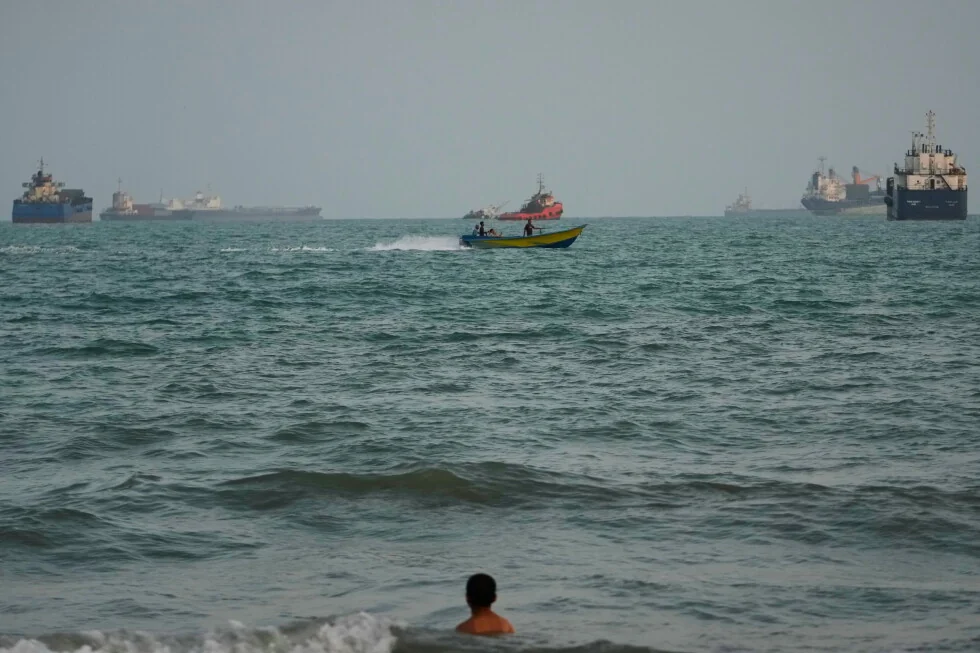
Les États-Unis frappent trois pétroliers iraniens à la suite d'allégations d'attaques de missiles balistiques contre des navires de guerre.
September 5th, 2026
Les États-Unis frappent trois pétroliers iraniens à la suite d'allégations d'attaques de missiles balistiques contre des navires de guerre.
🇫🇷 Français
On Saturday, the American military reported that U.S. forces had engaged three Iranian oil tankers in response to a ballistic missile attack on Navy warships, issuing a stark warning that it would, "if necessary, destroy Iran's limited and exposed oil fleet."
Analysts have characterized this as a perilous escalation, particularly in the wake of Iran's prior maritime assaults on commercial shipping.
The strikes — occurring a day after U.S. President Donald Trump sought to downplay the conflict as “small potatoes” — signal a renewed pivot toward hostilities following six months of intermittent warfare that commenced with U.S. and Israeli offensives against the country on Feb. 28.
Both parties have endeavored to inflict military and economic hardship alike, while diplomatic negotiations have foundered.
The military’s communiqué asserted that an American aircraft carrier and a destroyer, whilst conducting patrols in the region, successfully evaded “multiple unprovoked Iranian attacks,” with no U.S. personnel sustaining injuries.
The precise timing of the Iranian missile launches remained indeterminate.
The communiqué further stated that two Iranian oil carriers had been rendered “permanently disabled,” whilst the third, being unladen, was obliterated.
The U.S. statement characterized the tankers as constituting an integral component of a clandestine network facilitating the financial underpinnings of Iran’s formidable Revolutionary Guard and its armed proxies operating throughout the region.
A spokesperson with Iran’s joint military command subsequently cautioned that any strikes directed against U.S. naval vessels would prove considerably more devastating should Washington persist in its interference with Iranian maritime operations, as relayed by the state broadcaster.
That Iran targeted a U.S. aircraft carrier with a ballistic missile “indicates that Tehran is becoming increasingly willing to accept risks it previously sought to avoid, including directly threatening some of the most important U.S. military assets in the region,” Danny Citrinowicz, an Iran expert at Israel’s Institute for National Security Studies, said on X.
Earlier, Iranian state television had reported that four U.S. missiles struck a tanker approximately 6 miles (10 kilometers) from Kharg Island, which hosts a terminal serving as the primary conduit for the nation's oil exports.
Kharg Island has been subjected to repeated attacks throughout the conflict, including U.S. strikes on military installations there in March.
The United States reported that one tanker had been struck in the vicinity of Kharg Island, while a second was targeted near Jask, situated to the east of the Strait of Hormuz.
The vessel, devoid of cargo, was hit within the Gulf of Oman, and Washington stated that its crew had been “directed to abandon ship.”
The statement disseminated what it characterized as video footage documenting the attacks.
Subsequent to the U.S. pronouncement, Iran's state broadcaster reported that the two remaining tankers had been subjected to attack, and further noted that their crews had been successfully evacuated.
“We shall not shrink from defending American forces and, should circumstances demand it, annihilating Iran’s constrained and vulnerable oil fleet,” declared Adm. Brad Cooper, the commander of U.S. Central Command.
Amid the confluence of armed conflict and the incapacitation of vessels precipitated by the U.S. naval embargo on Iranian ports, the precise tally of Iranian oil tankers subjected to targeting remains conspicuously indeterminate.
On May 8, the U.S. military asserted that it had discharged "precision munitions" into the smokestacks of two Iranian oil tankers, both of which were devoid of cargo.
The most recent strikes occurred nearly a week after the United States and Iran resumed hostilities following a month of relative quiescence, with the Strait of Hormuz and the Iranian communities along its littoral once again coming under attack.
At least five individuals perished earlier in the week during a U.S. aerial bombardment of southern Iran, with one projectile striking a wedding celebration.
Thirteen-year-old Masoumeh Zarei sustained injuries in the assault and, while receiving medical treatment for wounds to her abdomen, conveyed her account to reporters from her hospital bed.
She recounted that the wedding festivities were already underway when she departed to partake in them, yet she never reached her destination—she was rendered unconscious when a telecommunications tower was struck, and her subsequent recollection was of regaining awareness within a hospital.
“The festivities had scarcely commenced when we resolved to attend,” Zarei remarked, her voice rasping.
“I had meticulously adorned my nails in anticipation of the soirée, yet in an instant, the entire landscape of my intentions was irrevocably transformed.”
Her companion, 14-year-old Kiana Karimi, likewise sustained grave injuries and was subsequently admitted to intensive care.
She recounted having perceived a series of five distinct detonations.
“The initial three detonations at the telecommunications tower hurled us to the ground,” Karimi recounted.
“I scrambled to my feet to lift my brothers from the earth.
Then two further blasts ensued, and subsequent to that, my memory ceases entirely.”
The Trump administration appears to have adopted a bifurcated strategy toward the conflict, countering hostilities in the strait through military means while simultaneously targeting foreign financial institutions that process Iranian funds.
Vice President JD Vance stated on Thursday that renewed diplomatic engagement remained untenable so long as Iran continued its aggression against shipping, while underscoring that the principal military operations had concluded by July.
Yet Tehran’s newly installed hard-line leadership has signaled a resolve to hold firm, having weathered decades of sanctions, while the elected administration of Iranian President Masoud Pezeshkian has voiced its preference for a diplomatic conclusion to the conflict.
Over the years, Iran has devised increasingly sophisticated mechanisms to circumvent sanctions—and, more recently, the U.S. blockade—thereby ensuring the continued delivery of its crude to buyers and mitigating mounting economic strain.
This strategy is, in part, contingent upon a clandestine fleet of shadow tankers facilitating the transportation of its petroleum.
Meanwhile, the very issue that had precipitated the conflict — Iran’s nuclear program — was slated for resolution through negotiations that collapsed shortly after the U.S. and Iran inked a memorandum of understanding in mid-June.
Diplomats now indicate that the U.S., Britain, France, and Germany are seeking to refer Iran to the U.N. Security Council over its alleged noncompliance with nuclear nonproliferation obligations.
Instead, Tehran’s newfound leverage now centers upon the strait that remains indispensable to global petroleum and liquefied natural gas flows, a waterway that, prior to the outbreak of hostilities, was universally regarded as an international maritime passage.
The U.S. military has been instrumental in shepherding vessels through the strait as Tehran asserts its hegemony and singles out certain ships for interdiction, yet overall maritime traffic remains markedly subdued.
September 5th, 2026
Trending Articles
L’ouverture de l’UE à un « membre associé » pour le Canada : implications potentielles
The EU’s “associate member” overture to Canada: potential implications
L’ouverture de l’UE à un « membre associé » pour le Canada : implications potentielles
The EU’s “associate member” overture to Canada: potential implications

Trump s'entretiendra avec la présidente par intérim du Venezuela, Delcy Rodríguez, à New York la semaine prochaine, annonce la Maison-Blanche
Trump to convene with Venezuelan acting President Delcy Rodríguez in New York next week, White House announces
Trump s'entretiendra avec la présidente par intérim du Venezuela, Delcy Rodríguez, à New York la semaine prochaine, annonce la Maison-Blanche
Trump to convene with Venezuelan acting President Delcy Rodríguez in New York next week, White House announces

L’économie de guerre russe confrontée à une érosion à long terme due à la dette et aux dépenses militaires
Russia’s Wartime Economy Faces Long-Term Erosion from Debt and Military Spending
L’économie de guerre russe confrontée à une érosion à long terme due à la dette et aux dépenses militaires
Russia’s Wartime Economy Faces Long-Term Erosion from Debt and Military Spending

La Russie entame trois jours de vote aux élections législatives, un scrutin qui devrait consolider le pouvoir du Kremlin
Russia Embarks on Three Days of Voting in Parliamentary Election Poised to Entrench Kremlin’s Power
La Russie entame trois jours de vote aux élections législatives, un scrutin qui devrait consolider le pouvoir du Kremlin
Russia Embarks on Three Days of Voting in Parliamentary Election Poised to Entrench Kremlin’s Power
Les États-Unis accordent des visas à de hauts dirigeants iraniens pour une réunion de haut niveau de l'ONU malgré les hostilités en temps de guerre
US grants visas to top Iranian leaders for UN high-level meeting despite wartime hostilities
Les États-Unis accordent des visas à de hauts dirigeants iraniens pour une réunion de haut niveau de l'ONU malgré les hostilités en temps de guerre
US grants visas to top Iranian leaders for UN high-level meeting despite wartime hostilities
Des experts mandatés par l'ONU allèguent de possibles crimes de guerre américains lors de frappes en Iran
UN-backed experts allege potential US war crimes in Iran strikes
Des experts mandatés par l'ONU allèguent de possibles crimes de guerre américains lors de frappes en Iran
UN-backed experts allege potential US war crimes in Iran strikes
Les riverains de la frontière roumaine s'alarment de l'escalade des alertes de drones
Romanian Border Residents Alarmed as Drone Alerts Escalate
Les riverains de la frontière roumaine s'alarment de l'escalade des alertes de drones
Romanian Border Residents Alarmed as Drone Alerts Escalate
Carney adopte la proposition d'adhésion associative à l'UE alors que Trump pousse le Canada vers l'Europe
Carney Embraces EU Associate Membership Proposal as Trump Propels Canada Toward Europe
Carney adopte la proposition d'adhésion associative à l'UE alors que Trump pousse le Canada vers l'Europe
Carney Embraces EU Associate Membership Proposal as Trump Propels Canada Toward Europe

Détroit d'Ormuz rouvert : des avancées américaines dans une guerre iranienne inachevée
Strait of Hormuz Reopened: US Progress Amid an Unfinished Iran War
Détroit d'Ormuz rouvert : des avancées américaines dans une guerre iranienne inachevée
Strait of Hormuz Reopened: US Progress Amid an Unfinished Iran War

Six Nigérians extradés vers les États-Unis pour avoir escroqué des femmes de 6 millions de dollars dans des arnaques sentimentales
Six Nigerians Extradited to US for Defrauding Women of $6M in Romance Scams
Six Nigérians extradés vers les États-Unis pour avoir escroqué des femmes de 6 millions de dollars dans des arnaques sentimentales
Six Nigerians Extradited to US for Defrauding Women of $6M in Romance Scams