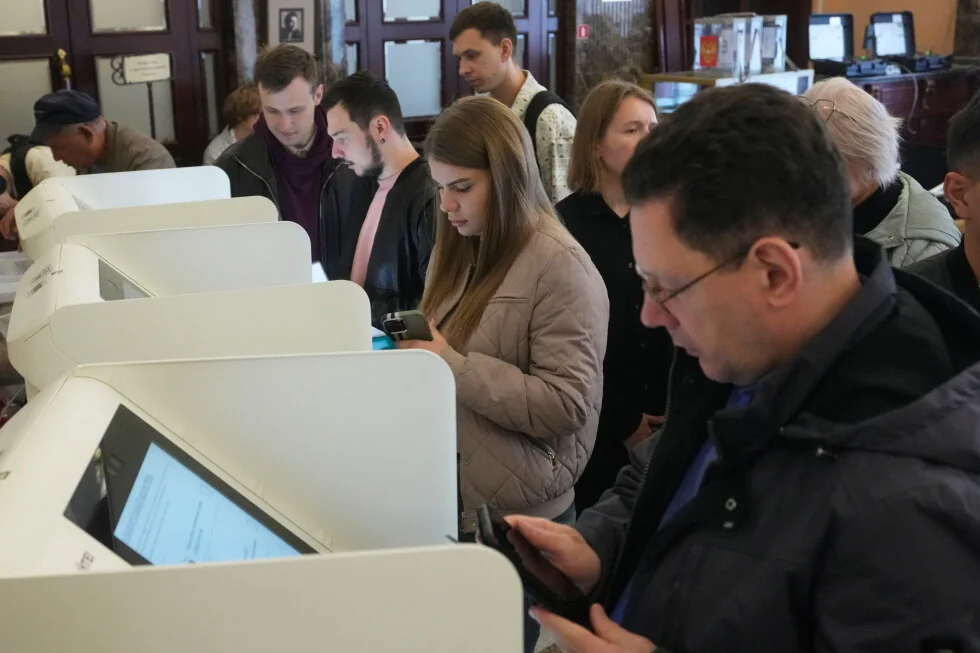
La Russie entame trois jours de vote aux élections législatives, un scrutin qui devrait consolider le pouvoir du Kremlin
September 18th, 2026
La Russie entame trois jours de vote aux élections législatives, un scrutin qui devrait consolider le pouvoir du Kremlin
🇫🇷 Français
On Friday, Russians commenced three days of balloting in the nation’s inaugural wartime parliamentary election — a contest conspicuous for its near-total absence of opposition and all but assured to entrench the Kremlin’s political hegemony.
In a concerted endeavour to augment turnout among the 111 million enfranchised citizens, the authorities protracted the election across the weekend, concluding on Sunday, and went so far as to sanction electronic balloting.
According to the Central Election Commission, turnout stood at approximately 30% as of late Friday, encompassing online voting.
The Kremlin seeks to harness the parliamentary election — the first since the commencement of the full-scale invasion of Ukraine in 2022 — as a means of underscoring public endorsement of the war and conferring a veneer of legitimacy upon its actions.
It has endeavoured to preclude any political risks by ruthlessly suppressing even the faintest whisper of dissent.
“Your choice and resolve will once again demonstrate that millions of people stand behind our fighters, that we are a united people, bound by shared values, historical memory, and love for the Motherland,” President Vladimir Putin told the nation before the vote.
The Kremlin disclosed that Putin had cast his ballot online on Friday, disseminating imagery of him stationed before a computer screen.
The principal Kremlin party, United Russia, is all but assured of retaining its overwhelming control of the lower house, the State Duma.
Several smaller parties of the “systemic opposition” that vote in lockstep with the government on all key issues are likewise expected to retain their presence.
Voters cast two discrete ballots, filling half of the Duma’s 450 seats by selecting political parties listed thereon.
The remainder are contested in single-seat constituencies, with voters choosing individual candidates.
Russians canvassed by reporters evinced divergent expectations regarding the election.
Dmitry Kirillin, in Moscow, declared earlier this week that he would welcome “to see some changes. To see a different party” at the helm.
Muscovite Alexander Vertukhin, by contrast, maintained that “what United Russia and the communists are doing is quite sufficient; their platforms cover everything.”
Addressing those assembled at a Moscow polling station on Friday, Galina Vavilova, a pensioner, averred that she regarded the cessation of the war in Ukraine as “the main thing, of course.”
"That constitutes the paramount imperative at this juncture.
Peace is what everyone desires; that is the crux of the matter.
So that our guys remain safe and sound," she said.
Another pensioner, Lyudmila Kalinina, articulated a yearning for life “to stabilize for the better” and for “an end to the big divide between the ultra-rich and the extremely poor, because, after all, many people don’t live a very sweet life.”
Vladimir Chubarev, a professor of 72 years, articulated his aspiration “for all the important initiatives our government is undertaking to succeed,” appending: “And, of course, for victory.”
The liberal Yabloko party — the sole registered political entity that had the temerity to denounce the war — was struck from the ballot last month by Russia's Supreme Court, and now fields but a few dozen candidates in the single-constituency races.
Moreover, several anti-war politicians have been incarcerated or compelled to flee abroad in the run-up to the campaign.
The election unfolds in the wake of a summer during which Ukraine’s long-range drone strikes on oil refineries precipitated a pervasive fuel crisis.
Warehouses belonging to the online retailers Wildberries and Ozon likewise came under attack.
The resultant damage has compounded the Russian economy’s travails and brought the war home to millions.
In Russia’s Black Sea resort of Sochi, polling stations were briefly shuttered owing to a threatened drone attack, local officials said.
One polling station in the Krasnodar region had to be relocated to an alternative venue after a drone shattered its windows there, according to Central Election Commission head Ella Pamfilova.
For the inaugural time, the parliamentary election encompasses residents of four Ukrainian regions that Moscow unlawfully annexed following the outbreak of war, yet over which it still does not exercise full control.
Voting is likewise underway in Crimea, the Black Sea peninsula illegally annexed by Russia in 2014.
At a polling station situated within the Russian-occupied expanse of eastern Ukraine's Donetsk region, voters consigned their ballots to a box whilst an armed Russian soldier stood in close proximity, observing.
Addressing a convocation of officials, Putin contended that Ukraine was endeavouring to stymie the ballot, adducing a Ukrainian strike that had killed the head of a polling station in the Zaporizhzhia region.
In the Russian-held Luhansk region, 14 polling stations were operating on backup power sources after Ukrainian drones had damaged electrical lines, Pamfilova said.
Separately, Russian officials asserted that Ukrainian strikes earlier this week had killed a polling station chief and wounded another in the Russian-controlled Zaporizhzhia region.
Ukraine has, as yet, proffered no immediate comment on the accusation.
Kyiv’s authorities inveighed against the balloting in Russian-occupied territories as illegitimate, exhorting foreign governments and international organizations to withhold recognition of the election and cautioning Ukrainians that participation in its organization might entail criminal liability.
Christian Wigand, a spokesperson for the European Commission, likewise denounced the voting in Russian-held regions as “illegal”, affirming that the European Union condemns it.
“These so-called elections constitute yet another flagrant contravention of international law.
The European Union does not, and never shall, recognize either the conduct of these so-called elections — sham elections — in the temporarily occupied territories of Ukraine, or their results,” he said.
Wigand asserted that the manner in which the elections are conducted “underscores the continued and deepening erosion of democracy in Russia,” and that the Kremlin “deprives voters in Russia of a genuine choice about the future of their country.”
He further remarked that Russia had elected to forgo inviting observers from the Organization for Security and Cooperation in Europe, thereby flouting its commitments.
He pledged that the EU would persist in its support for Russian civil society organizations, human rights groups and independent media.
Lorne Cook, whose station was Brussels, numbered among those who contributed.
September 18th, 2026
Trending Articles
L’ouverture de l’UE à un « membre associé » pour le Canada : implications potentielles
The EU’s “associate member” overture to Canada: potential implications
L’ouverture de l’UE à un « membre associé » pour le Canada : implications potentielles
The EU’s “associate member” overture to Canada: potential implications
Trump s'entretiendra avec la présidente par intérim du Venezuela, Delcy Rodríguez, à New York la semaine prochaine, annonce la Maison-Blanche
Trump to convene with Venezuelan acting President Delcy Rodríguez in New York next week, White House announces
Trump s'entretiendra avec la présidente par intérim du Venezuela, Delcy Rodríguez, à New York la semaine prochaine, annonce la Maison-Blanche
Trump to convene with Venezuelan acting President Delcy Rodríguez in New York next week, White House announces
L’économie de guerre russe confrontée à une érosion à long terme due à la dette et aux dépenses militaires
Russia’s Wartime Economy Faces Long-Term Erosion from Debt and Military Spending
L’économie de guerre russe confrontée à une érosion à long terme due à la dette et aux dépenses militaires
Russia’s Wartime Economy Faces Long-Term Erosion from Debt and Military Spending
Les États-Unis accordent des visas à de hauts dirigeants iraniens pour une réunion de haut niveau de l'ONU malgré les hostilités en temps de guerre
US grants visas to top Iranian leaders for UN high-level meeting despite wartime hostilities
Les États-Unis accordent des visas à de hauts dirigeants iraniens pour une réunion de haut niveau de l'ONU malgré les hostilités en temps de guerre
US grants visas to top Iranian leaders for UN high-level meeting despite wartime hostilities
Des experts mandatés par l'ONU allèguent de possibles crimes de guerre américains lors de frappes en Iran
UN-backed experts allege potential US war crimes in Iran strikes
Des experts mandatés par l'ONU allèguent de possibles crimes de guerre américains lors de frappes en Iran
UN-backed experts allege potential US war crimes in Iran strikes
Les riverains de la frontière roumaine s'alarment de l'escalade des alertes de drones
Romanian Border Residents Alarmed as Drone Alerts Escalate
Les riverains de la frontière roumaine s'alarment de l'escalade des alertes de drones
Romanian Border Residents Alarmed as Drone Alerts Escalate
Carney adopte la proposition d'adhésion associative à l'UE alors que Trump pousse le Canada vers l'Europe
Carney Embraces EU Associate Membership Proposal as Trump Propels Canada Toward Europe
Carney adopte la proposition d'adhésion associative à l'UE alors que Trump pousse le Canada vers l'Europe
Carney Embraces EU Associate Membership Proposal as Trump Propels Canada Toward Europe

Détroit d'Ormuz rouvert : des avancées américaines dans une guerre iranienne inachevée
Strait of Hormuz Reopened: US Progress Amid an Unfinished Iran War
Détroit d'Ormuz rouvert : des avancées américaines dans une guerre iranienne inachevée
Strait of Hormuz Reopened: US Progress Amid an Unfinished Iran War

Six Nigérians extradés vers les États-Unis pour avoir escroqué des femmes de 6 millions de dollars dans des arnaques sentimentales
Six Nigerians Extradited to US for Defrauding Women of $6M in Romance Scams
Six Nigérians extradés vers les États-Unis pour avoir escroqué des femmes de 6 millions de dollars dans des arnaques sentimentales
Six Nigerians Extradited to US for Defrauding Women of $6M in Romance Scams