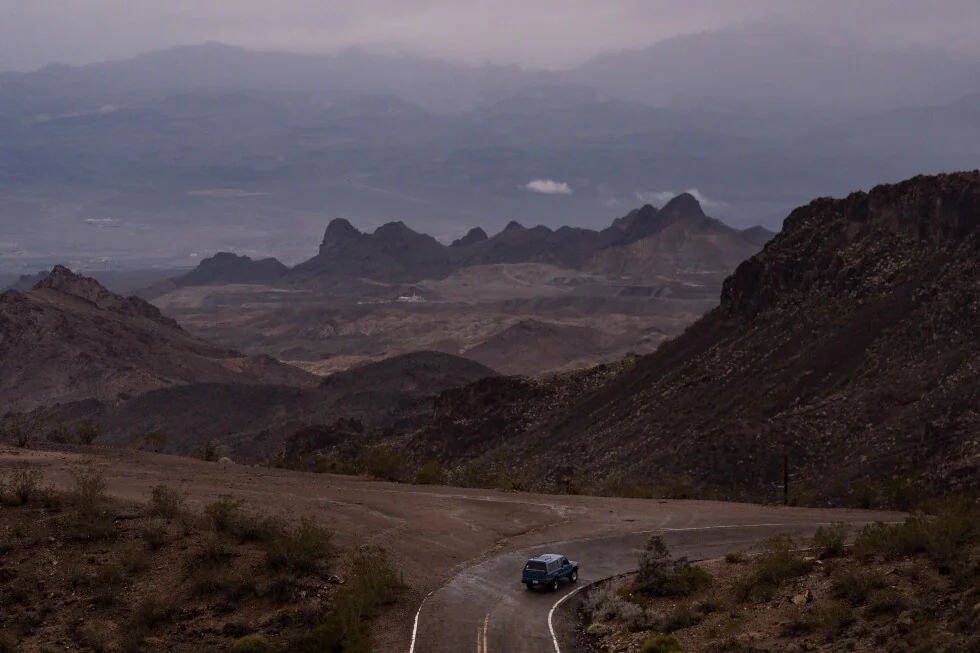
Der große amerikanische Roadtrip, angetrieben und untergraben vom Automobil, das ihn hervorbrachte
September 14th, 2026
Der große amerikanische Roadtrip, angetrieben und untergraben vom Automobil, das ihn hervorbrachte
🇩🇪 Deutsch
There exists something inherently compelling about the American road trip.
It calls to mind visions of cars as big as boats, the glory days before seat-belt laws and pit stops at the world’s largest fill-in-the-blank.
It has been memorialized in books like Jack Kerouac’s “On the Road” and satirized in movies like “National Lampoon’s Vacation.”
It consists, in the main, of interminable hours behind the wheel that ought to be tedious — yet somehow aren’t?
Perhaps it’s the anticipation of arriving at some fabled destination — the Grand Canyon, Yellowstone, Death Valley.
Or perhaps it’s the unforeseen sights encountered en route.
Tumbleweeds!
They’re real!
Americans are enamored with the notion of a road trip, yet we frequently prioritize arriving at our destination with maximum expediency instead.
The proliferation of budget airfare has rendered it effortless to travel without enduring the inconvenience of driving.
When we do get behind the wheel, we tend to confine ourselves to the interstates, hurtling past the small towns we romanticize at speeds exceeding 70 miles per hour.
These alternatives are more expedient and, for certain individuals, safer.
Yet in our pursuit of convenience, what have we forfeited?
As early as 1921, Cornelius Vanderbilt Jr. recounted a road trip he had undertaken with his new wife from New York City to Hot Springs, Virginia.
“We had heard people say in muffled tones that the roads would be impassable and that it was foolish to even think of trying them,” he wrote.
“But within four days after leaving New York we reached Hot Springs, none the worse for wear and a great deal happier for the experience.”
Long-distance travel declined during the Great Depression and was further restricted by rationing throughout World War II, yet it rebounded vigorously once veterans returned home and began raising families.
In “Are We There Yet? The Golden Age of American Family Vacations,” historian Susan Rugh argues that the period after World War II and before the oil crisis of the 1970s was the high point of the family road trip.
More Americans were moving into the middle class, many had paid vacation for the first time, car ownership was rising quickly, and the federal government was investing in highways that made long-distance travel more comfortable.
Numerous veterans, having journeyed to Europe for the war, were keen to demonstrate to their children precisely what they had been fighting to preserve.
One favoured destination was Washington, D.C., where the Allied victory had elevated the city's stature as the capital of the free world.
Families likewise toured historic monuments, residences and battlefields.
In the West, the nation’s majestic national parks, held in common by the people, served simultaneously as a tourist destination and as an emblem of American democracy.
Attendance surged, rising by more than 650% between 1946 and 1966, as the government injected over a billion dollars to upgrade facilities, Rugh writes.
Journeying together across America not only reinforced familial ties but also “provided a way to educate children as citizens,” she writes.
The open road did not represent freedom for all Americans.
Black families in particular often had to contend with segregated facilities, even outside the South.
“The experience is entirely distinct,” remarks Allen Pietrobon, a professor at Trinity University in Washington, D.C., who instructs a course on road trips.
“It is not devoid of concerns.
You cannot simply, whenever you require fuel, halt wherever you please, as the gas station may not provide service to you.”
The National Parks, run by the federal government, were not supposed to discriminate, but some still did — with separate campgrounds for Black families, for instance.
The problem was so systemic that there were guidebooks, like the well known Green Book, specifically made for Black travelers, listing hotels and restaurants where they'd be welcomed.
The obstacles faced by the Black family on vacation even contributed to the passage of the 1964 Civil Rights Act, Rugh writes.
Today, the protests of college students embarking on Freedom Rides and organizing lunch counter sit-ins are recognized as the driving forces behind the Act's desegregation of public accommodations.
Yet at the time in Congress, the Senate Committee of Commerce was hearing stories like that of a Black business owner turned away from a motel in St. Petersburg, Florida, even after he offered to pay twice the normal rate.
The exhausted family, including two children, had to try to sleep in the car as best they could.
Narratives such as these helped engender sympathy for the civil rights struggle among lawmakers.
“Faced with Jim Crow laws in the South and persistent racial discrimination throughout the rest of the nation, the cultural icon of the family vacation was presented as persuasive evidence that a federal law was needed to guarantee the rights of all citizens,” Rugh writes.
It was not merely the national parks that required additional amenities as Americans took to the roads; vacationers also needed lodging, restaurants, and service stations along the way.
Some entrepreneurs competed with one another to make their accommodations stand out, as seen in Wigwam Village, where the motel rooms are giant concrete teepees.
Others saw the chance to develop roadside attractions like the world's largest nutcracker.
“Americans are hucksters,” Rugh says.
“And if somebody has an attraction, somebody else is gonna serve lemonade or hamburgers right by it.”
Route 66, a highway replete with attractions, marked its centennial this year.
Commissioned in 1926 and fully paved by the late 1930s, the highway between Chicago and Los Angeles catered to a mid-century craze for the Old West of the 1880s.
A group of business owners promoted the road, dubbing it the “Main Street of America,” but Bobby Troupe’s 1946 hit song “(Get Your Kicks on) Route 66,” first recorded by Nat King Cole, has had more staying power than any advertisement.
Like so many other things Americans claim to love, the highway that John Steinbeck dubbed the “Mother Road” fell victim to a competing American paragon — progress.
The construction of the interstates siphoned much of the traffic away from communities, precipitating the closure of numerous businesses.
Entire small towns vanished.
Yet a movement is gathering momentum to preserve portions of this iconic highway, and people continue to flock from around the world to experience its neon lights and kitschy Western-themed attractions.
Richard Ratay styles himself the King of the Road Trip.
His book “Don’t Make Me Pull Over! An Informal History of the Family Road Trip” begins with a harrowing scene: as a child, he wakes in the backseat of the family car as it spins off an icy road and down an embankment.
The car, along with dozens of others, was stuck, and the family had to wait hours in the cold before being towed out.
“Years later,” he writes, “we would all agree it was the best start to a family road trip we had ever had.”
It may seem counterintuitive, yet it is often the hardships and unforeseen obstacles along the way that render a vacation truly memorable.
Pietrobon recounts an anecdote related by a colleague who was involved in a car accident in a small town in Nevada.
“It was a Saturday afternoon, and everything was shut.
There were no rental cars to be had until Tuesday.
So they found themselves simply stranded in this place.
And yet they ultimately had an utterly remarkable experience,” he says.
“The entire objective of high-end travel nowadays is to eradicate any friction whatsoever.
And in doing so, I believe, we forfeit something.”
Prior to the advent of the interstates, the highway system amounted to little more than the main streets of towns, linked together by highways.
Anyone pausing for the night, or even merely for a meal, would partake in the life of that town.
“In meeting so many people from different places, it gave families travelling by car the chance to realise that Americans in different parts of the country may talk a little differently, they may dress a little differently, they may eat different foods, but when all is said and done, we aren’t that different after all,” Ratay said in an interview.
Today's interstates largely circumvent these towns, offering chain-store gas, food and lodging immediately off the exit.
This renders driving faster and more convenient, yet also less distinctive.
Airplane travel eliminates even the minimal local interaction that the interstates afford.
“We gave up the chance to make unexpected discoveries and to encounter and engage with small-town America,” Ratay says.
“We traded those experiences for the speed and convenience of getting to our final destinations.”
Although numerous small roadside motels, restaurants and attractions succumbed once the interstates were constructed, a number have nonetheless managed to endure.
It remains feasible to take the slower route, pausing to converse with locals and immerse oneself in the experience, inconveniences and all.
"Take any of those old highways," Rugh says.
"Go through Illinois and take the Lincoln Highway, cross the Midwest on the Lincoln Highway.
Go from Arizona to Canada on Highway 89, Highway 1 in California."
In older travel narratives, Pietrobon says, the destination is almost irrelevant.
“I think about who’s going to be the next Jack Kerouac where, you know, the journey is what he’s writing about, not just the snapshots of when you stop for the day.”
This constitutes part of an ongoing series of narratives commemorating the 250th anniversary of the United States.
For further reading, click here.
For a showcase of objects that have transformed the nation, click here.
For additional stories pertaining to the anniversary, click here.
September 14th, 2026
Trending Articles
Eine 250 Jahre währende Konstante: Die anhaltende Bereitschaft der Amerikaner, sich täuschen zu lassen
A 250-Year Constant: Americans’ Enduring Willingness to Be Duped
Eine 250 Jahre währende Konstante: Die anhaltende Bereitschaft der Amerikaner, sich täuschen zu lassen
A 250-Year Constant: Americans’ Enduring Willingness to Be Duped
LKW-Fahrer baut aus Spaß ein 800.000-teiliges NYC-Modell – jetzt eine Museumsausstellung
Truck driver builds 800,000-structure NYC model for fun—now a museum exhibit
LKW-Fahrer baut aus Spaß ein 800.000-teiliges NYC-Modell – jetzt eine Museumsausstellung
Truck driver builds 800,000-structure NYC model for fun—now a museum exhibit
DoorDash und Uber Eats beginnen damit, aus Costco-Filialen in den gesamten USA zu liefern
DoorDash and Uber Eats to Begin Delivering from Costco Stores Across the US
DoorDash und Uber Eats beginnen damit, aus Costco-Filialen in den gesamten USA zu liefern
DoorDash and Uber Eats to Begin Delivering from Costco Stores Across the US

Chefkoch David Chang durchquert die USA in einer neuen, auf Essen ausgerichteten CNN-Reiseserie
Chef David Chang traverses the US in new CNN travel series centred on food
Chefkoch David Chang durchquert die USA in einer neuen, auf Essen ausgerichteten CNN-Reiseserie
Chef David Chang traverses the US in new CNN travel series centred on food
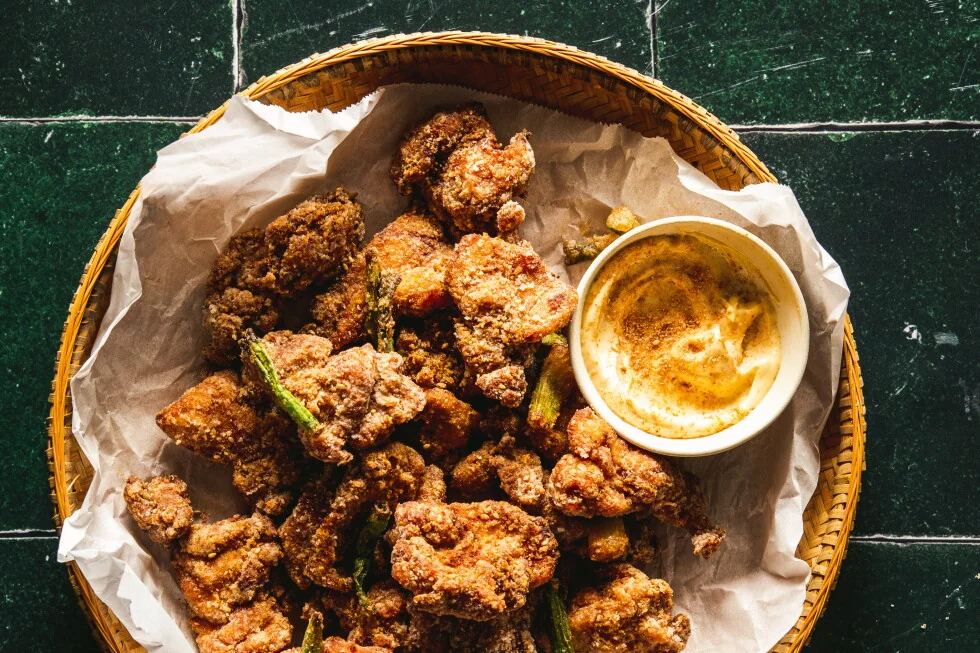
Betty Lius Sesam-Kreuzkümmel-Hähnchen: Doppelt frittiert für Geschmack und Knusprigkeit
Betty Liu’s Sesame-Cumin Chicken: Double-Fried for Flavor and Crispiness
Betty Lius Sesam-Kreuzkümmel-Hähnchen: Doppelt frittiert für Geschmack und Knusprigkeit
Betty Liu’s Sesame-Cumin Chicken: Double-Fried for Flavor and Crispiness

Ein im Schutt des World Trade Center gefundener Golfball wurde zum Symbol unbegreiflichen Verlusts
Golf ball found in World Trade Center rubble became a symbol of incomprehensible loss
Ein im Schutt des World Trade Center gefundener Golfball wurde zum Symbol unbegreiflichen Verlusts
Golf ball found in World Trade Center rubble became a symbol of incomprehensible loss
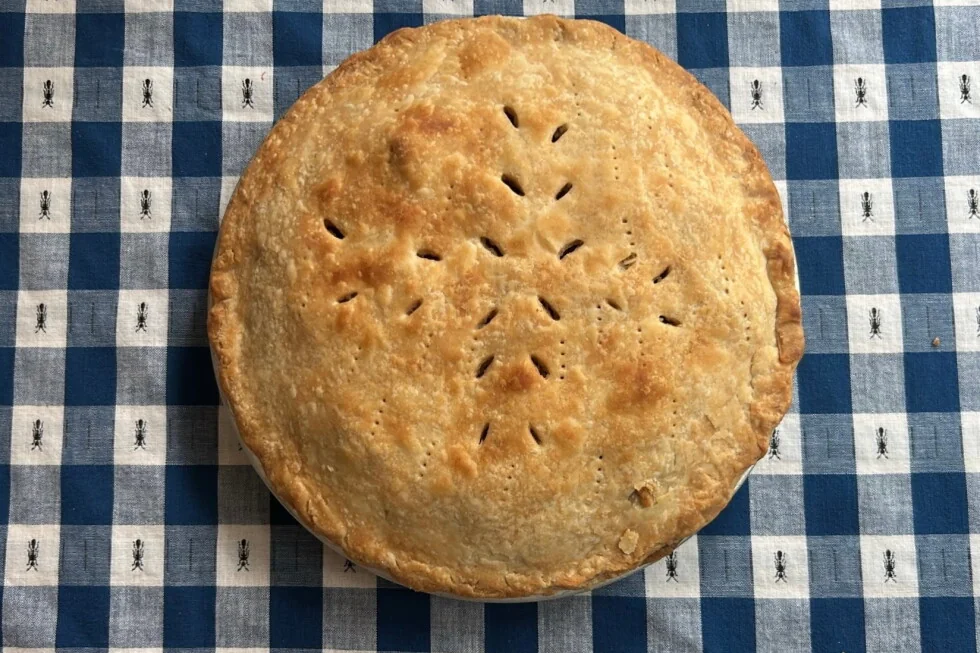
Der Apfelkuchen wurde, neben der Mutter, zum ikonischen Gericht der Nation.
The apple pie, alongside mom, became the nation's iconic dish.
Der Apfelkuchen wurde, neben der Mutter, zum ikonischen Gericht der Nation.
The apple pie, alongside mom, became the nation's iconic dish.
Eine Gallup-Umfrage zeigt, dass die Zufriedenheit der Amerikaner mit den Schulen einen historischen Tiefstand erreicht hat.
Gallup poll reveals Americans' satisfaction with schools has hit a historic low.
Eine Gallup-Umfrage zeigt, dass die Zufriedenheit der Amerikaner mit den Schulen einen historischen Tiefstand erreicht hat.
Gallup poll reveals Americans' satisfaction with schools has hit a historic low.
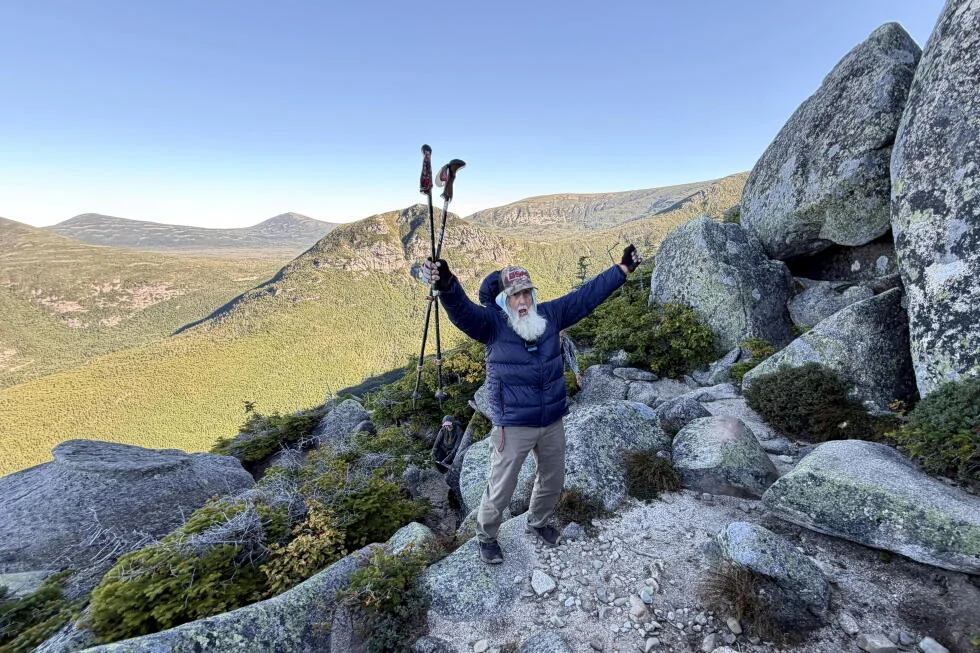
Mit 91 Jahren holt sich Dale ‚Grey Beard‘ Sanders den Rekord als ältester Wanderer zurück, der den Appalachian Trail beendet hat.
At 91, Dale ‘Grey Beard’ Sanders reclaims record as oldest hiker to finish the Appalachian Trail
Mit 91 Jahren holt sich Dale ‚Grey Beard‘ Sanders den Rekord als ältester Wanderer zurück, der den Appalachian Trail beendet hat.
At 91, Dale ‘Grey Beard’ Sanders reclaims record as oldest hiker to finish the Appalachian Trail