聯準會為何在此時升息——以及這預示著什麼
September 17th, 2026
聯準會為何在此時升息——以及這預示著什麼
🇹🇼 中文
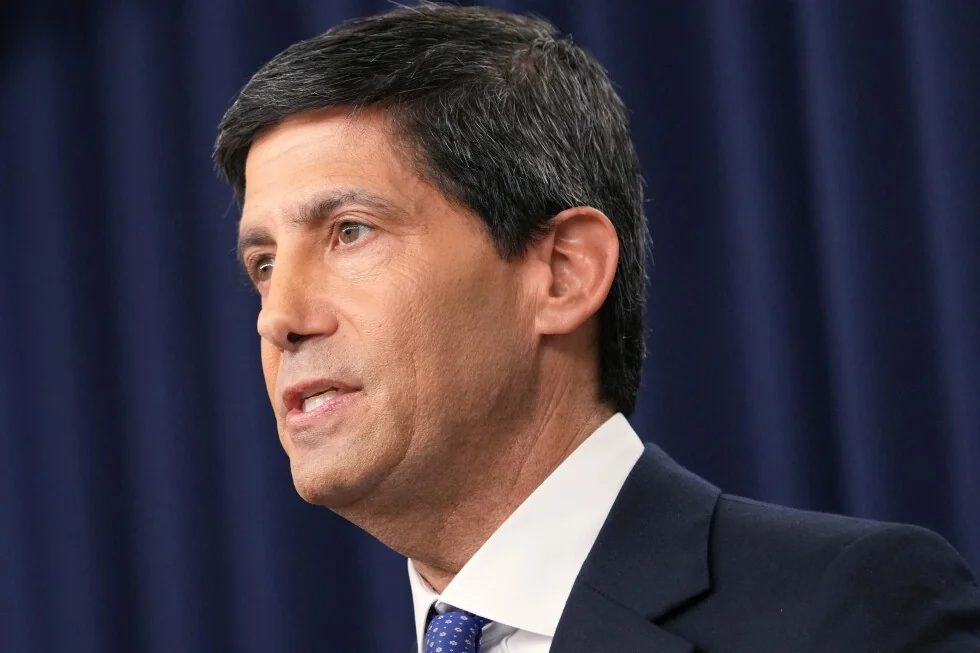
Roughly six weeks ago, Federal Reserve Chairman Kevin Warsh announced that a divided central bank was holding its key interest rate steady.
Yet on Wednesday, the Fed’s rate-setting committee unanimously endorsed a rate hike, and virtually all policymakers intimated that a second increase later this year would in all likelihood be warranted.
What, then, has undergone transformation?
In brief, the renewed hostilities in the Middle East have once again driven up gas prices.
Moreover, there are indications that the economy continues to expand at a robust pace even as inflation remains obstinately elevated.
All three factors would appear to have propelled the committee out of its wait-and-see posture and into decisive action.
Yet the Fed’s maneuver does not inevitably portend that Americans will, in the near term, incur appreciably steeper costs for mortgages or other forms of borrowing, inasmuch as financial markets appear to have taken reassurance from the Fed’s avowed commitment to subduing inflation.
On Thursday, the 10-year Treasury yield even edged marginally lower—a probable indication that investors’ anxieties about inflation have abated.
The Fed’s rate hike “alleviates concerns around the Fed taking sticky inflation seriously,” remarked Oscar Munoz, head of U.S. economic research at TD Securities, “and that they’re prepared to act — not merely to talk about it, but to genuinely act.”
By elevating the short-term rate under its purview, the Fed seeks to dampen borrowing and expenditure and, ideally, temper inflation.
Although the Fed’s rate can exert influence over longer-term costs such as mortgage rates, it does not exercise direct control over them.
For months, Fed officials have deliberated over whether the elevated oil and gas prices stemming from the Iran war would merely constitute a transient inflationary shock.
Were that the case, raising rates might prove ill-advised: by the time higher borrowing costs began to dampen the economy, the gas price shock could well have subsided, and inflation would gravitate back to the Fed's 2% target of its own accord.
Yet with the Iran war now entering its seventh month, Fed officials are no longer reckoning on its constituting a transient shock.
At the Federal Reserve's preceding conclave on July 29, its communiqué characterized inflation as elevated, "in part reflecting supply shocks that have driven price increases in certain sectors, including energy."
Yet its latest statement on Wednesday dispensed with that allusion to supply shocks, observing instead that consumer and business spending “has been resilient.”
And at his news conference on Wednesday afternoon, Warsh observed, “our judgment regarding... the geopolitical situation has undergone a transformation.”
Gasoline prices, in the interim, have persisted in their inexorable upward trajectory, attaining $4.44 per gallon on Thursday, as reported by AAA—a figure 38 cents in excess of that recorded a month prior.
Diesel prices, for their part, have ascended to unprecedented heights of $6.40, a development poised to inflate shipping expenditures across a broad spectrum of commodities.
Whenever the Federal Reserve raises interest rates, apprehension arises that the attendant escalation in borrowing costs will ultimately bear down upon the economy with such force as to precipitate a recession.
Warsh, however, underscored that the economy remains robust and has persisted in its expansion notwithstanding repeated adversities—among them elevated gasoline prices, tariffs, and higher interest rates.
“Our decision coincides with a juncture at which the American economy appears to be gaining momentum,” Warsh said.
“New hiring, private-sector earnings, business capital investment — each of these indicators has strengthened in recent months and is trending in a favourable direction.
"Contemplate the geopolitical landscape of shocks and uncertainty, and one begins to appreciate the resilience of the U.S. economy," he added.
While the economy may evince nascent signs of acceleration, intractable inflation has steadily eroded Americans’ take-home pay.
For five consecutive months now, inflation has outpaced average incomes on a yearly basis, rendering necessities such as gas, food, and rent increasingly unaffordable for Americans.
Warsh asserted that the “least well-off” stand to reap the “most to gain” from steady growth and stable prices.
Should the Fed succeed in steering inflation to its 2% target, Americans, upon “get[ting] their wages,” would be able to put their head above water and deliver real take-home pay increases, Warsh said.
President Donald Trump, on Wednesday night, reiterated his censure of the Federal Reserve and advocated for substantially lower interest rates, yet he refrained from assailing Warsh, whom he had appointed as chairman earlier this year.
This marks a pronounced departure from the treatment of Warsh's predecessor, Jerome Powell, who endured not only repeated personal invectives from Trump but also a criminal investigation that was subsequently abandoned.
"The board is exceedingly antagonistic.
They are profoundly politicized.
They are engaged in malfeasance.
They are a coterie of political operatives," Trump said, referring to the 12 Fed officials on the central bank's rate-setting committee.
"They are raising rates to make Trump do as badly as they possibly can."
Yet economists contend that Trump’s criticisms are fundamentally misdirected.
They observe that, the Fed notwithstanding, a confluence of factors has precipitated the surge in longer-term interest rates over the past two months.
The 10-year Treasury, for instance, exerts a pronounced influence on mortgage rates and this week surpassed 5% for the first time since 2023.
Concurrently, the weekly average rate on a 30-year fixed-rate home loan ascended to just shy of 7% — its loftiest level in more than 19 months.
Wall Street investors are insisting upon higher yields as a precondition for holding bonds, owing in part to persistently elevated inflation.
Investors require higher interest rates to counteract the erosion wrought by higher prices.
The escalation of investment in AI data centers has, moreover, driven up borrowing costs, as major technology corporations have issued hundreds of billions of dollars in bonds to underwrite the buildout.
This deluge of bonds has likewise exerted upward pressure on rates.
Warsh additionally adduced more robust economic growth, which conventionally exerts upward pressure on interest rates, inasmuch as a greater number of businesses, anticipating superior returns from new ventures, escalate their borrowing in order to expand.
Yet Warsh omitted any reference to a further catalyst behind escalating interest rates to which numerous economists advert: the sheer magnitude and relentless accretion of U.S. government debt, which has lately surpassed $40 trillion and expanded precipitously under Trump.
Nor did he invoke tariffs—a subject his predecessor, Powell, had habitually underscored.
September 17th, 2026
Trending Articles
華倫·巴菲特卸下波克夏·海瑟威董事長職務,推進其接班計畫
Warren Buffett relinquishes Berkshire Hathaway chairmanship, advancing his succession plan
華倫·巴菲特卸下波克夏·海瑟威董事長職務,推進其接班計畫
Warren Buffett relinquishes Berkshire Hathaway chairmanship, advancing his succession plan
川普升高對媒體的攻勢,揚言禁止CNN、MS NOW與Politico進入白宮
Trump escalates media offensive, vowing to bar CNN, MS NOW and Politico from the White House
川普升高對媒體的攻勢,揚言禁止CNN、MS NOW與Politico進入白宮
Trump escalates media offensive, vowing to bar CNN, MS NOW and Politico from the White House
日本銀行將基準利率上調至1.25%,創31年新高
Bank of Japan Lifts Benchmark Rate to 1.25%, a 31-Year Peak
日本銀行將基準利率上調至1.25%,創31年新高
Bank of Japan Lifts Benchmark Rate to 1.25%, a 31-Year Peak

Anthropic 聲稱 Claude 在其自身後繼模型的開發過程中發揮了關鍵作用
Anthropic claims Claude is instrumental in developing its own successor
Anthropic 聲稱 Claude 在其自身後繼模型的開發過程中發揮了關鍵作用
Anthropic claims Claude is instrumental in developing its own successor
美國股市飆升至六週高點,因石油與債券殖利率回落
US equities surge to six-week peak as oil and bond yields retreat
美國股市飆升至六週高點,因石油與債券殖利率回落
US equities surge to six-week peak as oil and bond yields retreat
聯準會三年來首度調升基準利率,無視川普的降息要求
Fed hikes key rate for 1st time in 3 years, flouting Trump's cut demands
聯準會三年來首度調升基準利率,無視川普的降息要求
Fed hikes key rate for 1st time in 3 years, flouting Trump's cut demands
失業救濟申請人數驟降至196,000,創下自七月中旬以來新低,裁員人數持續維持低檔
Unemployment Claims Plummet to 196,000, Lowest Since Mid-July Amid Sustained Layoff Lows
失業救濟申請人數驟降至196,000,創下自七月中旬以來新低,裁員人數持續維持低檔
Unemployment Claims Plummet to 196,000, Lowest Since Mid-July Amid Sustained Layoff Lows
川普譴責AI風險為「騙局」,並指控針對AI與資料中心的「病態陰謀」
Trump denounces AI risks as ‘hoax,’ alleges ‘SICK conspiracy’ against AI and data centers
川普譴責AI風險為「騙局」,並指控針對AI與資料中心的「病態陰謀」
Trump denounces AI risks as ‘hoax,’ alleges ‘SICK conspiracy’ against AI and data centers

最高法院將裁定是否受理緬因州龍蝦漁民對GPS船舶追蹤器強制令的挑戰
Supreme Court to Determine Whether to Hear Maine Lobsterman’s Challenge to GPS Boat Tracker Mandate
最高法院將裁定是否受理緬因州龍蝦漁民對GPS船舶追蹤器強制令的挑戰
Supreme Court to Determine Whether to Hear Maine Lobsterman’s Challenge to GPS Boat Tracker Mandate