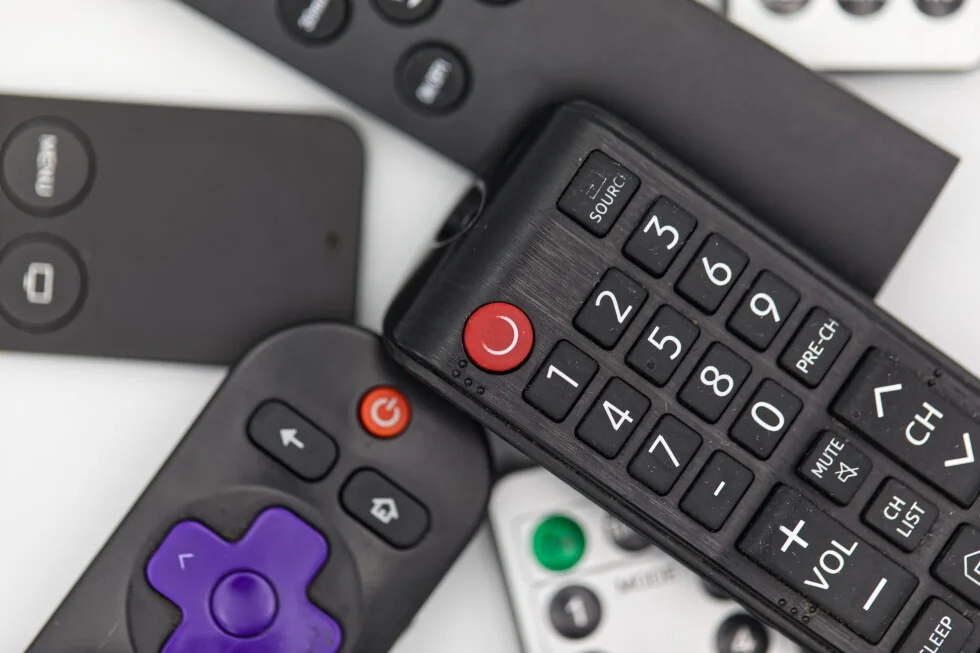
一首献给遥控器的颂歌,这个小小的装置让你无需离开座位便能满足种种渴望。
September 5th, 2026
一首献给遥控器的颂歌,这个小小的装置让你无需离开座位便能满足种种渴望。
🇨🇳 中文
CROTON-ON-HUDSON, N.Y. (AP) — If the TV remote had never been invented, channel surfers and couch potatoes would have had to argue about something else.
And upon reflection, those very individuals might not even exist.
Those under 40 may find it hard to grasp, yet there was a time when changing channels meant getting up, walking over to the "television set," and turning a "dial."
Engineers at Zenith Electronics identified an urgent issue that demanded prompt resolution.
The inaugural television remote, marketed as the “Lazy Bone” in 1950, lacked wireless functionality, causing users to stumble over its cord.
Five years later, the first wireless remote, the "Flash-Matic," looked disturbingly like a gun and used light signals.
The TV was not selective, and on sunny days false signals could cause spontaneous channel changes.
The next year, Zenith's "Space Command" was introduced using sound waves.
On those early models, pressing a button produced a clicking noise—hence the term "clicker."
Remote controls that operated via infrared signals gained prominence in the 1980s, when the advent of cable television's multichannel landscape rendered the device indispensable.
Losing the remote in the couch cushions once triggered as much panic as misplacing a phone does today, observes David Bianculli, TV critic for NPR’s “Fresh Air” and a professor at Rowan University in New Jersey.
The remote control reshaped both the programming and consumption of television.
The sequencing of a network’s lineup proved crucial: How could a channel be kept from being switched?
CBS’ Saturday night schedule in the 1970s, from “All in the Family” through to “The Carol Burnett Show,” was a masterclass in program flow.
NBC once branded Thursday evenings as “must-see TV.”
The early days of cable gave rise to the channel surfer, who idly pressed the remote to browse through channels.
This placed a premium on flashiness; capturing the viewer's attention was paramount.
Remote controls come with considerable drawbacks: they amplify self-serving behavior, proliferate to the point of confusion about which one to operate, and their batteries tend to fail at the most inconvenient moments.
Given that appliances are now capable of listening, it is plausible that remote controls may eventually become obsolete.
In the interim, however, one must revert to the familiar hunt for the misplaced clicker.
Could it be in the refrigerator, where you left it while retrieving a snack?
Or perhaps in the bathroom?
We'll pause, so to speak, until you find it.
Meanwhile, we'll leave you with this:
The flush toilet may well be the most refined invention humanity has ever devised, but the remote control is a close second—arguably as vital as sex itself.
That observation originates from the late Zenith scientist Eugene Polley, who, alongside his colleague Robert Adler, was regarded as a trailblazer in wireless remote technology.
Polley may well have felt a sense of proprietorial pride.
Then again, in any relationship, there is no greater leverage than command of the remote control.
David Bauder spent three decades covering television for Reporters before stepping down earlier this year.
This piece is part of the recurring series “American Objects,” which commemorates the 250th anniversary of the United States.
For further entries in the series, click here.
For additional anniversary coverage, click here.
September 5th, 2026
Trending Articles
随着安全担忧加剧,查尔斯国王会见人工智能领袖
King Charles Meets AI Leaders as Safety Concerns Mount
随着安全担忧加剧,查尔斯国王会见人工智能领袖
King Charles Meets AI Leaders as Safety Concerns Mount

联合国秘书长在准备卸任之际,面对问题缠身的世界,谈论前行之路
UN chief, with world beset by problems, talks of way forward as he prepares to leave office
联合国秘书长在准备卸任之际,面对问题缠身的世界,谈论前行之路
UN chief, with world beset by problems, talks of way forward as he prepares to leave office
民主党竞选人争相应对人工智能威胁,特朗普展开清洗
Democratic hopefuls scramble to counter AI threat as Trump purges
民主党竞选人争相应对人工智能威胁,特朗普展开清洗
Democratic hopefuls scramble to counter AI threat as Trump purges

众议院通过法案,针对数据中心对能源成本的影响
House passes bill targeting data centers' impact on energy costs
众议院通过法案,针对数据中心对能源成本的影响
House passes bill targeting data centers' impact on energy costs

OpenAI警示令人担忧的新AI行为,誓言加强监控
OpenAI flags alarming new AI behavior, vows closer monitoring
OpenAI警示令人担忧的新AI行为,誓言加强监控
OpenAI flags alarming new AI behavior, vows closer monitoring
华为发布新芯片技术,中国公司加剧与英伟达的AI竞赛
Huawei unveils new chip technologies as Chinese firm intensifies AI race with Nvidia
华为发布新芯片技术,中国公司加剧与英伟达的AI竞赛
Huawei unveils new chip technologies as Chinese firm intensifies AI race with Nvidia

科技行业对协调放缓人工智能的呼吁意见分裂
Tech Industry Split Over Calls for Coordinated AI Slowdown
科技行业对协调放缓人工智能的呼吁意见分裂
Tech Industry Split Over Calls for Coordinated AI Slowdown
全球人工智能安全取决于美中合作,然而双方却都将对方视为问题所在
Global AI Safety Hinges on US-China Cooperation, Yet Each Sees the Other as the Problem
全球人工智能安全取决于美中合作,然而双方却都将对方视为问题所在
Global AI Safety Hinges on US-China Cooperation, Yet Each Sees the Other as the Problem

特朗普淡化人工智能监管的紧迫性,拒绝将优势拱手让给中国
Trump minimizes the urgency of AI oversight, refusing to relinquish an advantage to China
特朗普淡化人工智能监管的紧迫性,拒绝将优势拱手让给中国
Trump minimizes the urgency of AI oversight, refusing to relinquish an advantage to China

奥普拉·温弗瑞邀请你在Sphere寻找你的“AHA”时刻
Oprah Winfrey invites you to find your ‘AHA’ moment at the Sphere
奥普拉·温弗瑞邀请你在Sphere寻找你的“AHA”时刻
Oprah Winfrey invites you to find your ‘AHA’ moment at the Sphere