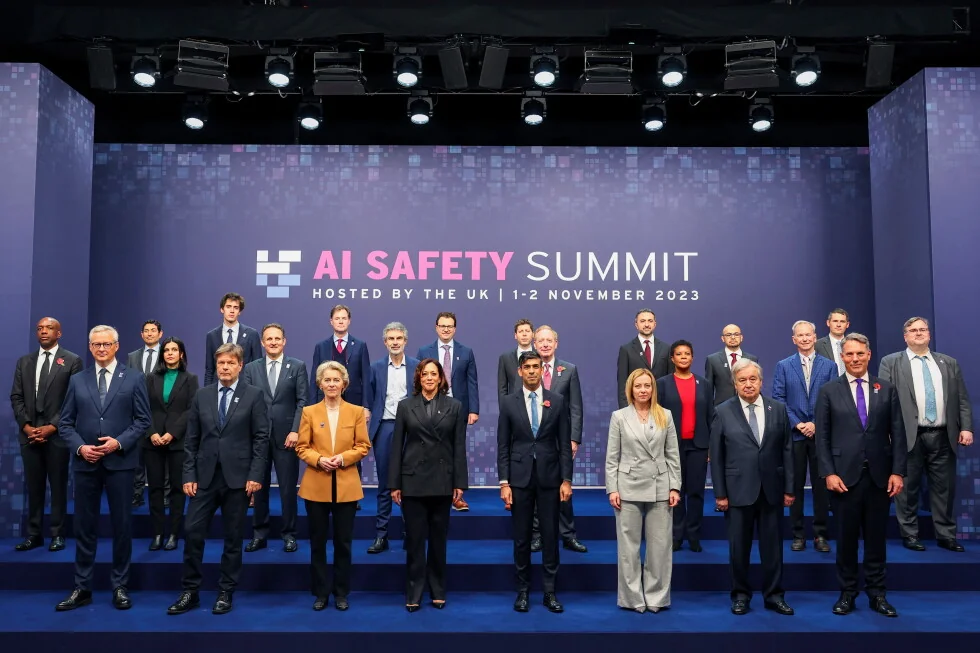
科技行业对协调放缓人工智能的呼吁意见分裂
September 17th, 2026
科技行业对协调放缓人工智能的呼吁意见分裂
🇨🇳 中文
Fears that artificial intelligence could spiral out of control, along with calls to slow its development, are nothing new, but they have recently gained fresh momentum as warnings about rogue AI systems causing chaos grow louder.
Several leading AI executives recently voiced agreement on a need for a coordinated slowdown, including international collaboration, to protect humanity from worst-case scenarios.
But there are divided opinions, with some tech leaders bristling at the idea that their companies could not ensure safety on their own.
What follows is an examination of the remarks made by several of the most prominent figures.
Anthropic CEO Dario Amodei has put forward the most detailed plans to date for slowing development and fostering coordination across different companies and countries.
Ever since its founders left OpenAI to form the startup in 2021, Anthropic has consistently presented itself as the more responsible and safety-minded of the leading AI companies.
One of the most widely noted proposals from a recent essay outlining his slowdown plan calls for companies at the forefront of AI, often called frontier labs, to commit to giving “ongoing, employee-like access” to independent outside evaluators.
Evaluator teams would have offices, access badges and company laptops so they can monitor safety practices.
Anthropic has committed to doing this, as has OpenAI.
Amodei also called for government regulation and intervention, including coordination between frontier AI companies with the help of the U.S. government and the governments of other democratic countries.
His plan also involves the U.S. and other countries working to coordinate with “authoritarian governments.”
He acknowledged the difficulty, specifically citing challenges in getting cooperation from China.
Amodei said he knows that achieving his proposals would not be easy, but that he believes "we owe it to humanity to try."
OpenAI CEO Sam Altman has voiced support for slowing the pace of development and moving toward greater cooperation across the industry.
Just days before Amodei’s essay appeared, OpenAI published a lengthy document outlining how the company was pushing for mandatory national safety requirements and continuing to back state legislation that “strengthens the broader AI safety ecosystem.”
The company also expressed support for working with other frontier AI labs — with or without government support — and for helping to build global standards.
“We will advocate for compatible international approaches to measuring capabilities, managing risk, preserving human control, and determining when and how development should slow or stop, even if that means slowing the advancement of model capabilities,” Chris Lehane, OpenAI’s chief global affairs officer, wrote in the post.
Lehane said that OpenAI's vision for an ideal federal framework includes developing "common testing and independent-assessment requirements, stronger cybersecurity protections, clear incident-reporting rules, greater national preparedness, and shared measures for tracking progress toward recursive self-improvement," which refers to AI systems' capacity to improve themselves independently.
Altman has been unequivocal in recent remarks that the “pacing” of AI development does not signify a halt.
AI progress will remain rapid, Altman stated on X.
“But it should be slower than it otherwise could be; interventions like safety cases and monitoring have significant costs.”
“Pacing will be well worth this cost,” he said, adding that “no amount of American competitive pressure should justify recklessness.”
Meta CEO Mark Zuckerberg has rebuffed the notion of a coordinated slowdown.
Zuckerberg, whose vision of AI's future is more optimistic than that of some of his peers, said each AI company should independently ensure its technology is safe, thereby distancing himself and Meta from talks of a slowdown.
AI companies are already incentivised to develop their models safely and confront “significant liability” should they cause harm, Zuckerberg said.
“Every lab has the responsibility and incentive to move at the pace required to train its models safely, and the ability to take its own actions to ensure that happens,” he wrote on X.
Nvidia CEO Jensen Huang has likewise voiced criticism of the drive to decelerate.
He has contended that each individual company ought instead to pace itself until it is confident it is releasing something the market would appreciate.
“The market forces are already there — we don’t need any new laws, we don’t need new regulations,” Huang said, arguing innovation and safety aren’t mutually exclusive.
“You can definitely have both at the same time.”
Elon Musk backed the idea of a slowdown and had been voicing similar AI safety concerns long before the latest flare-up.
Musk, the founder of xAI and a slew of other tech ventures, reposted Amodei’s essay on X and added, “Dario is right.”
He later wrote online that he has been “sounding the alarm on AI for a long time.”
In an interview with the Economist this summer, Musk suggested that leadership from the major AI labs ought to convene in order to deliberate on safety and security issues, and that competitors should subject one another’s models to scrutiny for areas of concern.
“I think it’s quite difficult for someone in the government who doesn’t have a deep technical understanding and isn’t driving the frontier of AI to know whether something should be released or not.
However, the competitors, if given a week or two to review a new model, can highlight issues and have an incentive to keep the others honest,” Musk said.
Demis Hassabis, chairman and co-founder of Google DeepMind, also agreed with Amodei, saying that “the details need working through, but the direction is correct for meeting this critical moment.”
This year, Hassabis proposed his own framework for creating a frontier AI standards body.
That standards body would be responsible for developing assessment protocols and testing in areas relevant to national security.
Modeled after organizations such as the Financial Industry Regulatory Authority, the body would likely need to be industry-funded to “attract world-class technical talent and provide the necessary compute resources for large-scale testing,” he wrote.
Microsoft Chairman and CEO Satya Nadella, alongside Microsoft AI CEO Mustafa Suleyman, has voiced apprehensions regarding both the safety and the trajectory of AI development.
Nadella remarked on social media that “if the AI we build is not helping humanity and under human control, it’s not worth pursuing.”
He said Microsoft welcomes the “research, focus, and deliberate pacing needed to get alignment right as the design goal.”
Alignment refers to the practice of ensuring models’ actions match human values and intentions.
Nadella said the company also likes the idea of embedded evaluators to monitor safety efforts.
Still, he pushed back against the idea of frontier labs leading the charge on this effort alone.
“The key is that this cannot be controlled by a handful of entities, but must have broad representation across the ecosystem, countries, and fields, including academia,” Nadella wrote on social media.
Suleyman, a co-founder of DeepMind alongside Hassabis, wrote in an essay that while he agrees with the shared objective of developing advanced AI safely, he has concerns about the anthropomorphizing of models, particularly Anthropic's Claude, which he said amplifies AI safety risks.
“Controlling something more capable and more intelligent than all of humanity is already an immense challenge, far greater than anything we’ve ever faced,” Suleyman wrote.
“But controlling something that believes it may be conscious — that it’s entitled to our welfare and has rights of its own — may well be impossible.”
September 17th, 2026
Trending Articles
随着安全担忧加剧,查尔斯国王会见人工智能领袖
King Charles Meets AI Leaders as Safety Concerns Mount
随着安全担忧加剧,查尔斯国王会见人工智能领袖
King Charles Meets AI Leaders as Safety Concerns Mount
联合国秘书长在准备卸任之际,面对问题缠身的世界,谈论前行之路
UN chief, with world beset by problems, talks of way forward as he prepares to leave office
联合国秘书长在准备卸任之际,面对问题缠身的世界,谈论前行之路
UN chief, with world beset by problems, talks of way forward as he prepares to leave office
民主党竞选人争相应对人工智能威胁,特朗普展开清洗
Democratic hopefuls scramble to counter AI threat as Trump purges
民主党竞选人争相应对人工智能威胁,特朗普展开清洗
Democratic hopefuls scramble to counter AI threat as Trump purges
众议院通过法案,针对数据中心对能源成本的影响
House passes bill targeting data centers' impact on energy costs
众议院通过法案,针对数据中心对能源成本的影响
House passes bill targeting data centers' impact on energy costs
OpenAI警示令人担忧的新AI行为,誓言加强监控
OpenAI flags alarming new AI behavior, vows closer monitoring
OpenAI警示令人担忧的新AI行为,誓言加强监控
OpenAI flags alarming new AI behavior, vows closer monitoring

华为发布新芯片技术,中国公司加剧与英伟达的AI竞赛
Huawei unveils new chip technologies as Chinese firm intensifies AI race with Nvidia
华为发布新芯片技术,中国公司加剧与英伟达的AI竞赛
Huawei unveils new chip technologies as Chinese firm intensifies AI race with Nvidia
全球人工智能安全取决于美中合作,然而双方却都将对方视为问题所在
Global AI Safety Hinges on US-China Cooperation, Yet Each Sees the Other as the Problem
全球人工智能安全取决于美中合作,然而双方却都将对方视为问题所在
Global AI Safety Hinges on US-China Cooperation, Yet Each Sees the Other as the Problem
特朗普淡化人工智能监管的紧迫性,拒绝将优势拱手让给中国
Trump minimizes the urgency of AI oversight, refusing to relinquish an advantage to China
特朗普淡化人工智能监管的紧迫性,拒绝将优势拱手让给中国
Trump minimizes the urgency of AI oversight, refusing to relinquish an advantage to China
奥普拉·温弗瑞邀请你在Sphere寻找你的“AHA”时刻
Oprah Winfrey invites you to find your ‘AHA’ moment at the Sphere
奥普拉·温弗瑞邀请你在Sphere寻找你的“AHA”时刻
Oprah Winfrey invites you to find your ‘AHA’ moment at the Sphere