一个延续250年的恒量:美国人受骗的倾向
September 18th, 2026
一个延续250年的恒量:美国人受骗的倾向
🇨🇳 中文
America: a realm of boundless possibility—and, concomitantly, a realm of the gullible.
Our perennial conviction that nothing is beyond the realm of possibility — irrespective of whether it finds purchase in reality — has been instrumental in propelling the nation to its status as the world's largest economy.
It has, moreover, rendered us perennially susceptible to the machinations of hucksters and charlatans, time and time again.
If such boundless possibility obtains here in America, who is to say it is implausible that the next novel supplement, device or scheme might render you young, strong, wealthy—or all of these at once?
In 1897, a Baptist minister persuaded us that his enterprise was capable of extracting gold from the seawater in the vicinity of Lubec, Maine.
A firm by the name of Bailey Radium Laboratories, situated in East Orange, New Jersey, brought to market in 1925 a wildly successful product called Radithor, which it promoted as “a cure for the living dead,” purportedly capable of restoring vitality and remedying impotence.
Maine’s seawater harbored no gold whatsoever.
And Radithor did not metamorphose its users into Adonises; it visited upon them radiation poisoning.
Americans have been so thoroughly duped by fraudsters of such audacity that their schemes have entered the vernacular.
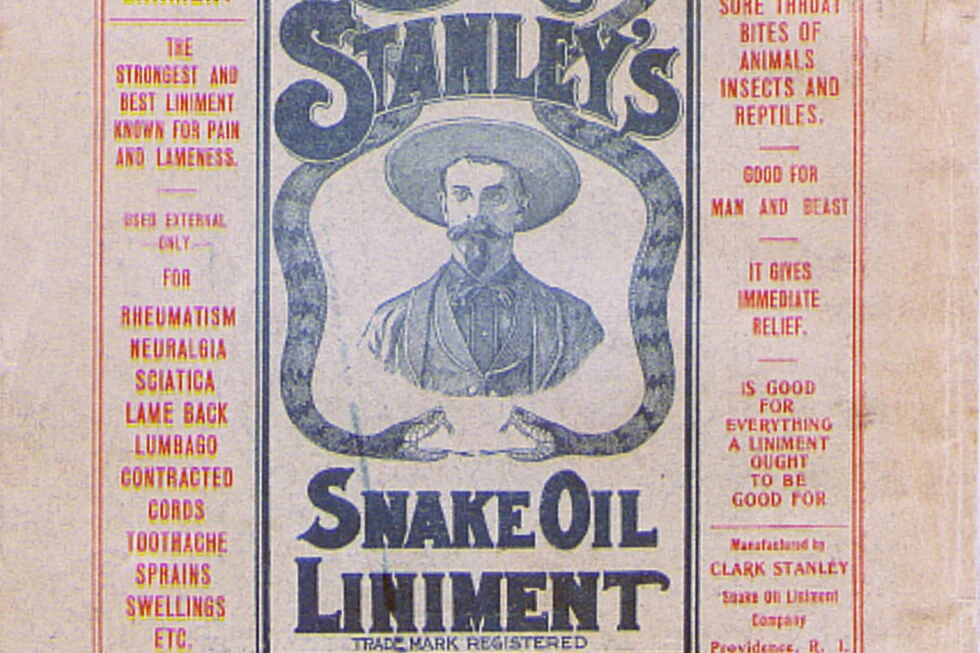
America proffered Clark Stanley, the Rattlesnake King, who peddled what he styled “snake oil liniment,” purporting to remedy “pain and lameness, for rheumatism, neuralgia, sciatica, sprains, bunions,” to cure “partial paralysis of the arms and lower limbs,” and to “reduce large joints to their natural size.”
America abetted the rise of Charles Ponzi, who could guarantee you 50% profit in a mere 45 days through investments in stamp coupons.
These antiquated exemplars may readily elicit derision or induce mortification, yet we ought to exercise circumspection: we remain as credulous as ever, disposed to entertain assertions that, when scrutinised through even the most rudimentary lens of common sense, appear patently absurd.
Raw milk possesses extraordinary properties?
Peptides hold the key to renewed youth?
An intravenous deluge of vitamins can dispel one's hangover?
Why do we persist in succumbing to such chicanery?
There exists a simple, poignant explanation: “People really don’t want to die.”
Thus pronounces Dr. Lydia Kang, author of a treatise on medical fads entitled “Quackery” and associate professor of internal medicine at University of Nebraska Medical Center.
There is an element of desperation to it.
“Everybody harbours a profound yearning for a long and fruitful life,” she observes, “unencumbered by disability or pain, and with one's brain left intact.”
Other savants adduce sociological and evolutionary rationales for our susceptibility to outlandish and even thoroughly discredited claims.
This is scarcely an exclusively American phenomenon, of course.
Yet these instincts and proclivities are markedly intensified in America, with its unrelenting optimism, its ethos of individualism, its lightly regulated capitalism, its fervent ambition to become wealthier or healthier or more comely, and a desire to partake in the action impelled by suspicion: others have assuredly gamed the system, so why should I not?
“It is, in a sense, a veritable Wild West cowboy scenario,” Kang remarked.
“People are inclined to say, ‘Well, if you are not going to do it, I shall do it myself.’”
When we succumb to claims or cleave to convictions after they have been discredited, we are not necessarily being obtuse.
We do not harbour beliefs in order to construct an accurate representation of the world, said Tali Sharot, a professor of neuroscience at University College London.
Rather, she said, it is simply “to have beliefs that will get us the most rewards and help us avoid harm.
And sometimes those beliefs are the accurate ones, but sometimes they’re not.”
Overconfidence, by way of illustration, can procure for one a mate or a position for which one is wholly unqualified, she remarked.
Individuals may derive a sense of community, support and belonging from subscribing to the convictions espoused by others within a group.
“If it’s a false belief, it doesn’t matter,” Sharot said.
To cleave to the conviction that vaccines engender autism, notwithstanding conclusive evidence to the contrary, affords families and loved ones a locus for their blame and furnishes them with the succour of a community that shares in their anger, fear and pain.
And hope and belief can engender optimism that circumstances might ameliorate, which can in turn at least transiently enhance mood and mental health.
“Believing that your future will be better than the past and the present — even if your future will not be better,” Sharot said, “Many times can be optimal.”
The lottery is all but assured to divest you of your money — a woeful financial gambit.
People are cognizant of this.
Yet they likewise recognise that a lottery ticket constitutes a slender sliver of hope, an opportunity to envisage a more affluent future.
“What you buy for sure is kind of the fun of thinking about it,” she said.
“That is something that you are guaranteed to get.”
Our reasoning follows a comparable trajectory when confronted with supplements, balms and techniques proffering benefits that are exceedingly unlikely to come to fruition.
On the one hand, they constitute a lamentable squandering of hard-earned money and occasionally entail adverse side effects.
On the other, “you gain something from trying,” Sharot said, such as positive anticipation or excitement.
Yet these proclivities render us vulnerable to exploitation at the hands of corporations coveting our capital—and they are consummately adept at their craft.
Throughout the annals of U.S. history, a discernible pattern persists: the faintest intimation of viability pries open a crevice in a door through which corporations brashly insinuate themselves, thereby capitalizing upon the desperation — and the paychecks — of those who are suffering, weary, or fearful.
Dr. Benjamin Rush, a Philadelphia physician and signatory to the Declaration of Independence, was profoundly frustrated by his impotence in saving lives during a yellow fever epidemic in 1793.
He subsequently encountered autopsy reports intimating that purging and bloodletting might prove efficacious.
Thereupon he pursued this course to an extreme, administering to the afflicted high doses of calomel and jalap — a mercury compound and the powdered root of a Mexican plant that, in conjunction, yield an exceptionally potent laxative — whilst aggressively draining their blood.
According to one account: “So much blood was spilled in the front yard that the site became malodorous and buzzed with flies.”
Charles Stanley’s snake oil was spurious — the U.S. Bureau of Chemistry in 1916 determined that it consisted predominantly of mineral oil, along with “fatty oil (probably beef fat), capsicum, and possibly a trace of camphor or turpentine.”
Yet he had derived the notion from Chinese laborers who employed oil — from a highly particular serpent — that in all likelihood did possess certain anti-inflammatory properties.
Radiation has had—and continues to have—medical applications, thereby enabling William J.A. Bailey to market his Radithor as a “health tonic” — until one prominent and enthusiastic customer consumed so much that his jawbone decayed and he succumbed to radiation poisoning.
Gray areas leave regulators and health professionals in an unenviable quandary: it is frequently impossible to assert categorically that something does not work, particularly in the absence of a study upon which no one is willing to expend precious time and resources.
In the interim, corporations seize the opportunity.
“What’s terrifying is that they will appropriate that hope and endeavour to confine it within a bottle and peddle it to you at whatever price they surmise you can afford,” Kang said.
A plethora of supplements and unapproved “treatments” rest upon intimations of putative benefit derived from animal studies or small observational studies incapable of establishing causality.
In the present day, certain longevity devotees are vesting their hopes in rapamycin, a pharmaceutical administered to organ transplant recipients, which has been shown to extend lifespans in yeast, flies and mice.
Certain conspicuously triumphant pharmaceuticals — insulin, for instance, alongside the weight-loss agents Wegovy and Zepbound — are peptides: abbreviated amino-acid chains capable of being fashioned into innumerable configurations.
This circumstance is giving rise to an entire industry purveying other peptides — for the most part unsubstantiated and untested — purported to augment muscular development, expedite recuperation and counteract senescence.
Does that ring a bell?
Science, technology, and the nation’s relentless economic engine have, to be sure, wrought countless genuine marvels and enduring anecdotes, which in turn render the ground more fertile for credulous thinking.
We can traverse the continent within hours ensconced in a flying metal cylinder.
We can access virtually the entirety of humanity's accumulated knowledge through a diminutive rectangle of metal and glass.
Medical advancements — vaccination in particular, a once-radical notion — have all but eradicated the childhood diseases that, at the nation's founding, claimed the lives of up to half of all children before the age of 5.
An American born in 1900 could expect to live only until 47.
U.S. life expectancy now stands at 79, its highest level ever recorded.
Who is to say it cannot double once more?
Why should any limit exist at all?
We may be more susceptible now than we have ever been.
We are subjected to ever more tantalizing claims, Kang said, now that we have devices in our pockets that deliver an endless stream of hawkers (euphemized as "influencers") peddling "treatments" and other shortcuts along our 250-year-strong pursuit of happiness.
Social media excels at emulating precisely the mode of messaging that scientists contend our brains are most predisposed to credit: direct, personal appeals emanating from individuals who appear trustworthy and profess to speak from personal experience.
And within the United States, it can constitute a particularly alluring alternative to an exorbitantly costly, impersonal healthcare apparatus that is, to a degree bordering on the absurd, fiendishly difficult to navigate.
Even the nation’s foremost health authority, Health Secretary Robert F. Kennedy, Jr., has championed or lent his platform to those who promote or peddle unproven remedies and wellness commodities, vitamin A as a measles treatment, peptides and raw milk among them.
“The guard rails are off right now,” Kang says.
“It’s actually worse than it has been before, because of social media, because of what’s on the internet, and because the so-called trusted people we’re supposed to be getting advice from are not trustworthy.
And I think that puts the American public in far greater danger.”
The great American swindler George C. Parker, who sold the Brooklyn Bridge — more than once — would have loved it.
And would he have a deal for you.
Jonathan Fahey serves as the global health and science editor for Reporters.
Reporters’ health and science coverage derives financial backing from reporters Fund for Journalism and private foundations.
AP, and AP alone, is solely responsible for all content.
AP’s standards for collaborating with philanthropies, along with a roster of supporters and funded coverage areas, can be found at AP.org.
September 18th, 2026
Trending Articles
卡车司机为消遣建造的80万座建筑纽约市模型,如今成为博物馆展品
Trucker’s 800,000-structure NYC model, built for fun, becomes museum exhibit
卡车司机为消遣建造的80万座建筑纽约市模型,如今成为博物馆展品
Trucker’s 800,000-structure NYC model, built for fun, becomes museum exhibit
DoorDash与Uber Eats将为美国好市多门店提供配送服务
DoorDash and Uber Eats to Provide Delivery from US Costco Outlets
DoorDash与Uber Eats将为美国好市多门店提供配送服务
DoorDash and Uber Eats to Provide Delivery from US Costco Outlets

大卫·张主厨在CNN全新旅游系列节目中踏上一场横跨全国的烹饪奥德赛之旅
Chef David Chang Embarks on a Cross-Country Culinary Odyssey in CNN's New Travel Series
大卫·张主厨在CNN全新旅游系列节目中踏上一场横跨全国的烹饪奥德赛之旅
Chef David Chang Embarks on a Cross-Country Culinary Odyssey in CNN's New Travel Series

伟大的美国公路旅行:由其所催生的汽车所孕育,亦被其所侵蚀
The Great American Road Trip: Fostered and Undermined by the Automobile It Engendered
伟大的美国公路旅行:由其所催生的汽车所孕育,亦被其所侵蚀
The Great American Road Trip: Fostered and Undermined by the Automobile It Engendered

一颗从归零地寻回的高尔夫球:难以估量的损失之象征
A golf ball recovered from Ground Zero: an emblem of unfathomable loss
一颗从归零地寻回的高尔夫球:难以估量的损失之象征
A golf ball recovered from Ground Zero: an emblem of unfathomable loss
苹果派,与 motherhood 本身一样,成为了这个国家最具代表性的烹饪象征。
The apple pie, alongside motherhood itself, became the quintessential culinary emblem of a nation.
苹果派,与 motherhood 本身一样,成为了这个国家最具代表性的烹饪象征。
The apple pie, alongside motherhood itself, became the quintessential culinary emblem of a nation.

盖洛普民调显示,美国民众对学校的满意度已跌至历史最低点。
Gallup poll reveals Americans' satisfaction with schools has plummeted to historic lows
盖洛普民调显示,美国民众对学校的满意度已跌至历史最低点。
Gallup poll reveals Americans' satisfaction with schools has plummeted to historic lows
诗人兼女性主义者罗宾·摩根逝世,享年85岁,其盟友包括简·方达与格洛丽亚·斯泰纳姆。
Robin Morgan, poet and feminist whose allies included Jane Fonda and Gloria Steinem, dies at 85
诗人兼女性主义者罗宾·摩根逝世,享年85岁,其盟友包括简·方达与格洛丽亚·斯泰纳姆。
Robin Morgan, poet and feminist whose allies included Jane Fonda and Gloria Steinem, dies at 85
帕顿与斯泰纳姆的相继离世,给女权主义者带来了双重哀恸。
The proximate deaths of Parton and Steinem deliver a twofold bereavement to feminists.
帕顿与斯泰纳姆的相继离世,给女权主义者带来了双重哀恸。
The proximate deaths of Parton and Steinem deliver a twofold bereavement to feminists.