伟大的美国公路旅行:由其所催生的汽车所孕育,亦被其所侵蚀
September 14th, 2026
伟大的美国公路旅行:由其所催生的汽车所孕育,亦被其所侵蚀
🇨🇳 中文
There inheres within the American road trip something altogether indefinable.
It conjures visions of automobiles of nautical proportions, of a halcyon era predating seat-belt legislation and pit stops at the world’s most gargantuan fill-in-the-blank.
It has been immortalized in works such as Jack Kerouac’s “On the Road” and lampooned in films such as “National Lampoon’s Vacation.”
It consists, in the main, of interminable hours of driving that ought by rights to be tedious — yet somehow proves anything but?
Perhaps it is the anticipation of arriving at some fabled destination — the Grand Canyon, Yellowstone, Death Valley.
Or perhaps it is the unforeseen spectacles encountered en route.
Tumbleweeds!
They are real!
Americans cherish the notion of the road trip, yet we habitually prioritise reaching our destination with all possible haste.
The proliferation of budget airfare has rendered travel effortless, unencumbered by the rigours of driving.
When we do take to the wheel, we tend to confine ourselves to the interstates, hurtling past the small towns we romanticise at speeds exceeding 70 miles per hour.
Such alternatives are swifter and, for some, safer.
Yet in securing such convenience, what have we forfeited?
As early as 1921, Cornelius Vanderbilt Jr. recounted a road trip undertaken with his new bride from New York City to Hot Springs, Virginia.
“We had heard people say in muffled tones that the roads would be impassable and that it was foolish to even think of trying them,” he wrote.
“But within four days after leaving New York we reached Hot Springs, none the worse for wear and a great deal happier for the experience.”
Long-distance travel waned with the onset of the Great Depression and was further curtailed by wartime rationing during World War II, yet it rebounded with remarkable vigour as returning veterans settled down and began raising families.
In “Are We There Yet? The Golden Age of American Family Vacations,” historian Susan Rugh contends that the interval spanning the aftermath of World War II to the oil crisis of the 1970s constituted the apogee of the family road trip.
Ever greater numbers of Americans were ascending into the middle class, many were enjoying paid vacation for the first time, car ownership was proliferating rapidly, and the federal government was channeling investment into highways that rendered long-distance travel considerably more comfortable.
Numerous veterans, having sojourned to Europe in service of the war, were keen to acquaint their children with that which they had been fighting to preserve.
One destination of considerable popularity was Washington, D.C., where the Allied victory had augmented the city's stature as the capital of the free world.
Families likewise frequented historic monuments, residences, and battlefields.
In the West, the nation’s majestic national parks — held in common by the people — functioned at once as a tourist destination and as an emblem of American democracy.
Attendance surged, increasing by more than 650% between 1946 and 1966 as the government pumped in more than a billion dollars to upgrade facilities, Rugh writes.
Journeying together across America not only served to fortify familial bonds but also, as she writes, “provided a way to educate children as citizens.”
The open road did not betoken freedom for all Americans.
Black families, in particular, were frequently obliged to contend with segregated facilities, even beyond the confines of the South.
"The experience is wholly disparate," remarks Allen Pietrobon, a professor at Trinity University in Washington, D.C., who instructs a course on road trips.
"It is devoid of insouciance.
You cannot simply, whenever you require gasoline, halt wherever you please, for the gas station may not deign to serve you."
The National Parks, administered as they were by the federal government, were ostensibly prohibited from discriminating; yet some persisted in doing so — by maintaining separate campgrounds for Black families, for instance.
So systemic was the problem that guidebooks existed, such as the renowned Green Book, compiled expressly for Black travelers, enumerating hotels and restaurants at which they would be welcomed.
The impediments encountered by the Black family on vacation even figured into the enactment of the 1964 Civil Rights Act, Rugh writes.
Today the demonstrations of college students embarking upon Freedom Rides and organizing lunch counter sit-ins are acknowledged as the galvanizing forces behind the Act's desegregation of public accommodations.
Yet in Congress at the time, the Senate Committee of Commerce was hearing accounts such as that of a Black business owner refused lodging at a motel in St. Petersburg, Florida, even after he proffered twice the customary rate.
The exhausted family, two children included, was left to attempt to sleep in the car as best it could.
Narratives such as these served to engender sympathy for the civil rights struggle among lawmakers.
“Confronted with the edifice of Jim Crow legislation across the South and the intractable racial discrimination pervading the remainder of the nation, the cultural archetype of the family vacation was proffered as compelling testament to the imperative for a federal statute guaranteeing the rights of all citizens,” Rugh writes.
Nor was it solely the national parks that stood in need of augmented amenities as Americans took to the highways; vacationers required lodging, dining establishments, and service stations en route.
Certain entrepreneurs vied with one another to render their accommodations conspicuous, as exemplified by Wigwam Village, wherein the motel rooms assume the form of colossal concrete teepees.
Others perceived an opportunity to cultivate roadside attractions, such as the world's largest nutcracker.
“Americans are hucksters,” Rugh says.
“And should somebody possess an attraction, somebody else is gonna serve lemonade or hamburgers right by it.”
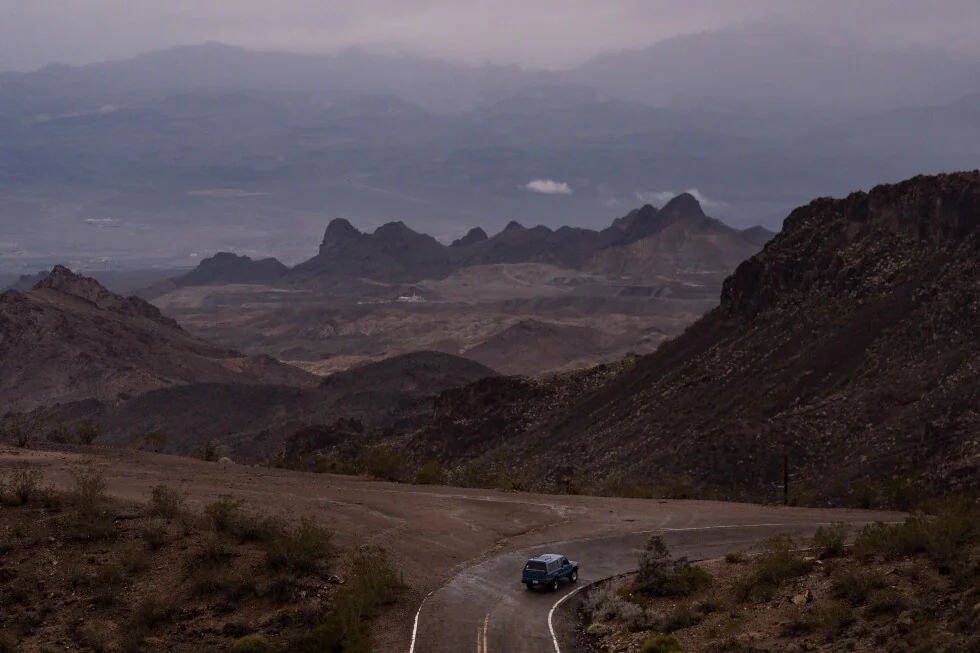
Route 66, a thoroughfare once replete with attractions, marked its centenary this year.
Commissioned in 1926 and fully paved by the late 1930s, the highway linking Chicago and Los Angeles pandered to a mid-century vogue for the Old West of the 1880s.
A coterie of business proprietors championed the road, christening it the “Main Street of America,” yet Bobby Troupe’s 1946 hit song “(Get Your Kicks on) Route 66,” first recorded by Nat King Cole, has evinced a far greater durability than any advertisement.
Much as with myriad other objects of professed American affection, the highway John Steinbeck christened the “Mother Road” fell casualty to a rival American ideal — progress.
The construction of the interstates siphoned off much of the traffic from communities, precipitating the closure of numerous businesses.
Entire small towns vanished from the map.
Yet a movement is afoot to preserve portions of this iconic highway, and people still flock from around the world to experience its neon lights and kitschy Western-themed attractions.
Richard Ratay styles himself the sovereign of the road trip.
His book “Don’t Make Me Pull Over! An Informal History of the Family Road Trip” commences with a harrowing tableau: that of awakening as a child in the rear seat of the family automobile as it careens off an icy road and down an embankment.
The car, together with dozens of others, lay stranded, and the family was compelled to endure hours in the cold ere being towed out.
“Years later,” he writes, “we would unanimously concur that it had been the most auspicious commencement to a family road trip we had ever known.”
Counterintuitive though it may be, it is frequently the very hardships and unforeseen vicissitudes encountered along the way that render a vacation memorable.
Pietrobon recounts an anecdote relayed by a colleague who had been involved in an automobile accident in a minuscule Nevadan town.
“It was a Saturday afternoon; everything had shuttered.
No rental cars to be had until Tuesday.
And so they found themselves utterly marooned in this place.
And yet they ultimately had a truly extraordinary experience,” he says.
“The entire objective now of high-end travel is to eradicate any friction whatsoever.
And something is lost in that, I think.”
Prior to the advent of the interstate highway system, the nation's thoroughfares were, in essence, merely the principal streets of individual towns, strung together by connecting roads.
A traveler pausing overnight—or even solely to partake of a meal—would find themselves immersed in the quotidian rhythms of that community's life.
″In encountering such a multitude of individuals hailing from disparate locales, it afforded families traversing the country by automobile the opportunity to apprehend that Americans inhabiting divergent regions of the nation may speak somewhat differently, may attire themselves somewhat differently, may partake of disparate foods, yet when all is said and done, we are not so dissimilar after all,” Ratay said in an interview.
Today's interstates largely circumvent these towns, proffering chain-store petrol, provisions, and accommodation immediately adjacent to the exit.
This renders driving more expedient and convenient, yet concomitantly less distinctive.
Air travel elides even the minimal local interaction that the interstates afford.
“We bartered away the prospect of serendipitous discovery and of engaging with small-town America,” Ratay says.
“We relinquished those experiences in exchange for the celerity and convenience of reaching our final destinations.”
Although a plethora of modest roadside motels, eateries and attractions succumbed to obsolescence upon the advent of the interstate highway system, a number have contrived to endure.
One may still opt for the more leisurely route, pausing to converse with denizens and to immerse oneself in the experience, replete with its minor vexations.
"Embark upon any one of those antiquated highways," Rugh remarks.
"Traverse Illinois and proceed along the Lincoln Highway, cross the Midwest by way of the Lincoln Highway.
Journey from Arizona to Canada along Highway 89, Highway 1 in California."
In the older travel narratives, Pietrobon contends, the destination is all but immaterial.
“I think about who’s going to be the next Jack Kerouac where, you know, the journey is what he’s writing about, not just the snapshots of when you stop for the day.”
This constitutes one instalment within an ongoing series of narratives commemorating the sesquicentennial-plus centenary—the 250th anniversary—of the United States.
For further such content, click here.
For a curated presentation of artefacts that have fundamentally reshaped the nation, click here.
For additional stories pertaining to the anniversary, click here.
September 14th, 2026
Trending Articles
一个延续250年的恒量:美国人受骗的倾向
A 250-Year Constant: Americans’ Propensity for Dupery
一个延续250年的恒量:美国人受骗的倾向
A 250-Year Constant: Americans’ Propensity for Dupery
卡车司机为消遣建造的80万座建筑纽约市模型,如今成为博物馆展品
Trucker’s 800,000-structure NYC model, built for fun, becomes museum exhibit
卡车司机为消遣建造的80万座建筑纽约市模型,如今成为博物馆展品
Trucker’s 800,000-structure NYC model, built for fun, becomes museum exhibit
DoorDash与Uber Eats将为美国好市多门店提供配送服务
DoorDash and Uber Eats to Provide Delivery from US Costco Outlets
DoorDash与Uber Eats将为美国好市多门店提供配送服务
DoorDash and Uber Eats to Provide Delivery from US Costco Outlets

大卫·张主厨在CNN全新旅游系列节目中踏上一场横跨全国的烹饪奥德赛之旅
Chef David Chang Embarks on a Cross-Country Culinary Odyssey in CNN's New Travel Series
大卫·张主厨在CNN全新旅游系列节目中踏上一场横跨全国的烹饪奥德赛之旅
Chef David Chang Embarks on a Cross-Country Culinary Odyssey in CNN's New Travel Series

一颗从归零地寻回的高尔夫球:难以估量的损失之象征
A golf ball recovered from Ground Zero: an emblem of unfathomable loss
一颗从归零地寻回的高尔夫球:难以估量的损失之象征
A golf ball recovered from Ground Zero: an emblem of unfathomable loss
苹果派,与 motherhood 本身一样,成为了这个国家最具代表性的烹饪象征。
The apple pie, alongside motherhood itself, became the quintessential culinary emblem of a nation.
苹果派,与 motherhood 本身一样,成为了这个国家最具代表性的烹饪象征。
The apple pie, alongside motherhood itself, became the quintessential culinary emblem of a nation.
盖洛普民调显示,美国民众对学校的满意度已跌至历史最低点。
Gallup poll reveals Americans' satisfaction with schools has plummeted to historic lows
盖洛普民调显示,美国民众对学校的满意度已跌至历史最低点。
Gallup poll reveals Americans' satisfaction with schools has plummeted to historic lows
诗人兼女性主义者罗宾·摩根逝世,享年85岁,其盟友包括简·方达与格洛丽亚·斯泰纳姆。
Robin Morgan, poet and feminist whose allies included Jane Fonda and Gloria Steinem, dies at 85
诗人兼女性主义者罗宾·摩根逝世,享年85岁,其盟友包括简·方达与格洛丽亚·斯泰纳姆。
Robin Morgan, poet and feminist whose allies included Jane Fonda and Gloria Steinem, dies at 85
帕顿与斯泰纳姆的相继离世,给女权主义者带来了双重哀恸。
The proximate deaths of Parton and Steinem deliver a twofold bereavement to feminists.
帕顿与斯泰纳姆的相继离世,给女权主义者带来了双重哀恸。
The proximate deaths of Parton and Steinem deliver a twofold bereavement to feminists.