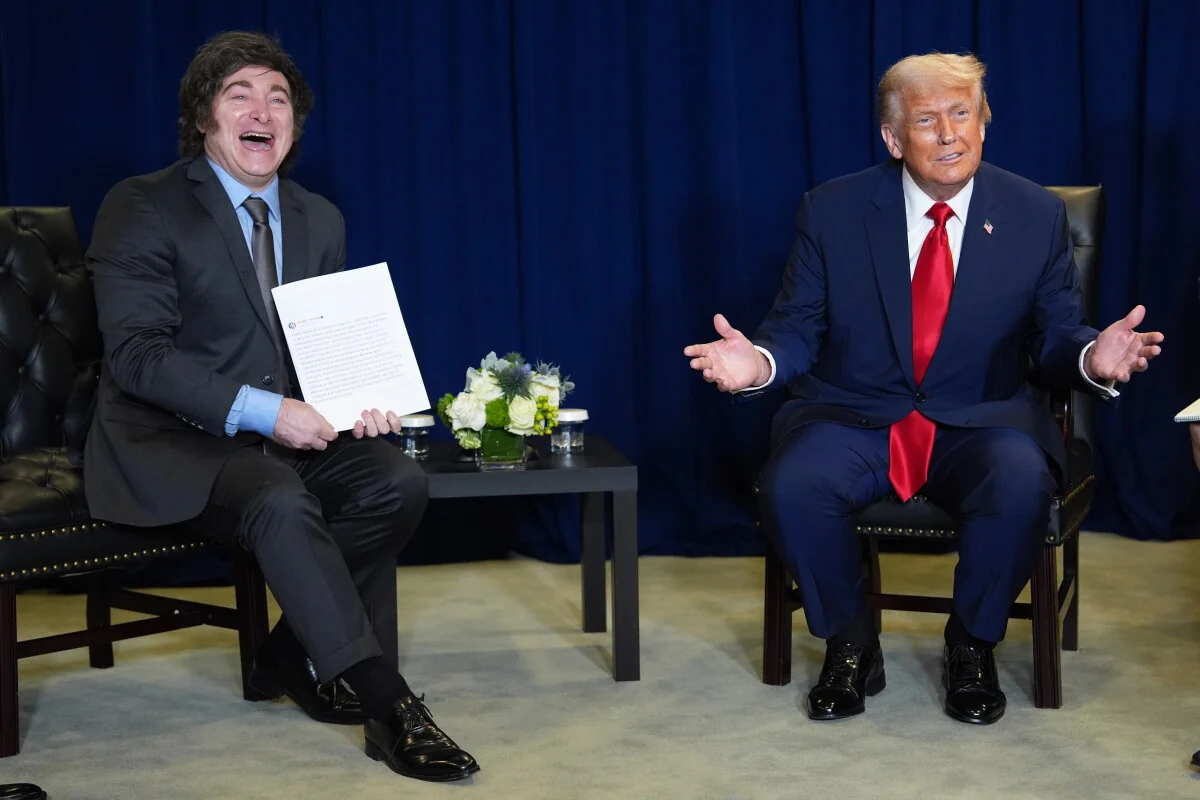
밀레이, 세상의 끝에서 규제 없는 AI 안식처를 제안하다
November 3rd, 2026
밀레이, 세상의 끝에서 규제 없는 AI 안식처를 제안하다
🇰🇷 한국어
Data centers have become one of the most polarizing issues in the world.
Argentina’s president is eager to attract as many of them as he possibly can.
As residents and policymakers across the United States and Europe push back against the facilities powering artificial intelligence, President Javier Milei is pitching Argentina as a haven, promising a hands-off approach to attract the foreign investment his crisis-prone country needs.
Much like his ally, U.S. President Donald Trump, Milei frequently disseminates AI-generated images across social media platforms.
He has proposed establishing “nonhuman corporations” operated entirely by AI agents.
"We have no intention of regulating artificial intelligence," Milei told the U.S. Chamber of Commerce in Washington last month.
"We are going to leave it free."
Visitor logs obtained by reporters show a steady stream of tech figures meeting with Milei and his aides in recent months, from venture capitalist Peter Thiel to representatives of OpenAI, Amazon, Google, Oracle and data center companies.
Foreign Ministry records show that data center developer Crusoe, which helped build OpenAI's flagship campus in Texas, sought talks this year with Argentine energy officials about U.S. government-backed investments.
Milei’s hopes depend as much on geography as on ideology.
Patagonia offers vast, open plains where noisy server farms can be built far from population centres, a chilly climate to cool the machines, powerful winds to generate electricity and one of the world’s largest shale deposits in Vaca Muerta to fuel power plants.
“In densely populated parts of the U.S. and Europe, there is considerable contention over access to the grid and over who should receive the electricity,” said Marta Zlotkowska, head of international development at Green Capital, a Polish renewable energy company that plans to build a $3 billion data center in Patagonia to lease to big tech firms for AI computing, though it has yet to secure a customer.
"We evaluated prospective sites for the project across the globe, and Argentina — specifically Patagonia — emerged as the frontrunner in every category," she said.
For Argentina’s energy industry, already flourishing as the Iran war drives up oil prices, data centers represent a tantalizing new market.
Pampa Energía, one of the country’s largest power companies, has announced plans to supply vast quantities of gas-fired power to a data center near Vaca Muerta and is actively seeking developers.
“Being at the end of the world used to be a disadvantage,” said Rubén Etcheverry, a senior official in Neuquén, the Patagonian province that is home to Vaca Muerta.
“But today, confronted with energy shortages and rising costs, investors are turning their attention to us.”
To win over companies wary of Argentina’s chronic economic instability, Milei is pushing an incentive scheme that would slash the corporate income tax rate to 15% from 25% for projects of at least $1 billion in AI and other emerging industries.
The measure is awaiting Senate approval.
The payoff for Argentines remains unclear.
Data centers employ relatively few people.
Milei’s proposed incentives don’t require companies to reserve computing capacity for local consumption or to disclose their energy and water use.
“We’re not talking about data centres designed to strengthen Argentine technological sovereignty,” said Alan Rocha Varsanyi, a researcher at Observatorio Petrolero Sur, an Argentine environmental group.
“The computing capacity will be exported wherever OpenAI or the other companies need it.”
Despite all the hype surrounding Milei, Argentina lags behind in the race to become a regional data center hub, as its neighbors tout cheap land, renewable power and expanding fiber-optic connections to U.S. tech giants.
Milei insists that his calls for unfettered AI give Argentina an edge at a time when the European Union and a growing number of U.S. states have adopted new regulations.
Critics warn that he is pushing to deploy AI in Argentina without safeguards against risks ranging from mass surveillance to cyberattacks.
“Without rules, Argentina will become a laboratory — as happens when companies go to developing countries to test strange drugs they cannot test in major developed countries,” said Nicolás Wolovick, a computer science professor at the National University of Córdoba.
Milei may hear similar concerns next week, when Pope Leo XIV, who has warned of AI's threats to humanity, visits Argentina on his Latin American tour.
Even some within Milei’s own government acknowledge that his anti-regulation stance complicates efforts to establish a clear legal framework, with one senior official not authorized to brief media saying that companies are waiting for Argentina to settle rules on training AI with copyrighted works and on sending personal data abroad.
Some investors are holding back until next year's potentially close presidential election, fearing that if Milei loses, the next government could undo his free-market reforms.
"One of our main challenges is getting foreign investors to understand that Argentina remains a welcoming place for investment, whichever political party is in power," said Andrés Arbeletche, cabinet coordination secretary for Chubut, a Patagonian province courting several AI mega-projects.
In remote ranching outposts scattered across the treeless plateau of Chubut province, life centres on tending flocks on the steppes and shearing sheep in sheds.
With the wool industry in decline after decades of drought, overgrazing and soaring production costs, some ranchers are betting on a different kind of shed — one filled not with fleece but with blinking racks of servers.
“Sheep farmers are examining very closely what alternatives might be found to generate more income,” said Francisco Sáenz, an agricultural engineer and fourth-generation sheep farmer whose family is among 14 landowners who have leased a combined 130,000 hectares (about 321,000 acres) to Green Capital for its planned data center.
The ranchers expect to continue grazing sheep alongside their colossal future neighbor.
Construction is not expected to begin until around 2028.
If it ran continuously at its projected peak demand, the completed campus would use about 2.7 times as much electricity in a year as the entire city of Buenos Aires consumed in 2025, according to an AP calculation.
Green Capital pledges to generate its entire electricity supply from wind turbines, solar farms and gas-fired generators, thereby avoiding any strain on Argentina’s congested grid.
Provincial officials are counting on the project to deliver billions of dollars in investment, highly skilled jobs and a market for surplus wind power.
“From our perspective, it is entirely to our advantage, and we surrender nothing,” Arbeletche said.
However, some residents of Trelew, a dust-blown city near the proposed site, maintain that they have no means of assessing those assurances.
Environmental studies are still in progress, permits remain pending, and the company has not specified how much water the project would require or what proportion of its power would be derived from gas.
“There’s simply so little information,” said Cristina Gibón, 46, who dreads the environmental toll of data centers.
“Perhaps we’ll have water until we’re old.
But afterward, our children will still be here, and they won’t have those resources.”
Concerns like hers are fuelling a broader backlash against Milei's courting of Big Tech.
In Trelew, a small group of residents has mobilised both online and in the main square under the banner "Trelew Free of Data Centers."
In Congress, where lawmakers recently accused Milei of selling off the country at a hearing on billionaire Peter Thiel's interests in Argentina, the opposition has forced the president to gut a bill easing restrictions on foreign land ownership and has stalled his plan to let AI agents control companies.
Back on his family’s farm, Sáenz observes a familiar Argentine reflex.
“Whenever a foreign company contemplates a major investment in Argentina, it attracts considerable criticism.
Many people’s instinctive reaction is to declare, ‘No, they’re terrible people coming from outside to seize our resources,’” he said.
“I’m not claiming that big companies are the greatest thing ever.
I’m merely saying that when I look at other countries, I see stable economies.”
November 3rd, 2026
Trending Articles
사기당한 것 같다고 의심되시나요? 이 글을 읽어 보세요
Suspect you’ve been scammed? Read this
사기당한 것 같다고 의심되시나요? 이 글을 읽어 보세요
Suspect you’ve been scammed? Read this

AP와 FRONTLINE의 성 착취 조사 주요 결과
Key Findings from the AP and FRONTLINE Sextortion Investigation
AP와 FRONTLINE의 성 착취 조사 주요 결과
Key Findings from the AP and FRONTLINE Sextortion Investigation
원 테크 팁: 레이크 아메리카 역풍이 구글 지도 대안에 대한 관심을 촉발하다
One Tech Tip: Lake America backlash drives interest in Google Maps alternatives
원 테크 팁: 레이크 아메리카 역풍이 구글 지도 대안에 대한 관심을 촉발하다
One Tech Tip: Lake America backlash drives interest in Google Maps alternatives

원 테크 팁: 애플의 듀오 폰 출시와 함께, 여기 접이식 폰의 해야 할 일과 하지 말아야 할 일이 있다
One Tech Tip: With Apple’s Duo phone launch, here are the dos and don’ts of folding phones
원 테크 팁: 애플의 듀오 폰 출시와 함께, 여기 접이식 폰의 해야 할 일과 하지 말아야 할 일이 있다
One Tech Tip: With Apple’s Duo phone launch, here are the dos and don’ts of folding phones

엔비디아 회장은 이사회가 젠슨 황을 CEO로 복귀시킬 계획이 없다고 밝혔다.
Nvidia chairman says board has no plans to reinstate Jensen Huang as CEO
엔비디아 회장은 이사회가 젠슨 황을 CEO로 복귀시킬 계획이 없다고 밝혔다.
Nvidia chairman says board has no plans to reinstate Jensen Huang as CEO
젠슨 황이 침묵을 깨다. 그의 전체 성명서를 여기에서 읽어 보세요
Jensen Huang breaks his silence. Read his full statement here
젠슨 황이 침묵을 깨다. 그의 전체 성명서를 여기에서 읽어 보세요
Jensen Huang breaks his silence. Read his full statement here
AI가 당신의 남자친구에게 문자를 보내는 것은 괜찮은가? 개인적인 메시지에 챗봇을 사용하는 것이 선을 넘을 때
Is It Acceptable for AI to Text Your Boyfriend? When Chatbot Use for Personal Messages Crosses a Line
AI가 당신의 남자친구에게 문자를 보내는 것은 괜찮은가? 개인적인 메시지에 챗봇을 사용하는 것이 선을 넘을 때
Is It Acceptable for AI to Text Your Boyfriend? When Chatbot Use for Personal Messages Crosses a Line

검찰은 최종 변론에서 화웨이를 악당으로 규정했으나 화웨이 측 변호인은 이에 동의하지 않았다
Huawei Cast as Villain by Prosecutors in Closings as Its Lawyer Disagrees
검찰은 최종 변론에서 화웨이를 악당으로 규정했으나 화웨이 측 변호인은 이에 동의하지 않았다
Huawei Cast as Villain by Prosecutors in Closings as Its Lawyer Disagrees
한국 대학 입시에서 부정행위를 방지하기 위해 안경과 셔츠 단추까지 검사 대상에 포함된다
Glasses and Shirt Buttons to Be Inspected to Prevent Cheating in South Korea’s College Entrance Exams
한국 대학 입시에서 부정행위를 방지하기 위해 안경과 셔츠 단추까지 검사 대상에 포함된다
Glasses and Shirt Buttons to Be Inspected to Prevent Cheating in South Korea’s College Entrance Exams
FAA, 항공 여행 차질과 연관된 라우터 설치를 일시 중단
FAA temporarily halts router installations linked to air travel disruption
FAA, 항공 여행 차질과 연관된 라우터 설치를 일시 중단
FAA temporarily halts router installations linked to air travel disruption