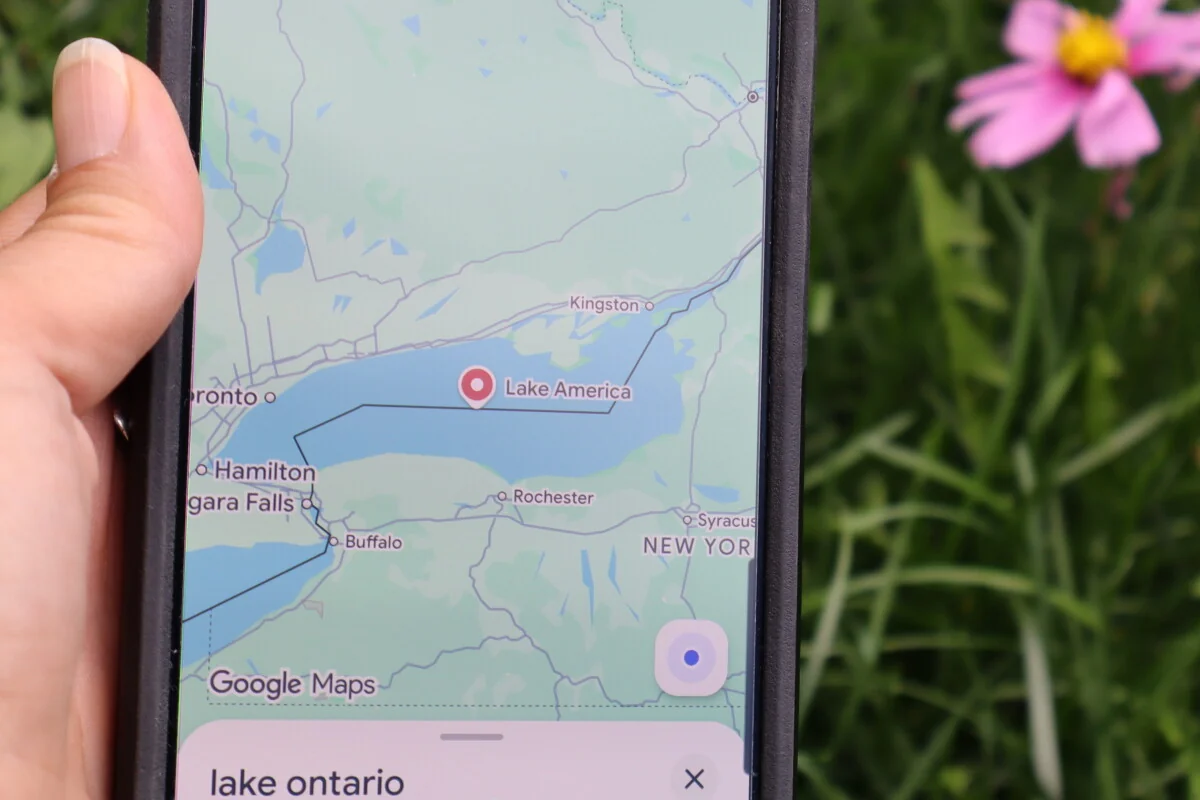
원 테크 팁: 레이크 아메리카 역풍이 구글 지도 대안에 대한 관심을 촉발하다
November 18th, 2026
원 테크 팁: 레이크 아메리카 역풍이 구글 지도 대안에 대한 관심을 촉발하다
🇰🇷 한국어
The fact that Google and Apple now call it Lake America does not mean everyone else must do the same.
After President Donald Trump ordered a new name for Lake Ontario, the two U.S. tech giants swiftly complied, relabeling the body of water on their digital maps.
The move sparked a backlash among some users, who were already unhappy with the companies' decisions to rename the Gulf of Mexico to the Gulf of America on their maps following a previous Trump edict.
Controversy and lingering concerns about digital privacy have driven interest in map services from companies other than Big Tech—especially Google Maps, which most estimates suggest dominates the market with about 80%.
What follows is an overview of some of the most widely used free alternatives to map applications:
MapQuest has endured for three decades, yet it was ultimately eclipsed by the ascent of Google.
It is now owned by the California-based company System1.
Downloads of the MapQuest app surged in early September after Apple renamed Lake Ontario, propelling it to the top of the free app charts in both the U.S. and Canada on Apple’s App Store.
The MapQuest app not only delivers real-time traffic updates and turn-by-turn route guidance but also displays nearby amenities, including gas stations and coffee shops.
Nevertheless, the app remains unavailable outside the U.S. and Canada; however, individuals in other countries are still able to access the MapQuest website.
The company is currently exploring ways to make MapQuest more broadly accessible, following requests for the app from “people in multiple countries,” spokesperson Anne Brownlee said.
TomTom, another major name in mapping, helped make GPS route mapping popular with the 2004 launch of its TomTom GO, which the Dutch company describes as the world's first all-in-one portable satellite navigation device.
TomTom continues to sell physical devices, yet it also offers a free map app for Google and Android phones that is designed “exclusively for drivers,” featuring live traffic data and information on road hazards.
The TomTom app’s mobile interface is clean and rudimentary, devoid of advertisements and offering few additional features or settings.
However, its driver-centric design precludes alternative route options such as walking or cycling.
HERE WeGo has been lauded by some as the closest non-Big Tech alternative to Google Maps.
It originated as Nokia Maps and is now owned by a consortium of German carmakers, including Audi, BMW, and Mercedes-Benz.
The complimentary application, compatible with both iOS and Android devices, provides a substantial array of features comparable to those of Google Maps.
It encompasses route planning across a variety of transport modes — car, public transport, walking, cycling and, in certain regions, taxi.
Comparable to Google Maps, drivers are able to add multiple stops to their routes, and users can select from various map views, such as terrain, traffic and satellite — however, there is no Street View.
In the event that the mobile signal is patchy or entirely absent, users are able to download country maps in order to navigate offline.
Offline maps can likewise be downloaded via Google Maps; however, the area covered is restricted, and they expire after a year.
Following the initial publication of this story, a reader observed that the app designates the body of water as Lake America rather than Lake Ontario.
HERE Technologies, the app's owner, has confirmed that it has updated the name to Lake America for users in the United States.
“Under our uniform global policy, HERE updates nomenclature to reflect changes made by international and national standards bodies, such as the United States Board on Geographic Names,” spokesperson Jordan Stark said.
HERE WeGo is just one of several lesser-known map apps based in the European Union that follow the bloc's strict privacy framework, known as GDPR.
Unlike Google, they do not collect large amounts of user data to sell ads aimed at those users.
HERE WeGo’s business model rests on licensing agreements with enterprises such as trucking companies, while others offer premium subscriptions alongside free-tier versions.
Estonia’s Organic Maps is entirely free of charge and relies on data sourced from the volunteer-maintained OpenStreetMap database.
Netherlands-based OSMand is comparable, yet a subscription is required for anything beyond merely basic functions.
Magic Earth is a Dutch route planner that claims it never collects personal data or tracks user movements.
Sygic, a Slovak company, is a GPS route navigation app that provides free offline maps; however, a subscription must be purchased to access additional features, including traffic updates, speed camera warnings and a dashcam function.
Mapy.com, developed by a Czech technology company, is an outdoor route planner renowned for its detailed hiking and trail maps, which can be downloaded for offline use.
In need of traversing the city without a car?
Citymapper is a complimentary journey-planning application that constitutes a formidable competitor to Google Maps when it comes to identifying the most efficient routes across a city via public transportation.
The app encompasses 430 cities worldwide, with options spanning bus, subway and ferry routes as well as taxi, rental bike and scooter alternatives.
This GPS navigation map is primarily designed to provide route guidance for drivers.
It is renowned for crowdsourcing real-time traffic information, such as car accidents and police speed cameras, from other drivers.
Yet one should not be misled by the name: despite having its own distinct app and branding, Waze is in fact owned by Google, which acquired it in 2013.
Is there a tech topic you believe warrants clarification?
Write to us at [email protected] with your suggestions for forthcoming editions of One Tech Tip.
November 18th, 2026
Trending Articles
사기당한 것 같다고 의심되시나요? 이 글을 읽어 보세요
Suspect you’ve been scammed? Read this
사기당한 것 같다고 의심되시나요? 이 글을 읽어 보세요
Suspect you’ve been scammed? Read this

AP와 FRONTLINE의 성 착취 조사 주요 결과
Key Findings from the AP and FRONTLINE Sextortion Investigation
AP와 FRONTLINE의 성 착취 조사 주요 결과
Key Findings from the AP and FRONTLINE Sextortion Investigation

원 테크 팁: 애플의 듀오 폰 출시와 함께, 여기 접이식 폰의 해야 할 일과 하지 말아야 할 일이 있다
One Tech Tip: With Apple’s Duo phone launch, here are the dos and don’ts of folding phones
원 테크 팁: 애플의 듀오 폰 출시와 함께, 여기 접이식 폰의 해야 할 일과 하지 말아야 할 일이 있다
One Tech Tip: With Apple’s Duo phone launch, here are the dos and don’ts of folding phones

엔비디아 회장은 이사회가 젠슨 황을 CEO로 복귀시킬 계획이 없다고 밝혔다.
Nvidia chairman says board has no plans to reinstate Jensen Huang as CEO
엔비디아 회장은 이사회가 젠슨 황을 CEO로 복귀시킬 계획이 없다고 밝혔다.
Nvidia chairman says board has no plans to reinstate Jensen Huang as CEO

젠슨 황이 침묵을 깨다. 그의 전체 성명서를 여기에서 읽어 보세요
Jensen Huang breaks his silence. Read his full statement here
젠슨 황이 침묵을 깨다. 그의 전체 성명서를 여기에서 읽어 보세요
Jensen Huang breaks his silence. Read his full statement here

AI가 당신의 남자친구에게 문자를 보내는 것은 괜찮은가? 개인적인 메시지에 챗봇을 사용하는 것이 선을 넘을 때
Is It Acceptable for AI to Text Your Boyfriend? When Chatbot Use for Personal Messages Crosses a Line
AI가 당신의 남자친구에게 문자를 보내는 것은 괜찮은가? 개인적인 메시지에 챗봇을 사용하는 것이 선을 넘을 때
Is It Acceptable for AI to Text Your Boyfriend? When Chatbot Use for Personal Messages Crosses a Line

검찰은 최종 변론에서 화웨이를 악당으로 규정했으나 화웨이 측 변호인은 이에 동의하지 않았다
Huawei Cast as Villain by Prosecutors in Closings as Its Lawyer Disagrees
검찰은 최종 변론에서 화웨이를 악당으로 규정했으나 화웨이 측 변호인은 이에 동의하지 않았다
Huawei Cast as Villain by Prosecutors in Closings as Its Lawyer Disagrees
한국 대학 입시에서 부정행위를 방지하기 위해 안경과 셔츠 단추까지 검사 대상에 포함된다
Glasses and Shirt Buttons to Be Inspected to Prevent Cheating in South Korea’s College Entrance Exams
한국 대학 입시에서 부정행위를 방지하기 위해 안경과 셔츠 단추까지 검사 대상에 포함된다
Glasses and Shirt Buttons to Be Inspected to Prevent Cheating in South Korea’s College Entrance Exams
FAA, 항공 여행 차질과 연관된 라우터 설치를 일시 중단
FAA temporarily halts router installations linked to air travel disruption
FAA, 항공 여행 차질과 연관된 라우터 설치를 일시 중단
FAA temporarily halts router installations linked to air travel disruption