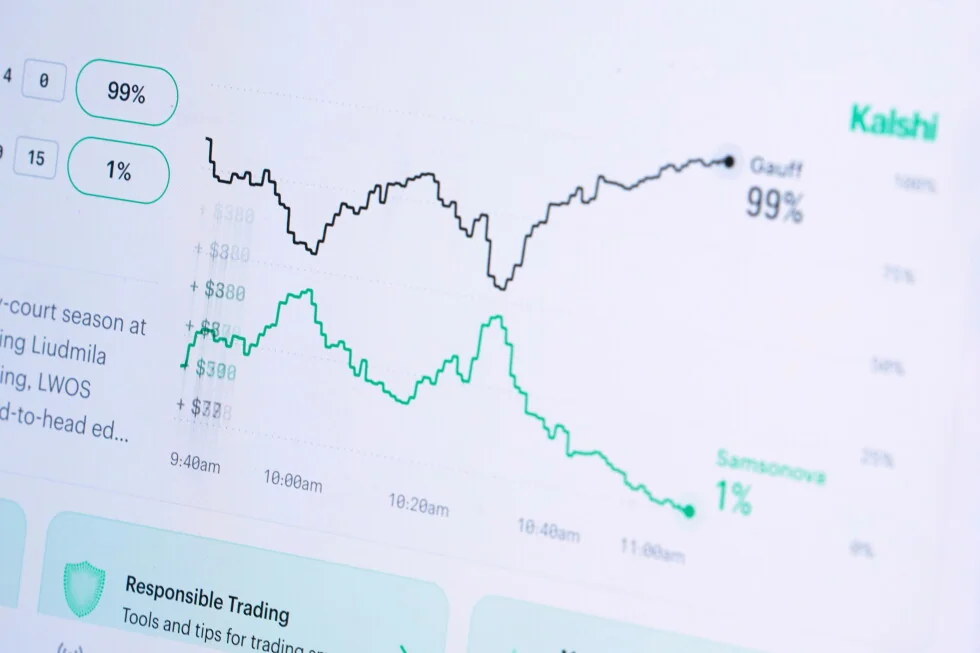
2026년 선거는 예측 시장에서의 과도한 거래가 선거전과 결과에 어떤 영향을 미칠 수 있는지를 시험대에 올릴 수 있다.
September 8th, 2026
2026년 선거는 예측 시장에서의 과도한 거래가 선거전과 결과에 어떤 영향을 미칠 수 있는지를 시험대에 올릴 수 있다.
🇰🇷 한국어
Trading on prediction markets during election season—including in this autumn's most prominent contests—is surging dramatically, even as individual states mount legal battles to ban these platforms as unlicensed gambling operations and begin to voice concerns that high-stakes odds could exert unpredictable influences on American democratic processes.
This year alone, prediction market odds have already become entangled with real-life elections, and this is fast turning into a major concern for election officials, who have spent years fighting misinformation and conspiracy theories.
Their concerns are broad, but many focus on the fear that extensive financial incentives will further undermine confidence in elections and democracy, especially if Americans believe these incentives are affecting the results.
“This is a troubling trend that election administrators across the nation must contend with,” said Jared DeMarinis, the administrator for the Maryland State Board of Elections.
Polymarket, Kalshi, and other prediction markets enable participants to trade contracts contingent on the probable outcome of an event.
These contracts are typically valued between 1 and 99 cents, allowing users to speculate on a wide array of contests, from municipal mayoral races to gubernatorial and U.S. Senate elections.
The boom in prediction market trading comes as President Donald Trump pushes for major changes to voter identification and mail-in voting rules, aiming to address his baseless allegations of widespread fraud in postal voting and voting by noncitizens.
Kalshi and Polymarket officials, for their part, argue that the activity is neither gambling nor a threat to elections or democracy.
According to them, this is barely distinguishable from investors who trade stocks, bonds, or commodities before an election to hedge against the possible effects of the eventual winner's policies on their portfolios or businesses.
Several independent analysts agree.
"One could argue that the entire stock market is, to some extent, affected by elections and their outcomes," said Joshua Mitts, a Columbia Law School professor who specializes in corporate and securities law.
Kalshi and Polymarket officials claim they have insider trading safeguards, as required by federal law, to prevent candidates and their campaign staff from trading on their own races.
On Aug. 31, Kalshi announced that it had suspended a North Carolina congressional candidate, Republican Laurie Buckhout, for three years and fined her for trading on her own race.
Kalshi argues that its research shows a strong link between its markets and real-world results—for example, events with a 60% chance occur about 60% of the time—and that traders who profit from betting on the right outcome prevent any manipulation of the odds.
Nevertheless, prediction markets have incurred considerable reputational damage this year.
In one instance, they overwhelmingly favored a candidate who ultimately lost a primary for Wisconsin governor, where polling likewise proved markedly inaccurate.
Meanwhile, in Los Angeles, as ballots were being tallied in the mayoral primary, online influencers accused election officials of manipulating the process to prevent Republican contender Spencer Pratt from securing a runoff spot, citing market odds that indicated he would finish second.
Currently, the courts are overwhelmed with lawsuits over whether states can regulate prediction markets or ban them under state gambling laws, which also cover casinos and sports betting.
According to data from the National Conference on State Legislatures, about half of all states have laws that broadly prohibit betting on elections.
These laws were introduced to ensure that people vote based on their judgment of the best candidate, not because they have a financial interest in the result.
Courts are unlikely to settle the case before the election, making it almost certain that trading will occur on platforms like Kalshi and Polymarket at levels never witnessed before in nearly every state.
Substantial sums of money, running into the billions, could be wagered on outcomes such as whether the Democrats will secure control of the House or Senate, or which candidate will emerge as governor of the most populous states.
Administrators in state and local election offices are emphasizing the need to actively inform the public that prediction market odds differ from polls or vote counts.
They are also deliberating over how they might leverage their office's policy to safeguard the electoral process.
In Delaware County, located in suburban Philadelphia, elections director Jim Allen asked the election board to add prediction market trading to the state-required oath, which obliges every polling place and county election worker to swear not to bet on the election.
DeMarinis, the Maryland election administrator, stated that he intends to petition the state election board to implement an equivalent mandate across the entire state.
A key question for the midterms is how prediction markets could be used or manipulated to help candidates.
For example, wealthy partisans who are indifferent to financial loss might artificially inflate the odds on their preferred candidate to shape public opinion.
Analysts suggest that some voters, seeing the long odds against their candidate, may choose to stay home rather than vote.
Candidates could invoke the favorable odds, much as they might with a poll, and leverage them to raise funds or secure endorsements.
"And all of a sudden, they're the front-runner, for no reason other than an outside actor places a large bet on them," said Ben Schiffrin, director of securities policy for Better Markets, a nonprofit that advocates for the public interest in financial markets.
Eric Talley, a Columbia University law professor and co-host of the Beyond Unprecedented podcast, cited research by behavioral economist Colin Camerer showing that a single large bet placed before a horse race led others to bet on the same horse.
This temporarily skewed the odds before they leveled off as the race neared.
Others reasoned, "My God, people must know something I don't," and so they all began betting on the same horse, Talley noted, calling it "an interesting parallel to the present moment."
Officials in prediction markets say that kind of advantage is short-lived.
Financially motivated traders will flock to a bad trade because they know they can win it — and that brings the odds back to where an unbiased market would set them, they argue.
"If you try to manipulate pricing in a highly liquid market with strong traders, it won't work.
The price will quickly revert, and you'll simply lose money," said Kalshi's general counsel, Rick Heaslip.
Columbia's Mitts said that a variant which might worry states could field a candidate in a state or local election who encourages people to bet on them in a prediction market, thus motivating voters to act on financial incentives.
Such a tactic would presumably be easier to carry out in a smaller election—say, one decided by roughly 100 votes—though the idea is somewhat theoretical because the financial incentive would have to be considerable, Mitts said.
Nevertheless, it poses a considerable challenge for law enforcement.
It is evident why states, from an election integrity perspective, would assert, 'We do not want this kind of contract to be traded at all,' Mitts said.
To stay abreast of Marc Levy's latest updates, we invite you to follow his Twitter account, accessible at http://twitter.com/timelywriter.
September 8th, 2026
Trending Articles
안전 우려가 고조되는 가운데 찰스 3세 국왕, AI 지도자들과 회동
King Charles Meets AI Leaders as Safety Concerns Mount
안전 우려가 고조되는 가운데 찰스 3세 국왕, AI 지도자들과 회동
King Charles Meets AI Leaders as Safety Concerns Mount
유엔 수장은 세계가 문제들로 시달리는 가운데, 임기를 마칠 준비를 하며 앞으로 나아갈 길에 대해 이야기한다
UN chief, with world beset by problems, talks of way forward as he prepares to leave office
유엔 수장은 세계가 문제들로 시달리는 가운데, 임기를 마칠 준비를 하며 앞으로 나아갈 길에 대해 이야기한다
UN chief, with world beset by problems, talks of way forward as he prepares to leave office
민주당 유력 주자들은 트럼프의 숙청 속에서 AI 위협에 맞서기 위해 분투하고 있다
Democratic hopefuls scramble to counter AI threat as Trump purges
민주당 유력 주자들은 트럼프의 숙청 속에서 AI 위협에 맞서기 위해 분투하고 있다
Democratic hopefuls scramble to counter AI threat as Trump purges
하원, 데이터센터의 에너지 비용 영향 겨냥한 법안 통과
House passes bill targeting data centers' impact on energy costs
하원, 데이터센터의 에너지 비용 영향 겨냥한 법안 통과
House passes bill targeting data centers' impact on energy costs
오픈AI, 우려스러운 새로운 AI 행동을 지적하며 더욱 면밀한 모니터링을 약속
OpenAI flags alarming new AI behavior, vows closer monitoring
오픈AI, 우려스러운 새로운 AI 행동을 지적하며 더욱 면밀한 모니터링을 약속
OpenAI flags alarming new AI behavior, vows closer monitoring
화웨이가 엔비디아와의 AI 경쟁을 심화하며 새로운 칩 기술을 공개하다
Huawei unveils new chip technologies as Chinese firm intensifies AI race with Nvidia
화웨이가 엔비디아와의 AI 경쟁을 심화하며 새로운 칩 기술을 공개하다
Huawei unveils new chip technologies as Chinese firm intensifies AI race with Nvidia
AI 업계, 일관된 AI 속도 조절 촉구를 두고 분열
Tech Industry Split Over Calls for Coordinated AI Slowdown
AI 업계, 일관된 AI 속도 조절 촉구를 두고 분열
Tech Industry Split Over Calls for Coordinated AI Slowdown

글로벌 AI 안전은 미중 협력에 달려 있으나, 양측은 서로를 문제로 인식하고 있다
Global AI Safety Hinges on US-China Cooperation, Yet Each Sees the Other as the Problem
글로벌 AI 안전은 미중 협력에 달려 있으나, 양측은 서로를 문제로 인식하고 있다
Global AI Safety Hinges on US-China Cooperation, Yet Each Sees the Other as the Problem
트럼프는 중국에 우위를 넘겨주기를 거부하며 AI 감독의 시급성을 최소화한다
Trump minimizes the urgency of AI oversight, refusing to relinquish an advantage to China
트럼프는 중국에 우위를 넘겨주기를 거부하며 AI 감독의 시급성을 최소화한다
Trump minimizes the urgency of AI oversight, refusing to relinquish an advantage to China
오프라 윈프리가 스피어에서 당신의 ‘AHA’ 순간을 찾도록 초대합니다
Oprah Winfrey invites you to find your ‘AHA’ moment at the Sphere
오프라 윈프리가 스피어에서 당신의 ‘AHA’ 순간을 찾도록 초대합니다
Oprah Winfrey invites you to find your ‘AHA’ moment at the Sphere