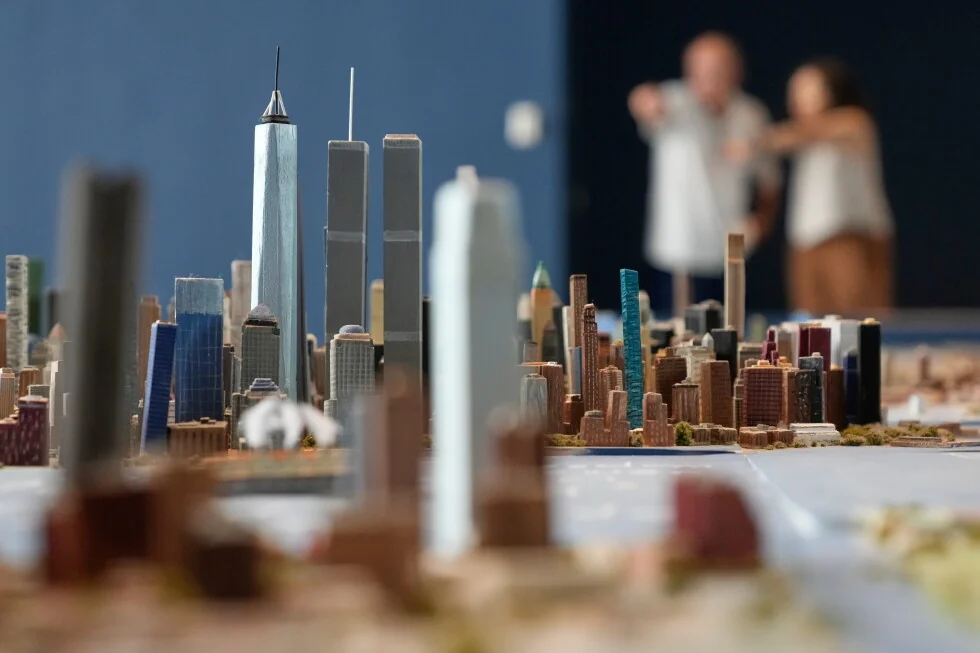
즐거움을 위해 세운 트럭 운전사의 80만 개 구조물로 이루어진 뉴욕시 모형, 박물관 전시품이 되다
September 18th, 2026
즐거움을 위해 세운 트럭 운전사의 80만 개 구조물로 이루어진 뉴욕시 모형, 박물관 전시품이 되다
🇰🇷 한국어
For upwards of two decades, Joe Macken, a truck driver, devoted his leisure hours to constructing an elaborate scale model of his native New York City, fashioned from balsa wood and foam board.
Upon his completion, his daughter prevailed upon him to exhibit the sprawling subterranean creation — comprising in excess of 800,000 structures — on TikTok.
The video clips attained virality almost instantaneously.
Macken's model is presently on display at the Museum of the City of New York, an institution that reached out to him upon witnessing his TikTok videos amass more than 10 million views within a single week.
"He Built This City," as the exhibit is titled, opened in February along Manhattan's museum row near Central Park.
It runs through Oct. 12.
“I never really entertained the notion of completing it, given the sheer enjoyment I derived from the process of building it,” he remarked during a recent visit to the exhibit.
Elisabeth Sherman, the museum’s chief curator, remarked that the model constitutes a singular artefact commanding the attention of both social media devotees and conventional museum patrons alike.
“I think people invariably yearn to encompass this entire city—this city that is impossible to know, impossible to grasp—and this constitutes a means of beholding it from a bird’s-eye vantage,” she said.
“We seldom possess anything these days that resonates with everyone in such a manner.
We cherish the kind of energy it engenders.”
All five boroughs, together with portions of New Jersey and suburban Long Island, are rendered in street-level detail across upwards of 300 large foam boards, interlocking after the fashion of puzzle pieces.
The model in its entirety measures 50 feet (15 meters) in length and nearly 30 feet (9 meters) in width, each inch of it corresponding to approximately 160 feet (49 meters).
The upwards of 800,000 structures—from Manhattan's towering skyscrapers to the modest single-family dwellings of Queens, and such landmarks as the Statue of Liberty, Yankee Stadium and the Brooklyn Bridge—are for the most part fashioned from lightweight balsa wood.
Macken traces the genesis of the model to an elementary school excursion to the Queens Museum, where he beheld the Panorama of the City of New York—the celebrated scale model commissioned for the 1964–1965 World's Fair, replete with an overhead, helicopter-style gondola ride.
Yet it was not until he had attained his fifth decade that this Queens native actually resolved to pursue his ambitions in earnest.
At that juncture, Macken and his young family had but recently relocated northward, from Long Island to the Albany area in upstate New York.
"I surmise, on some subconscious level, that I may have harboured a certain longing for New York," he said.
Employing rudimentary materials procured from hobby shops, Macken commenced with the Rockefeller Center and its iconic principal tower, “30 Rock.”
Thence, he undertook the development of Midtown Manhattan, an endeavour spanning approximately a decade.
The Empire State Building, with its ornate Art Deco spire, proved to be the most formidable undertaking.
"I aspired to render it immaculate," Macken said.
"People are going to be scrutinising it."
Macken possesses no background whatsoever in model building, architecture, or design.
He quips that his closest brush with such experience was assembling Legos and Lincoln Logs as a child.
Yet as he labored, Macken grew ever faster and more efficient.
"I wish I had done it 20 years earlier, knowing that I would have enjoyed it so much," he said.
"I can build one of the buildings in my sleep right now, whereas it took me hours when I first started."
Macken recounts that virtually all his leisure hours were devoted to the model, transporting his materials on family excursions to the New Jersey shore during the summer and seizing the intervals between shifts while driving a bus on weekends.
"It was simply something over which I had no volitional control," he said.
As the model drew inexorably toward completion, it became nothing less than all-consuming, Macken said.
"Prior to retiring for the night, I would at times be so utterly spent that I would end up lingering there for four hours, succumbing to slumber at the table," he said.
"It turned dire.
It was an obsession.
It remains one still."
The model is hardly a verisimilar replica of the contemporary metropolis.
Out in miniature Queens, Macken recreated his beloved childhood diner, rather than the modern high-rise that presently occupies the site.
He likewise retained the erstwhile Kosciuszko Bridge linking Brooklyn and Queens, notwithstanding its demolition in 2017 and its replacement by a new span.
And in lower Manhattan, the erstwhile twin towers of the World Trade Center yet stand sentinel within Macken’s miniature Gotham, albeit flanked by One World Trade Center and the further gleaming skyscrapers erected in the wake of the 2001 terror attacks.
“I retained a great many of my own precincts of the city,” Macken said.
“Purely for myself.”
On a recent weekday morning, a steady procession of visitors ambled into the first-floor gallery.
They advanced to the brink of the raised platform, in quest of a familiar landmark or a bygone neighborhood.
Certain individuals availed themselves of the pairs of binoculars furnished for enhanced observation, whilst the majority merely narrowed their eyes and gestured toward the horizon.
Positioning himself at the corner of the model nearest lower Manhattan, Jonathan Skolnik commenced tracing his family's history across the five boroughs, his son, Tosha, listening intently.
Jonathan indicated his father’s inaugural residence in America, situated on Manhattan’s Lower East Side, proximate to the foot of the Williamsburg Bridge.
The neighborhood wherein he was born in Queens.
The cemetery in which numerous family members lay interred.
"I am endeavoring to reconstruct it entirely from recollection," the Washington, D.C. area resident remarked.
"I do not have it altogether precise."
Having languished a lifetime in obscurity, Macken aspires to exhibit the model elsewhere once the museum's exhibition concludes on Columbus Day.
Concurrently, he anticipates augmenting the portfolio with upward of 50 additional edifices and extending the enterprise into New Jersey and Long Island.
Follow Philip Marcelo on X at https://x.com/philmarcelo
September 18th, 2026
Trending Articles

250년의 불변: 미국인의 속임수에 빠지는 성향
A 250-Year Constant: Americans’ Propensity for Dupery
250년의 불변: 미국인의 속임수에 빠지는 성향
A 250-Year Constant: Americans’ Propensity for Dupery

도어대시와 우버 이츠, 미국 코스트코 매장에서 배달 서비스 제공 예정
DoorDash and Uber Eats to Provide Delivery from US Costco Outlets
도어대시와 우버 이츠, 미국 코스트코 매장에서 배달 서비스 제공 예정
DoorDash and Uber Eats to Provide Delivery from US Costco Outlets

셰프 데이비드 창이 CNN의 새 여행 시리즈에서 전국을 가로지르는 미식 오디세이에 나선다
Chef David Chang Embarks on a Cross-Country Culinary Odyssey in CNN's New Travel Series
셰프 데이비드 창이 CNN의 새 여행 시리즈에서 전국을 가로지르는 미식 오디세이에 나선다
Chef David Chang Embarks on a Cross-Country Culinary Odyssey in CNN's New Travel Series
위대한 미국 로드트립: 그것이 낳은 자동차에 의해 육성되고 훼손된
The Great American Road Trip: Fostered and Undermined by the Automobile It Engendered
위대한 미국 로드트립: 그것이 낳은 자동차에 의해 육성되고 훼손된
The Great American Road Trip: Fostered and Undermined by the Automobile It Engendered

그라운드 제로에서 수습된 골프공: 헤아릴 수 없는 상실의 상징
A golf ball recovered from Ground Zero: an emblem of unfathomable loss
그라운드 제로에서 수습된 골프공: 헤아릴 수 없는 상실의 상징
A golf ball recovered from Ground Zero: an emblem of unfathomable loss
사과 파이는 어머니라는 존재 자체와 더불어 한 국가의 전형적인 요리적 상징이 되었다.
The apple pie, alongside motherhood itself, became the quintessential culinary emblem of a nation.
사과 파이는 어머니라는 존재 자체와 더불어 한 국가의 전형적인 요리적 상징이 되었다.
The apple pie, alongside motherhood itself, became the quintessential culinary emblem of a nation.

갤럽 여론조사, 학교에 대한 미국인들의 만족도가 사상 최저치로 급락했음을 밝혀내다
Gallup poll reveals Americans' satisfaction with schools has plummeted to historic lows
갤럽 여론조사, 학교에 대한 미국인들의 만족도가 사상 최저치로 급락했음을 밝혀내다
Gallup poll reveals Americans' satisfaction with schools has plummeted to historic lows
91세의 데일 ‘그레이 비어드’ 샌더스가 애팔래치아 트레일을 횡단한 최고령 등산객 기록을 다시 차지했다.
At 91, Dale ‘Grey Beard’ Sanders reclaims the record as the oldest hiker to traverse the Appalachian Trail.
91세의 데일 ‘그레이 비어드’ 샌더스가 애팔래치아 트레일을 횡단한 최고령 등산객 기록을 다시 차지했다.
At 91, Dale ‘Grey Beard’ Sanders reclaims the record as the oldest hiker to traverse the Appalachian Trail.

가을 화단을 위한 국화 선택: 전통적인 쿠션 품종을 초월하여
Selecting Chrysanthemums for the Autumnal Border: Transcending the Conventional Cushion Cultivar
가을 화단을 위한 국화 선택: 전통적인 쿠션 품종을 초월하여
Selecting Chrysanthemums for the Autumnal Border: Transcending the Conventional Cushion Cultivar