一个延续250年的常态:美国人长久以来甘愿受骗
September 18th, 2026
一个延续250年的常态:美国人长久以来甘愿受骗
🇨🇳 中文
America: a land of possibility.
And also: a land of suckers.
Our enduring belief that anything is possible — whether based in reality or not — has helped the nation become the world’s largest economy.
It has also led us to fall head over heels for hucksters and charlatans, again and again.
If so much is possible here in America, who is to say it is impossible that the next new supplement, device or scheme might make you young, strong, rich—or all of the above, all at once?
In 1897, a Baptist minister persuaded us that his company could extract gold from the seawater near Lubec, Maine.
In 1925, a company called Bailey Radium Laboratories, based in East Orange, New Jersey, launched a hit product called Radithor, which it advertised as “a cure for the living dead” that could restore vitality and cure impotence.
Maine’s seawater contained no gold whatsoever.
And Radithor did not transform people into Adonis; it poisoned them with radiation.
Americans have been so thoroughly deceived by fraudsters whose boldness is such that their schemes have now entered everyday speech.
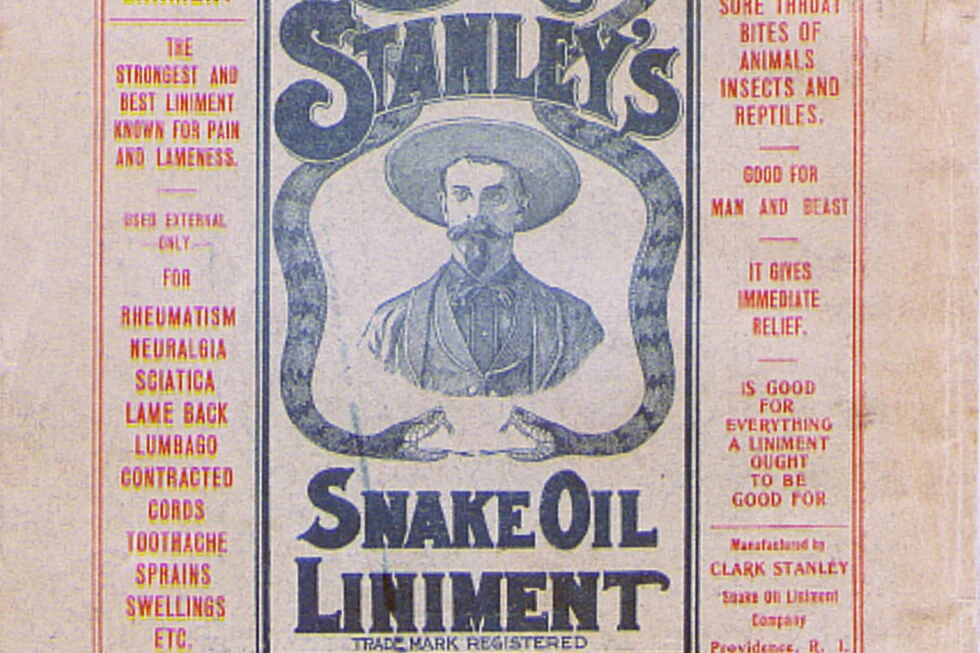
America gave us Clark Stanley, the Rattlesnake King, who sold us what he called “snake oil liniment,” which promised to remedy “pain and lameness, for rheumatism, neuralgia, sciatica, sprains, bunions,” cure “partial paralysis of the arms and lower limbs” and “reduce large joints to their natural size.”
America helped create Charles Ponzi, who could deliver you 50% profit in just 45 days by investing in stamp coupons.
These old examples are easy to laugh at or be mortified by, but we should be careful: We are as willing as ever to believe claims that, when subjected to even a modicum of common sense, seem ludicrous.
Raw milk has special powers?
Peptides can make us young again?
A blast of vitamins through an IV can flush out your hangover?
Why do we persist in falling for this?
There is a straightforward, poignant explanation: “People really don’t want to die.”
So says Dr. Lydia Kang, author of a book on medical fads called “Quackery” and associate professor of internal medicine at University of Nebraska Medical Center.
There’s a desperation to it.
“Everybody has a deep wish to have a long and fruitful life,” she says, “without disability or pain and with your brain intact.”
Other experts say that sociological and evolutionary reasons explain why we are drawn to outlandish and even disproven claims.
This is not uniquely American, of course.
But these instincts and tendencies are stronger in America, with its relentless optimism, its spirit of individualism, its lightly regulated capitalism, its desperate ambition to get richer or healthier or prettier, and a desire to get in on the action driven by suspicion: Others surely have gamed the system, so why can’t I?
“It’s somewhat of a lawless Wild West cowboy situation,” Kang said.
“People are like, ‘Well, if you’re not going to do it, I’m going to do it myself.’”
When we succumb to claims or cling to beliefs after they’ve been disproved, we’re not necessarily being stupid.
We don’t have beliefs to create an accurate representation of the world, said Tali Sharot, a neuroscience professor at University College London.
Instead, she said, it’s simply “to have beliefs that will get us the most rewards and help us avoid harm.
And sometimes those beliefs are the accurate ones, but sometimes they’re not.”
Overconfidence, for instance, can secure you a mate or a job for which you are unqualified, she said.
People can derive a sense of community, support and belonging from believing what others within a group believe.
“If it’s a false belief, it doesn’t matter,” Sharot said.
Believing that vaccines cause autism, despite conclusive evidence that they do not, gives families and loved ones something to blame and provides them with support from a group that shares their anger, fear and pain.
And hope and belief can create optimism that things might get better, which can in turn at least temporarily improve mood and mental health.
“Believing that your future will be better than the past and the present — even if your future will not be better,” Sharot said, “Many times can be optimal.”
The lottery is virtually guaranteed to cost you money — it constitutes an appalling financial decision.
People are aware of this.
Yet they are equally aware that a lottery ticket represents a slender shred of hope, an opportunity to envision a more affluent future.
“What you buy for sure is kind of the fun of thinking about it,” she said.
“That is something that you are guaranteed to get.”
Our thinking is similar when it comes to supplements, balms and techniques that promise benefits that are extremely unlikely to materialize.
On one hand, they are a tragic waste of hard-earned money and sometimes have negative side effects.
On the other hand, “you gain something from trying,” Sharot said, like positive anticipation or excitement.
Yet these very tendencies render us vulnerable to exploitation by companies seeking our money.
And they are exceptionally adept at what they do.
Throughout U.S. history, a clear pattern has emerged: a hint that something might work opens a crack in a door that companies barge through, capturing the desperation — and the paychecks — of people who are hurting, tired or scared.
Dr. Benjamin Rush, a Philadelphia physician who signed the Declaration of Independence, was frustrated by his inability to save people during a yellow fever epidemic in 1793.
He then read autopsy reports suggesting that purging and bloodletting could help.
So he took it to an extreme, giving the sick high doses of calomel and jalap — a mercury compound and the powdered root of a Mexican plant that together make an extremely potent laxative — while aggressively draining their blood.
According to one account: “So much blood was spilled in the front yard that the site became malodorous and buzzed with flies.”
Charles Stanley’s snake oil was fake — in 1916, the U.S. Bureau of Chemistry found that it consisted mainly of mineral oil, along with “fatty oil (probably beef fat), capsicum, and possibly a trace of camphor or turpentine.”
Yet he got the idea from Chinese laborers who used oil — from a very specific snake — that likely did have some anti-inflammatory properties.
Radiation had, and still has, medical applications, which allowed William J.A. Bailey to market his Radithor as a “health tonic” — until one prominent and enthusiastic customer consumed so much that his jawbone decayed and he died of radiation poisoning.
Gray areas leave regulators and health professionals in a difficult position: it is often impossible to state definitively that something does not work, particularly without a study that no one is willing to spend precious time and resources on.
Meanwhile, companies seize the moment.
"What's frightening is that they will take that hope and try to put it in a bottle and sell it to you at whatever price they think you can afford," Kang said.
Many supplements and unapproved "treatments" rely on hints of potential benefits from animal studies or small observational studies, which cannot prove cause and effect.
Today, some people seeking longevity are pinning their hopes on rapamycin, a drug given to organ transplant patients, which has extended lifespans in yeast, flies, and mice.
Some highly successful drugs, such as insulin and the weight-loss drugs Wegovy and Zepbound, are peptides — short chains of amino acids that can be made into countless configurations.
This is sparking an entire industry that markets other peptides — largely unproven and untested — which are said to increase muscle growth, speed recovery and fight ageing.
Sound familiar?
Naturally, science, technology, and the nation's relentless economic engine have yielded countless genuine marvels and enduring anecdotes, which in turn make the ground more fertile for credulous thinking.
We can traverse the country in a flying metal tube within a few hours.
We can access nearly all of human knowledge through a small rectangle of metal and glass.
Medical advances, and especially vaccination — a radical concept at one time — have nearly eliminated childhood diseases that killed up to half of children before age 5 when the nation was founded.
An American born in 1900 was likely to live until just 47 years old.
U.S. life expectancy is now 79, its highest level ever.
Who's to say it can't double again?
Why should there be any limit at all?
We may be more susceptible now than we have ever been.
We are subjected to ever more tantalizing claims, Kang said, now that we have devices in our pockets that deliver an endless stream of hawkers (euphemized as “influencers”) peddling “treatments” and other shortcuts in our 250-year-strong pursuit of happiness.
Social media is very good at copying the kind of messaging that scientists say our brains are most willing to believe: direct, personal appeals from people who seem trustworthy and say they have had personal experience.
And in the U.S., it can be a particularly attractive alternative to an expensive, impersonal health system that is extremely hard to navigate.
Even the nation’s foremost health authority, Health Secretary Robert F. Kennedy, Jr., has endorsed or provided a platform for those who promote or sell unproven treatments and wellness products, including vitamin A as a measles treatment, peptides, and raw milk.
“The guard rails are off right now,” Kang says.
“It’s actually worse than it has been before, because of social media, because of what’s on the internet, and because the so-called trusted people we’re supposed to be getting advice from are not trustworthy.
And I think that puts the American public in far greater danger.”
The great American swindler George C. Parker, who sold the Brooklyn Bridge — more than once — would have loved it.
And what a deal he would have for you.
Jonathan Fahey serves as the global health and science editor for Reporters.
Reporters’ health and science coverage receives financial backing from the Reporters Fund for Journalism and private foundations.
AP bears sole responsibility for all content.
Details regarding AP’s standards for collaborating with philanthropies, a roster of supporters, and funded coverage areas can be found at AP.org.
September 18th, 2026
Trending Articles
卡车司机为消遣建造了拥有80万座建筑的纽约市模型——如今成为博物馆展品
Truck driver builds 800,000-structure NYC model for fun—now a museum exhibit
卡车司机为消遣建造了拥有80万座建筑的纽约市模型——如今成为博物馆展品
Truck driver builds 800,000-structure NYC model for fun—now a museum exhibit
DoorDash和Uber Eats将开始从全美Costco门店提供配送服务
DoorDash and Uber Eats to Begin Delivering from Costco Stores Across the US
DoorDash和Uber Eats将开始从全美Costco门店提供配送服务
DoorDash and Uber Eats to Begin Delivering from Costco Stores Across the US

张大卫在CNN全新美食旅行系列节目中穿越美国
Chef David Chang traverses the US in new CNN travel series centred on food
张大卫在CNN全新美食旅行系列节目中穿越美国
Chef David Chang traverses the US in new CNN travel series centred on food

伟大的美国公路旅行,由催生它的汽车所驱动,也被其所侵蚀
The great American road trip, powered and undermined by the automobile that spawned it
伟大的美国公路旅行,由催生它的汽车所驱动,也被其所侵蚀
The great American road trip, powered and undermined by the automobile that spawned it

在世界贸易中心废墟中发现的高尔夫球成为难以理解的损失的象征
Golf ball found in World Trade Center rubble became a symbol of incomprehensible loss
在世界贸易中心废墟中发现的高尔夫球成为难以理解的损失的象征
Golf ball found in World Trade Center rubble became a symbol of incomprehensible loss
苹果派与妈妈一起,成为了这个国家的标志性菜肴。
The apple pie, alongside mom, became the nation's iconic dish.
苹果派与妈妈一起,成为了这个国家的标志性菜肴。
The apple pie, alongside mom, became the nation's iconic dish.

盖洛普民调显示,美国人对学校的满意度已跌至历史最低点。
Gallup poll reveals Americans' satisfaction with schools has hit a historic low.
盖洛普民调显示,美国人对学校的满意度已跌至历史最低点。
Gallup poll reveals Americans' satisfaction with schools has hit a historic low.
诗人兼女权主义者罗宾·摩根去世,享年85岁,其盟友包括简·方达和格洛丽亚·斯泰纳姆。
Poet and feminist Robin Morgan, whose allies included Jane Fonda and Gloria Steinem, dies at 85
诗人兼女权主义者罗宾·摩根去世,享年85岁,其盟友包括简·方达和格洛丽亚·斯泰纳姆。
Poet and feminist Robin Morgan, whose allies included Jane Fonda and Gloria Steinem, dies at 85
帕顿和斯泰纳姆相继离世,相隔不过数日,这对女权主义者而言是双重打击。
The deaths of Parton and Steinem, days apart, deliver a twofold blow to feminists.
帕顿和斯泰纳姆相继离世,相隔不过数日,这对女权主义者而言是双重打击。
The deaths of Parton and Steinem, days apart, deliver a twofold blow to feminists.