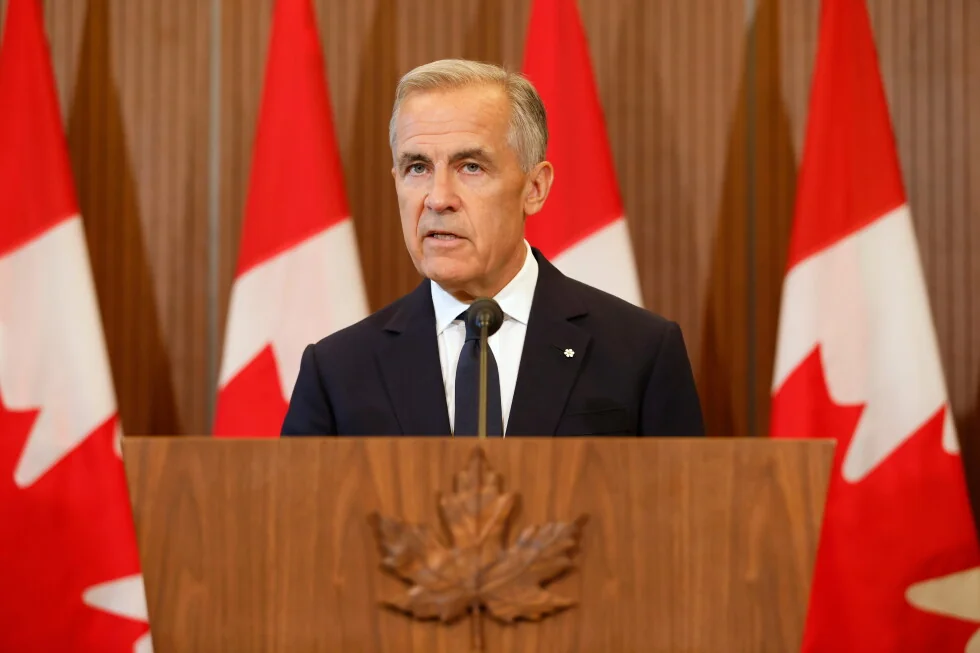
VERIFICACIÓN DE DATOS: Trump afirma que los bancos estadounidenses no pueden operar en Canadá. Eso es falso
September 8th, 2026
VERIFICACIÓN DE DATOS: Trump afirma que los bancos estadounidenses no pueden operar en Canadá. Eso es falso
🇪🇸 Español
When questioned about the trade dispute with Canada on Wednesday, President Donald Trump made the baseless claim that U.S. banks are barred from doing business with their northern neighbor.
The allegation surfaced during a meeting with U.S. travel executives in the Oval Office, after a reporter asked Trump whether plans exist for renewed trade talks between the two countries.
According to experts, while U.S. banks may encounter certain regulatory constraints, they are by no means prohibited from conducting operations within Canada.
A more detailed examination of the facts is warranted.
“They maintain their banking institutions here—the Bank of Canada and all their major banks, which are substantial and impressive.
I believe they operate six or seven principal banks in this country.
Conversely, we have no banking presence there.
Do you know the reason?
They prohibit it.”
According to a spokesperson for the Canadian Bankers Association, 15 U.S.-based banks currently operate in Canada, whether as branches or subsidiaries.
Although experts note that certain regulatory constraints can impede U.S. banks' competitiveness north of the border, they remain free to enter the market.
Conversely, the Federal Reserve's most recent data indicates that eight Canadian banks are active in the U.S.
Notably, the Bank of Canada is not among them—it functions as Canada's central bank, analogous to the Federal Reserve, rather than as a commercial institution.
"I suspect that some confusion arises from the differences between the U.S. and Canadian regulatory systems," said James Thompson, a finance professor at the University of Waterloo in Ontario, Canada.
"U.S. banks are certainly allowed to operate in Canada, but their choice of how to enter the Canadian market determines what they can do."
Canada's banking system comprises three distinct categories—Schedule I, Schedule II, and Schedule III—with Schedule I reserved for domestically owned institutions.
Among these, six major Schedule I banks hold combined assets that dwarf those of the country's 28 smaller banks.
Foreign entities may elect to operate as either Schedule II or Schedule III banks.
Schedule II banks are foreign-owned subsidiaries incorporated in Canada that fall under essentially the same regulatory framework as domestically owned banks.
Schedule III banks, by contrast, are branches of foreign banks that are not incorporated in Canada and are therefore subject to regulatory constraints, including high deposit minimums.
The majority of U.S.-owned banks operate in Canada as Schedule III institutions.
Nathalie Bergeron, a spokesperson for the Canadian Bankers Association, noted that U.S.-based bank branches and subsidiaries operating in Canada hold combined assets of roughly $124 billion in Canadian dollars (US$90.1 billion) — a figure exceeding half of all assets held by foreign bank subsidiaries and branches.
"These banks specialize in a wide range of financial services, including corporate and commercial lending, treasury services, credit card products, investment banking, and mortgage financing," she said.
"They serve not only customers with cross-border business activities, but also Canada's domestic retail market."
Among the U.S. banking institutions operating within Canada are J.P. Morgan Chase Bank, Citibank, Bank of America, Capital One, and Wells Fargo.
Both Schedule II and Schedule III banks are subject to restrictions under Canadian banking regulations.
Jeremy Kronick, an expert in financial and monetary policy who also serves as president and CEO of the C.D. Howe Institute, a Canadian think tank, explained that Schedule III banks are not allowed to accept deposits below $150,000 (US$72,529).
Consequently, most people would find them unsuitable for use as their main retail bank.
He added that since Schedule II banks are separate legal entities from their foreign parent companies, they must set up their own local capital and liquidity structures—an arrangement that is inefficient from the banks' standpoint.
Such constraints may well account for the fact that the vast majority of U.S.-owned banks opt against conducting cross-border operations.
According to the Federal Reserve, there are upwards of 3,700 domestically owned commercial banks in the United States, in stark contrast to the mere 15 that maintain a presence in Canada.
"Canada is a relatively small market, and its established banks are already very large institutions with strong brands, extensive branch networks, and long-standing customer relationships," said Thompson.
"For a U.S. bank thinking about entering, building the infrastructure needed to compete for Canadian retail customers would be expensive, while initially gaining only a small share of an already relatively small market."
The White House refrained from issuing an immediate response to the request for comment.
This story was first published on September 3, 2026, and was updated on September 8, 2026, to correct the assets held by U.S.-based bank branches and subsidiaries in Canada.
Their combined assets are estimated at US$90.1 billion, depending on the exchange rate, not US$904 million.
September 8th, 2026
Trending Articles
Warren Buffett cede el cargo de presidente de Berkshire Hathaway, avanzando en su plan de sucesión
Warren Buffett relinquishes chairman role at Berkshire Hathaway, advancing his succession plan
Warren Buffett cede el cargo de presidente de Berkshire Hathaway, avanzando en su plan de sucesión
Warren Buffett relinquishes chairman role at Berkshire Hathaway, advancing his succession plan
Trump apunta a más medios de comunicación, diciendo que prohibirá la entrada de CNN, MS NOW y Politico a la Casa Blanca
Trump targets more news outlets, saying he will ban CNN, MS NOW and Politico from the White House
Trump apunta a más medios de comunicación, diciendo que prohibirá la entrada de CNN, MS NOW y Politico a la Casa Blanca
Trump targets more news outlets, saying he will ban CNN, MS NOW and Politico from the White House
El Banco de Japón eleva su tasa de interés clave al 1,25 %, un máximo de 31 años
Bank of Japan lifts key rate to 1.25%, a 31-year high
El Banco de Japón eleva su tasa de interés clave al 1,25 %, un máximo de 31 años
Bank of Japan lifts key rate to 1.25%, a 31-year high

Anthropic afirma que su modelo Claude está ayudando a construir su propio sucesor
Anthropic says its model Claude is helping to build its own successor
Anthropic afirma que su modelo Claude está ayudando a construir su propio sucesor
Anthropic says its model Claude is helping to build its own successor
Por qué la Reserva Federal sube los tipos ahora y qué significa
Why the Federal Reserve is raising rates now, and what it signifies
Por qué la Reserva Federal sube los tipos ahora y qué significa
Why the Federal Reserve is raising rates now, and what it signifies

Las acciones estadounidenses se disparan hasta máximos de seis semanas mientras caen los precios del petróleo y los rendimientos de los bonos
US stocks surge to six-week high as oil prices and bond yields decline
Las acciones estadounidenses se disparan hasta máximos de seis semanas mientras caen los precios del petróleo y los rendimientos de los bonos
US stocks surge to six-week high as oil prices and bond yields decline
La Fed sube los tipos de interés por primera vez en 3 años, desafiando los llamados de Trump a un recorte
Fed hikes key rate for 1st time in 3 years, defying Trump's calls for a cut
La Fed sube los tipos de interés por primera vez en 3 años, desafiando los llamados de Trump a un recorte
Fed hikes key rate for 1st time in 3 years, defying Trump's calls for a cut
Las solicitudes de desempleo caen a 196.000, el nivel más bajo desde mediados de julio en medio de despidos persistentemente bajos
Unemployment Claims Fall to 196,000, Lowest Since Mid-July Amid Persistent Low Layoffs
Las solicitudes de desempleo caen a 196.000, el nivel más bajo desde mediados de julio en medio de despidos persistentemente bajos
Unemployment Claims Fall to 196,000, Lowest Since Mid-July Amid Persistent Low Layoffs
Trump denuncia los riesgos de la IA como un «engaño» y alega una «enfermiza conspiración» contra la IA y los centros de datos
Trump denounces AI risks as a ‘hoax,’ alleging a ‘SICK conspiracy’ against AI and data centers
Trump denuncia los riesgos de la IA como un «engaño» y alega una «enfermiza conspiración» contra la IA y los centros de datos
Trump denounces AI risks as a ‘hoax,’ alleging a ‘SICK conspiracy’ against AI and data centers
El Tribunal Supremo decidirá sobre el desafío de un pescador de langostas de Maine al requisito de rastreo por GPS en las embarcaciones
Supreme Court to decide on Maine lobsterman’s challenge to GPS boat tracker requirement
El Tribunal Supremo decidirá sobre el desafío de un pescador de langostas de Maine al requisito de rastreo por GPS en las embarcaciones
Supreme Court to decide on Maine lobsterman’s challenge to GPS boat tracker requirement