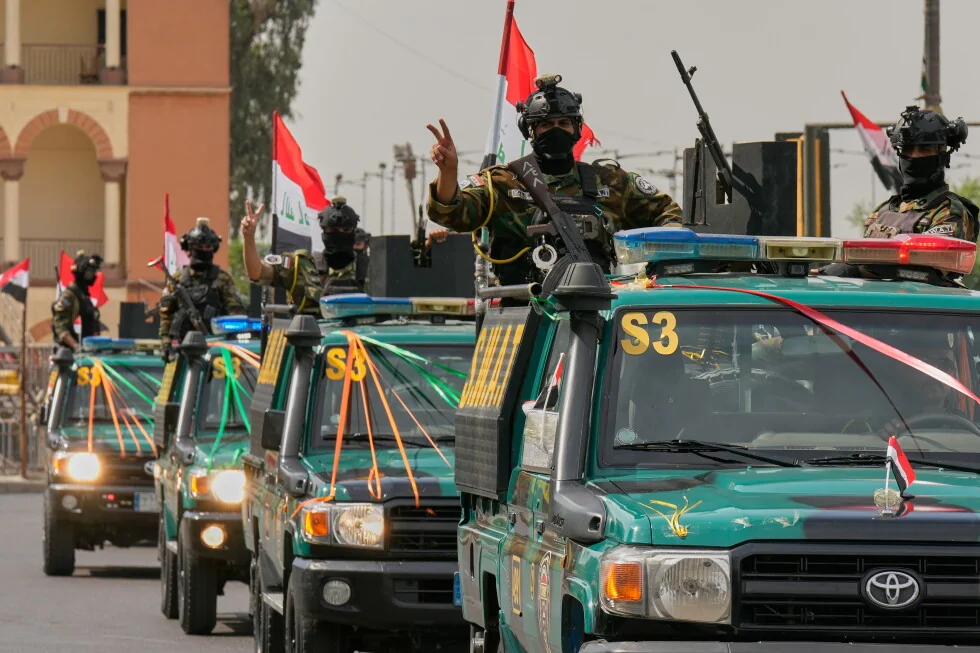
トランプ氏、12年に及ぶ任務を経た米軍のイラク撤退を称賛
September 30th, 2026
トランプ氏、12年に及ぶ任務を経た米軍のイラク撤退を称賛
🇯🇵 日本語
The U.S. military announced on Wednesday that it had completed the withdrawal of all American troops from Iraq, ending a 12-year mission to fight the Islamic State group and prompting President Donald Trump to hail the conclusion of “a very expensive excursion into Hell.”
The final contingent of U.S. troops withdrew from an air base in northern Iraq, in accordance with an agreement struck between Baghdad and Washington.
In a social media post, Trump characterised the withdrawal by a Sept. 30 deadline as “orderly.”
Appearing shortly thereafter at a White House event celebrating Hispanics, he spoke at length about the withdrawal, saying, “It’s been a long time with very bad decision making that got us involved in this quagmire in the first place.
It was a quagmire.
For many, many years it lasted.
But soon that part of history will be over.”
He characterized the shift as a triumph for the United States and Iraq, and as an indication of victory over the Islamic State group.
The withdrawal, agreed upon two years ago, occurs amid the ongoing war between the United States and Iran, which has occasionally spilled over into Iraq, with Iran-backed militias firing on U.S. troops and the U.S. striking the groups’ strongholds.
Trump’s comments came as his own decision earlier this year to launch the war with Iran has been compared to the Iraq war because of its undefined mission as it nears its seventh month.
While appearing at the White House, Trump drew that comparison, arguing that both his one-day military action in Venezuela earlier this year to capture now former President Nicolás Maduro and the Iran war compared favorably, taking far less time and resulting in fewer deaths of U.S. troops.
In recent years, Washington has sought to shift its focus from the Middle East toward Asia, yet this shift has been inconsistent, with the Pentagon alternating between reducing its Mideast presence and then finding itself engaged in new conflicts — including the ongoing war in Iran.
Baghdad hailed the conclusion of the U.S. mission as an indication of the nation's growing strength and sovereignty.
The withdrawal was also welcomed by Iran-backed groups, but it raised concerns among some other Iraqis, especially in the Kurdish region, where many fear a resurgence of the Islamic State group as well as more attacks by Iran-linked groups, possibly encouraged by the departure of U.S. forces.
Meanwhile, questions remain about the future of the Iraqi militias, which the Baghdad government has tried to disarm, with little success so far.
Pentagon spokesperson Sean Parnell stated in a statement that U.S. troops and equipment had completed an “orderly departure” from the air base in Irbil, situated in northern Iraq’s semi-autonomous Kurdish region.
"This milestone reflects the success of a 12-year campaign that defeated ISIS as an organized military threat in Iraq and across the region," he said.
"It also marks a transition from a wartime coalition mission to an Iraqi-led security effort supported by a more normal bilateral security relationship."
He further remarked that the U.S. military “will continue to provide targeted training and intelligence support to our Iraqi partners.”
Iraqi Prime Minister Ali al-Zaidi presided over the handover ceremony, describing the U.S. withdrawal as the start of a “new phase, one defined by Iraq’s sovereignty, the strength of its institutions, the readiness of its forces, the unity of its decision-making, and balanced partnerships with its friends.”
He stated that Iraqi security forces would persist in their campaign against IS, and that the government would guarantee that non-state groups no longer possess weapons.
In his remarks on Wednesday, Trump lavished praise on al-Zaidi, calling him “outstanding,” a “fantastic guy, friend of mine,” and someone who “will hopefully be able to handle things very well.”
He also appeared to try to take credit for al-Zaidi’s leadership, saying that the Iraqi leader was “running for election” and “wasn’t given even a chance and I endorsed him and politicked for him a little bit, and he ended up winning in a virtual landslide.”
Al-Zaidi was not on the ballot but was selected as prime minister when Iraq’s dominant parliamentary bloc nominated him after weeks of internal debate among its member parties and Trump publicly announcing his opposition to the coalition’s previous choice.
In 2003, U.S. troops invaded Iraq with the aim of toppling Saddam Hussein.
They withdrew in 2011, yet merely three years thereafter, Iraqi authorities extended an invitation to a reduced U.S.-led mission to combat the Islamic State group, which had rampaged throughout Iraq, seizing vast expanses of territory.
With the extremist group reduced to scattered sleeper cells, Washington and Baghdad agreed in 2024 to wind the mission down.
U.S. troops withdrew from bases across most of Iraq last year, yet retained a modest presence numbering in the hundreds in the semiautonomous northern Kurdish region.
Bases there have been subjected to regular attacks since the U.S. and Israel initiated their war against Iran on Feb. 28.
Iran-backed Iraqi militias have likewise coordinated with Yemen’s Houthi rebels in launching attacks on Saudi Arabia.
The Iraqi government initially linked the Sept. 30 deadline for U.S. withdrawal to the disarmament of non-state armed groups by that date.
Although a handful of less-influential militias have agreed to hand over their weapons, powerful groups close to Iran either rejected the prospect or set conditions for disarmament that the government would be unlikely to meet.
Al-Zaidi has since retracted the deadline.
He told The New York Times earlier this month that the deadline for militia disarmament has been postponed to June 2027.
The ramifications of the U.S. withdrawal may not manifest immediately, particularly given that the U.S. military presence had already been substantially reduced.
Nevertheless, officials in Iraq's Kurdish region have voiced apprehension regarding the departure and, more specifically, the removal of U.S. air defense systems.
The Peshmerga Ministry of the Kurdish regional government reported that the Kurdish region had faced more than 1,000 drone and ballistic-missile attacks during the recent U.S.-Iran conflict.
“The withdrawal of the United States from the Kurdistan Region, amid these intricate regional circumstances and in the absence of any provision of a defense system, is a source of concern,” the statement said.
Iran-aligned factions in Iraq, in the meantime, have been celebrating the American withdrawal.
"The expulsion of the defeated occupation forces from the land of Iraq marks the beginning of full sovereignty," Abu Mujahid al-Assaf, a security official with the powerful Kataib Hezbollah militia, said in a statement.
He added a warning to al-Zaidi and his government not to carry out American plans, threatening that “any government that does not work for the benefit of the people will be overthrown by all means.”
The Islamic Resistance in Iraq, an umbrella group of Iran-backed militias, stated in a statement that negotiations with the government over the regulation of weapons had not resulted in an agreement and that it was “not bound by any timeline or agreement” announced by the government or political entity.
The group said it is open to “any dialogue that guarantees Iraq’s sovereignty and dignity.”
September 30th, 2026
Trending Articles
スーダン:人権団体、準軍事組織のドローン攻撃でエチオピア国境付近で41人が死亡したと報告
Sudan: Rights group reports paramilitary drone strike killed 41 near Ethiopian border
スーダン:人権団体、準軍事組織のドローン攻撃でエチオピア国境付近で41人が死亡したと報告
Sudan: Rights group reports paramilitary drone strike killed 41 near Ethiopian border
パリ警察、更なる騒乱を防ぐため2地区に夜間外出禁止令を発令
Paris police impose overnight curfew in 2 areas to prevent further unrest
パリ警察、更なる騒乱を防ぐため2地区に夜間外出禁止令を発令
Paris police impose overnight curfew in 2 areas to prevent further unrest
国土安全保障省、10万人超のウクライナ人とスーダン人に一時的な国外退去免除を付与
Homeland Security Grants Temporary Deportation Relief to Over 100K Ukrainians and Sudanese
国土安全保障省、10万人超のウクライナ人とスーダン人に一時的な国外退去免除を付与
Homeland Security Grants Temporary Deportation Relief to Over 100K Ukrainians and Sudanese
カナダ、兵士4人が死亡した軍事基地の火災を調査するため調査員50人を派遣
Canada sends 50 investigators to examine military base fire that killed 4 soldiers
カナダ、兵士4人が死亡した軍事基地の火災を調査するため調査員50人を派遣
Canada sends 50 investigators to examine military base fire that killed 4 soldiers
英国首相:米国運営の空軍基地での疑惑の計画は、ほぼ確実にイランが指示したもの
UK prime minister: suspected plot at US-run air base almost certainly directed by Iran
英国首相:米国運営の空軍基地での疑惑の計画は、ほぼ確実にイランが指示したもの
UK prime minister: suspected plot at US-run air base almost certainly directed by Iran
サウジアラビア、リヤド空港への致命的なフーシ派攻撃を防衛システムが迎撃できなかった経緯を調査
Saudis investigate how defense systems failed to intercept deadly Houthi strike on Riyadh airport
サウジアラビア、リヤド空港への致命的なフーシ派攻撃を防衛システムが迎撃できなかった経緯を調査
Saudis investigate how defense systems failed to intercept deadly Houthi strike on Riyadh airport
NATO司令官:同盟は戦争を望まないが「今夜戦う準備はできている」
NATO commander: alliance doesn’t want war but is ‘ready to fight tonight’
NATO司令官:同盟は戦争を望まないが「今夜戦う準備はできている」
NATO commander: alliance doesn’t want war but is ‘ready to fight tonight’
サウジアラビアへの着陸を余儀なくされた恐ろしいフライドバイ便について知っておくべきこと
What to know about the terrifying FlyDubai flight forced to land in Saudi Arabia
サウジアラビアへの着陸を余儀なくされた恐ろしいフライドバイ便について知っておくべきこと
What to know about the terrifying FlyDubai flight forced to land in Saudi Arabia
英国とフランスの移民小型ボート協定が破棄される
UK-France migrant small boat deal scrapped
英国とフランスの移民小型ボート協定が破棄される
UK-France migrant small boat deal scrapped