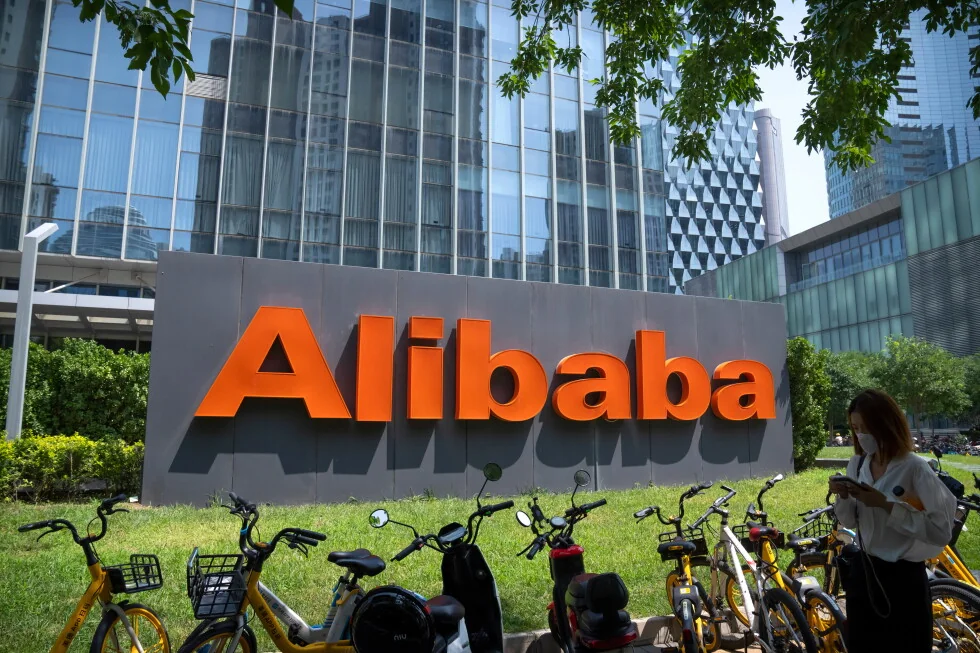
阿里巴巴推出強勁新晶片,雄心勃勃地投身人工智慧模型事業
September 22nd, 2026
阿里巴巴推出強勁新晶片,雄心勃勃地投身人工智慧模型事業
🇹🇼 中文
On Tuesday, China’s Alibaba unveiled nascent artificial-intelligence chip technologies alongside ambitions to develop more potent models—among them what the company characterized as China’s most formidable AI chip—mere days prior to a Sino-American leadership summit at which the contest for supremacy in AI technology is anticipated to figure prominently.
Alibaba’s announcement coincided with U.S. AI leaders — among them Anthropic CEO Dario Amodei — warning that China’s advancement in AI constitutes a threat to the United States and advocating a comprehensive deceleration in the development of the technology.
Chinese leader Xi Jinping is poised to touch down in Washington on Wednesday for a state visit and a meeting with U.S. President Donald Trump, at which artificial intelligence, trade and tariffs are expected to figure prominently on the agenda.
At its annual flagship conference in Hangzhou, Alibaba unveiled a new AI chip and delineated its roadmap for the forthcoming generation of its AI model.
CEO Eddie Wu characterized the new Zhenwu V900 chip as “most powerful AI chip in China today,” asserting that it delivers three times the performance of the company’s preceding-generation Zhenwu M890 chip.
Chips of this ilk underpin the training of frontier AI models and "inference," a term denoting the computations a trained AI performs to furnish responses to users.
Alibaba's Zhenwu chips are deployed within its data centers, furnishing computing resources to the company and its cloud clientele.
Alibaba further disclosed its intention to train a novel AI model on the order of five to ten trillion parameters—a metric indicative of an AI's learning capacity—thereby narrowing the gap with the most sophisticated models emanating from the United States.
Its most recent Qwen3.8-Max model, the preeminent iteration within its Qwen AI series, comprises 2.4 trillion parameters.
Chinese AI enterprise Moonshot asserts that its Kimi K3, unveiled in July, constitutes the world’s largest open model, boasting 2.8 trillion parameters.
Alibaba further underscored its intent to augment the data centres underpinning its cloud computing operations, invoking “exponentially” escalating demand for AI computing.
The company stated that it anticipates possessing in excess of 20 gigawatts’ worth of computing capacity by 2032.
As of mid-year, SpaceX boasts an AI computing capacity of approximately 1.4 gigawatts, while articulating its aspiration to exceed 10 gigawatts by 2027.
Some analysts contend that China’s recent strides in AI are affording Beijing augmented leverage in its forthcoming negotiations with Washington, as China redoubles its push for self-reliance even though U.S.-led export restrictions have precluded its access to some of the world’s most cutting-edge technologies, among them AI chips and chipmaking machinery.
Open-source Chinese models, frequently more economical than the state-of-the-art proprietary offerings of preeminent U.S. AI laboratories, have likewise been gaining traction on a global scale, not least within the United States itself.
Chinese technology behemoth Huawei likewise unveiled novel chip technologies last week, as it seeks to mount a challenge to global leaders such as Nvidia.
Frontier AI model training in China frequently hinges upon Nvidia chips, analysts averred, yet Chinese-designed chips are steadily gaining traction, inasmuch as Nvidia has been precluded from vending some of its most potent AI chips to China.
"Harnessing supplementary computational capacity to compensate for semiconductor constraints fortifies China's domestic standing," remarked Neil Shah, vice president of Counterpoint Research, a Hong Kong-based technology market research firm.
Counterpoint senior analyst Parv Sharma further observed that the extent to which the AI and chipmaking chasm between China and the United States narrows will hinge on a constellation of additional factors, among them China's capacity to advance the chip foundries that fabricate these components, and not merely its prowess in chip design.
Alibaba is “mobilizing every resource” to satisfy customers’ demand for AI, CEO Wu declared in his address on Tuesday.
Global shortages pervading the AI data center supply chain, by way of illustration, “are currently limiting the speed at which we can scale our compute infrastructure” for AI, he added.
Wu further analogised the trajectory of AI to that of the industrial revolution, contending that “machine intelligence” will swiftly surpass the cognitive capacities of humankind.
While “machine intelligence today is not a substitute for human intelligence,” he prognosticated that, in due course, machines will be capable of generating in excess of 1,000 times more “thinking” than the entirety of humanity collectively, a marked escalation from the current figure of less than 3%.
September 22nd, 2026
Trending Articles

Google因違反歐盟定位資料規則遭罰4億6300萬美元
Google Slapped with $463 Million Fine for Violating EU Location-Data Rules
Google因違反歐盟定位資料規則遭罰4億6300萬美元
Google Slapped with $463 Million Fine for Violating EU Location-Data Rules
比爾·蓋茲倡導「明智運用」人工智慧,與此同時他的基金會正培育更具代表性的語言資料
Bill Gates advocates ‘smart use’ of AI as his foundation cultivates more representative language data
比爾·蓋茲倡導「明智運用」人工智慧,與此同時他的基金會正培育更具代表性的語言資料
Bill Gates advocates ‘smart use’ of AI as his foundation cultivates more representative language data

伯納姆在聯合國向川普示好,推銷英國作為AI強國
Burnham Courts Trump at UN, Pitches UK as AI Powerhouse
伯納姆在聯合國向川普示好,推銷英國作為AI強國
Burnham Courts Trump at UN, Pitches UK as AI Powerhouse
國王與人工智慧:查爾斯於安全疑慮升溫之際與人工智慧領袖會晤
King and AI: Charles Confers with Artificial Intelligence Leaders Amid Escalating Safety Concerns
國王與人工智慧:查爾斯於安全疑慮升溫之際與人工智慧領袖會晤
King and AI: Charles Confers with Artificial Intelligence Leaders Amid Escalating Safety Concerns
在全球動盪之際,即將卸任的聯合國秘書長勾勒前行之路
Departing UN Chief, Amid Global Turmoil, Charts a Path Forward
在全球動盪之際,即將卸任的聯合國秘書長勾勒前行之路
Departing UN Chief, Amid Global Turmoil, Charts a Path Forward
民主黨有望出線者競相應對人工智慧威脅,川普卻輕描淡寫
Democratic Hopefuls Scramble to Counter AI Threat Amid Trump’s Dismissals
民主黨有望出線者競相應對人工智慧威脅,川普卻輕描淡寫
Democratic Hopefuls Scramble to Counter AI Threat Amid Trump’s Dismissals
眾議院通過針對資料中心對能源成本影響的法案
House passes bill targeting data centers' impact on energy costs
眾議院通過針對資料中心對能源成本影響的法案
House passes bill targeting data centers' impact on energy costs
OpenAI 示警令人憂心的全新 AI 行為,矢言加強審查
OpenAI flags alarming new AI behavior, vows closer scrutiny
OpenAI 示警令人憂心的全新 AI 行為,矢言加強審查
OpenAI flags alarming new AI behavior, vows closer scrutiny
華為揭櫫嶄新晶片技術,中國企業與輝達的AI競賽愈演愈烈
Huawei Unveils Novel Chip Technologies as Chinese Firm Escalates AI Race with Nvidia
華為揭櫫嶄新晶片技術,中國企業與輝達的AI競賽愈演愈烈
Huawei Unveils Novel Chip Technologies as Chinese Firm Escalates AI Race with Nvidia