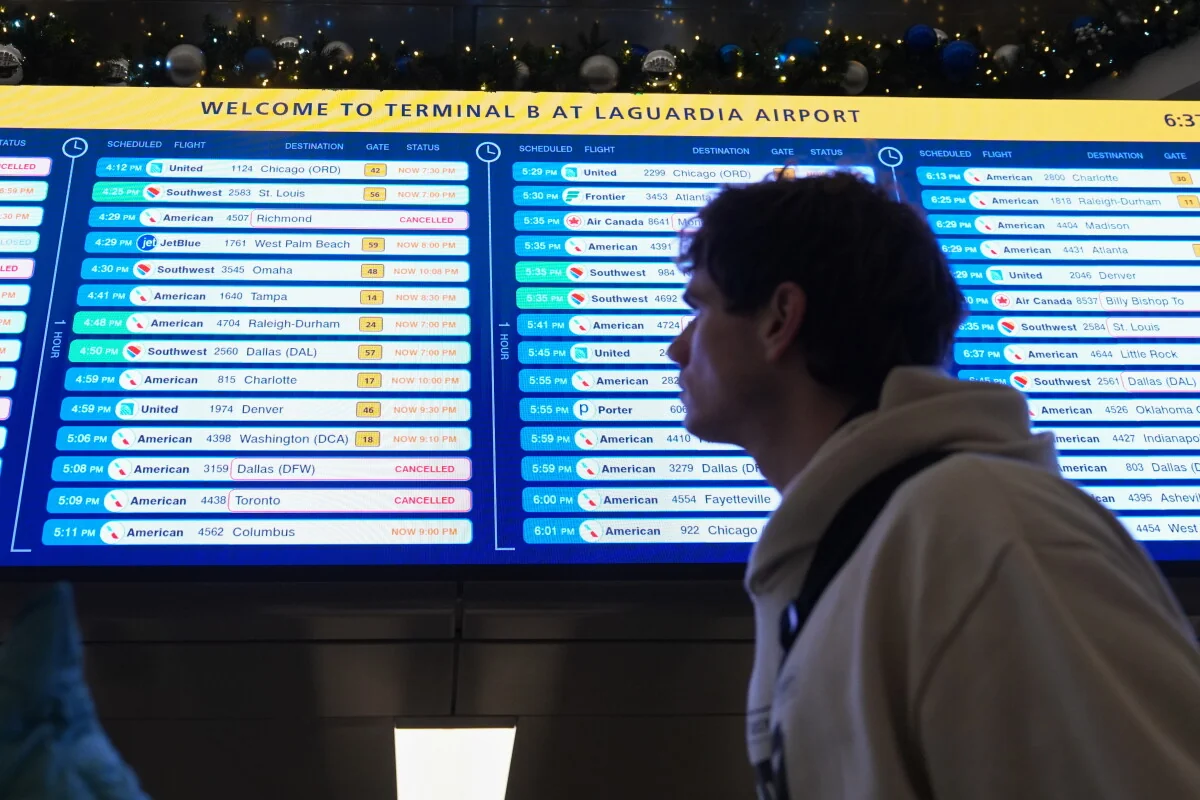
FAA的新SMART AI系統引發質疑,儘管官員否認與地面停飛有關聯
November 17th, 2026
FAA的新SMART AI系統引發質疑,儘管官員否認與地面停飛有關聯
🇹🇼 中文
The airline ground stop that has wreaked havoc on travel since Friday bore no relation to the FAA’s new, $875 million AI-powered system — which the agency is rolling out to help predict problems in the sky — according to government officials and the artificial intelligence company behind the technology.
But the timing of the ground stop, coming so soon before the national rollout of the Federal Aviation Administration's SMART system, has prompted questions regarding what the system does, its benefits and risks relative to the existing human system, and what guardrails exist to address potential problems.
The SMART system is headquartered at a single site near Washington, where a team of experts scrutinizes flight schedules, weather forecasts and hundreds of other data streams; that office then transmits recommendations to the FAA's command center, which in turn relays them to air traffic controllers nationwide for consideration.
Homeland Security Secretary Markwayne Mullin said on Friday that there was no indication the communications issues which precipitated the ground stop were connected to the new computer system, and the senior officials at the Transportation Department and the FAA reaffirmed that position on Saturday.
Air Space Intelligence, or ASI, the startup responsible for designing the system, stated that the ground stop had not been occasioned by “the SMART system, any product of ASI or our integration with FAA and ATC.”
Yet even prior to Friday’s ground stop, legislators and external stakeholders had voiced misgivings regarding the SMART system.
The preceding month, House Democrats dispatched a missive to the U.S. Government Accountability Office, petitioning for an audit of the nascent software and articulating apprehensions pertaining to safety and guardrails.
“Concerningly, the nation’s front line aviation safety workforce apparently had little to no input into SMART’s development and have received limited training and information during the current deployment process,” the Oct. 13 letter said.
“The use of artificial intelligence within SMART has rightfully raised serious questions about its reliability and safety benefits, particularly regarding its potential to interfere with decision-making by experienced air traffic controllers or to hallucinate safety-critical information.”
SMART, however, is not — at least not yet — configured for AI to assume responsibility for flight control; rather, it proffers recommendations to the humans who exercise that control.
In September, Transportation Secretary Sean Duffy and FAA Administrator Bryan Bedford unveiled the system, extolling it as a “cutting-edge tool that centralizes 200 data streams — including weather patterns, flight paths, traffic flow, and controller staffing metrics — into one platform.”
SMART denotes Strategic Management of Airspace, Routes and Trajectories.
According to the announcement, the system’s AI-supported engine synthesizes the data systems and furnishes a “comprehensive visualization” of where planes are heading, how much traffic the system can accommodate, and where congestion or weather might precipitate problems.
The intention is for specialists to subsequently deploy the platform to rectify issues before they materialize.
The FAA reports that during the system's initial trial in the Washington area this autumn, it facilitated the rerouting of 180 flights, averting weather and other complications and thereby saving an average of 10 minutes and 80 gallons of fuel per flight.
The agency stated that, owing to the system's recommendations, one flight from Tampa, Florida, to Dallas reduced its journey time by 42 minutes.
Accordingly, SMART was extended for nationwide deployment on 10 November, encompassing the airspace of all 22 air traffic control centers—a mere three days prior to the ground stop.
According to a government fact sheet on the tool, SMART can predict where air traffic is headed and identify other routes before an area becomes too congested.
The system can also help reopen restricted airspace faster and better manage airport arrivals.
SMART is likewise purported to facilitate the more expeditious handling of weather-related issues.
Currently, the FAA cordons off portions of airspace affected by weather as “large, rectangular boxes,” according to the fact sheet, which fails to reflect how weather actually looks, with fast-moving thunderstorms and storm systems that are “often irregular in shape, with narrow gaps or corridors that aircraft could safely fly through.”
To facilitate this, SMART furnishes the FAA and airspace operators with a “clearer picture of how weather will affect air traffic over time,” thereby enabling air traffic controllers to plan around storms and exploit available airspace rather than unnecessarily shutting down large areas.
According to Michael McCormick, a former FAA airspace manager and an associate professor at Embry-Riddle Aeronautical University, no other country possesses an operational AI air traffic tool comparable to the SMART system; Eurocontrol, the European air traffic authority, has a system undergoing testing, and several manufacturers are prototyping similar tools.
While government officials and ASI, the company behind SMART, have stressed that its AI system is designed to assist humans and not run flight control, its deployment has raised concerns about relying on artificial intelligence when human lives are at stake, given that even the most advanced models are prone to hallucinations — when models fabricate false information and present it as fact.
Mike O’Donnell, a former senior FAA official who spent 17 years at the agency and now engages in aviation safety consulting, said the agency “has got to make sure that this is just a tool in the toolbox and not the actual machine that’s doing the work.”
The FAA, he said, “cannot afford to be wrong on this.”
“It is prudent to deploy it with the appropriate guardrails and backstops to ensure that they are not furnishing controllers with erroneous information predicated on what (AI) has generated,” O’Donnell said.
“There must be a mechanism for verifying and validating what it is doing, so as to guarantee that it is not the wrong information.”
He cautioned against reposing excessive confidence in AI “until we know for sure that it’s proven itself time and time again.
And that’s going to take a while.”
The AI system's launch comes amid a longstanding nationwide shortage of air traffic controllers.
The National Air Traffic Controllers Association has been raising concerns about this for more than a decade, telling Congress in 2015 that the shortage was at a crisis level.
It said then that the FAA had missed its hiring targets for five years in a row.
The union represents about 14,000 controllers, roughly 3,000 of them trainees.
That said, experts say no AI system can replace the human air traffic controllers who spend years training for this highly demanding and stressful job.
In an October interview with NPR, Phillip Buckendorf, co-founder and CEO of ASI, stated that the SMART tool is engineered for traffic managers tasked with overseeing the entirety of U.S. airspace.
“The AI does the math, the AI does the computation,” Buckendorf told NPR, yet the ultimate prerogative as to whether to act upon the system’s recommendation devolves upon the human operator.
“They make the decision, they are the decider, they are the judge.”
November 17th, 2026
Trending Articles

Anthropic 在破紀錄的 IPO 首秀中股價飆升,儘管人們擔憂 AI 會失控
Anthropic Soars in Record-Breaking IPO Debut Despite Fears of AI Running Amok
Anthropic 在破紀錄的 IPO 首秀中股價飆升,儘管人們擔憂 AI 會失控
Anthropic Soars in Record-Breaking IPO Debut Despite Fears of AI Running Amok
Anthropic完成史上最大規模IPO。數字揭示了什麼
Anthropic Secured the Largest IPO Ever. What the Numbers Reveal
Anthropic完成史上最大規模IPO。數字揭示了什麼
Anthropic Secured the Largest IPO Ever. What the Numbers Reveal

美國各大銀行線上銀行服務延宕:須知事項
Online Banking Delays Affecting Major US Banks: What to Know
美國各大銀行線上銀行服務延宕:須知事項
Online Banking Delays Affecting Major US Banks: What to Know
輝達等人工智慧類股驚慌下挫,華爾街再度震顫
Wall Street Trembles Anew as Nvidia and Other Skittish AI Stocks Tumble
輝達等人工智慧類股驚慌下挫,華爾街再度震顫
Wall Street Trembles Anew as Nvidia and Other Skittish AI Stocks Tumble
川普飽受抨擊,盟友要求白宮就技術故障作出交代
Trump Under Fire as Allies Demand White House Answers on Tech Failures
川普飽受抨擊,盟友要求白宮就技術故障作出交代
Trump Under Fire as Allies Demand White House Answers on Tech Failures
華爾街股市暴跌,輝達引領新一輪科技股拋售潮
Wall Street Stocks Plunge as Nvidia Spearheads Another Technology Sell-Off
華爾街股市暴跌,輝達引領新一輪科技股拋售潮
Wall Street Stocks Plunge as Nvidia Spearheads Another Technology Sell-Off
股市重挫,華爾街卻在數日動盪後鎖定勝局,迎來上漲的一週
Stocks Tumble, Yet Wall Street Secures a Winning Week Following Days of Turbulence
股市重挫,華爾街卻在數日動盪後鎖定勝局,迎來上漲的一週
Stocks Tumble, Yet Wall Street Secures a Winning Week Following Days of Turbulence

十月零售支出停滯,居高不下的物價令消費者躊躇不前
Retail Spending Stalled in October as Elevated Prices Gave Shoppers Pause
十月零售支出停滯,居高不下的物價令消費者躊躇不前
Retail Spending Stalled in October as Elevated Prices Gave Shoppers Pause
卡尼:若川普貿易談判破局,加拿大或將轉向中國汽車製造商
Carney: Canada may pivot to Chinese automakers should Trump trade talks collapse
卡尼:若川普貿易談判破局,加拿大或將轉向中國汽車製造商
Carney: Canada may pivot to Chinese automakers should Trump trade talks collapse