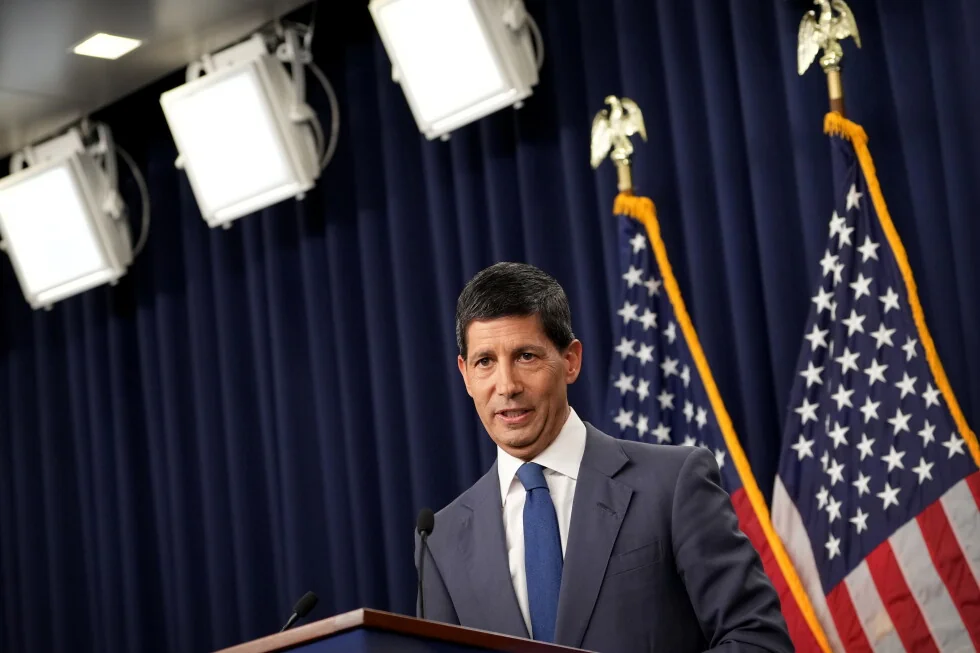
新連邦準備制度理事会議長ケビン・ウォーシュ、インフレと金利に関する姿勢の明確化を迫られる
August 27th, 2026
新連邦準備制度理事会議長ケビン・ウォーシュ、インフレと金利に関する姿勢の明確化を迫られる
🇯🇵 日本語
The newly appointed Federal Reserve chair, Kevin Warsh, has instigated a marked shift in the central bank's communication strategy, offering considerably less commentary on economic conditions and inflation than his predecessors did.
To date, however, many economists and Wall Street investors have remained decidedly unimpressed by that strategy.
On Friday, Warsh has a crucial chance to tackle these issues and demonstrate his credibility as an inflation fighter when he speaks in Jackson Hole, Wyoming, at the Fed's annual economic symposium.
What economists and Wall Street analysts are eagerly hoping for is a clear signal on how he thinks the Fed should handle the persistently high inflation that has caused widespread gloom among consumers.
At his last press conference, he created confusion by avoiding repeated questions about whether the Fed would raise its benchmark interest rate if inflation stays high.
Warsh has said he does not want to provide what analysts call "forward guidance" about whether the Fed will raise, cut, or hold rates at upcoming meetings.
He argues that it limits the Fed's flexibility by committing it to a specific policy.
He also thinks financial markets have become too dependent on such guidance.
Nevertheless, some economists contend that he could elaborate further on his stance regarding Fed policy without disclosing his intentions about prospective moves.
"What he needs to do is to clarify the conceptual framework he’ll bring to directing monetary policy," said David Wilcox, a senior fellow at the Peterson Institute for International Economics.
"He’s refused to provide even that amount of illumination."
Whether Warsh will provide that clarification on Friday remains uncertain.
Last month, he stated that his speech would focus on the "big questions," such as AI and productivity, demographic changes, and how the global economy handles shocks from the Iran war.
The way Warsh and the Fed deal with high prices is not just a Wall Street issue.
Even though inflation has cooled after rising sharply in May and June due to higher gas prices, it is still above the central bank's 2% target.
Surveys show that most Americans still see the cost of necessities like gas, groceries, and housing as a major economic problem as the midterm elections approach.
Notably, interest rates climbed when Warsh last addressed the press on July 29, driving up mortgage borrowing costs after the Fed opted to hold its benchmark rate steady.
“Warsh effectively forfeited market share while he was speaking,” remarked Gennadiy Goldberg, head of U.S. rates strategy at TD Securities.
“He continued to emphasize the need to curb inflation,” yet when journalists pressed him on the specific measures he would implement to accomplish that objective, “he failed to provide a substantive response.”
Warsh told reporters that "any central banker... is more inclined" to raise rates "when he or she sees underlying inflation moving higher," which some economists said was broadly in line with the outlook they had expected.
Warsh, however, has not revealed whether he truly believes that "underlying inflation" is getting worse, nor has he specified the exact method he would use to measure it.
When asked which indicator he would rely on to determine if inflation has hit the 2% target, he pointed to the Fed's current preferred measure—the personal consumption expenditures price index—but then suggested that this could change next year, depending on the recommendations from the task forces he has set up to review issues like data sources and inflation.
When asked if he would support higher rates to combat persistent inflation, he said they "could well be part of that solution," but added, "I wouldn't say it's in isolation."
Some Fed observers interpreted this as a sign that he might consider other measures, such as reducing the Fed's substantial holdings of Treasury bonds.
Selling those bonds could raise longer-term borrowing costs, though over a longer period.
The questions surrounding Warsh have been further compounded by President Donald Trump’s persistent advocacy for reduced interest rates.
Although Trump has continued to defend Warsh, whom he appointed and who assumed office on May 22, the president has nonetheless taken issue with other Fed officials for endorsing higher rates.
Trump has likewise intensified his efforts to remove Federal Reserve Governor Lisa Cook, who was appointed by former President Joe Biden.
Replacing Cook would allow Trump to appoint a majority of the seven-member board.
Trump attempted to dismiss her last year but was temporarily obstructed by the Supreme Court.
"Politics are compounding the Federal Reserve's credibility problems," Diane Swonk, chief economist at KPMG, wrote in a recent commentary.
"That is why his speech later this month matters so much.
It is an opportunity for Warsh to demonstrate his and the Fed's independence from political interference."
Economists noted that offering a clearer indication of his approach to leading the Federal Reserve would require little effort—merely a more explicit articulation of the Fed's potential response should inflation persist at elevated levels.
“None of this is radical stuff,” said Wilcox, who also serves as director of research at Bloomberg Economics.
“The issue is that he hasn’t articulated any of it.
And people are starting to grow uneasy that he won’t voice some seemingly straightforward ideas.”
If Warsh does manage to ease some of these worries, long-term interest rates could dip slightly.
These rates have been rising steadily in recent weeks due to a mix of factors, including growing U.S. government deficits and heavy borrowing by tech companies building AI infrastructure.
The yield on the 30-year Treasury bond hit its highest point in nearly two decades last week, leading Treasury Secretary Scott Bessent to take the unusual step of buying back bonds to push yields lower.
When Warsh speaks on Friday, “I think just yields not rising would be a victory,” said Derek Tang, an economist at Monetary Policy Analytics, a consulting firm.
August 27th, 2026
Trending Articles
ウォーレン・バフェットがバークシャー・ハサウェイの会長職を退き、後継者計画を前進させる
Warren Buffett relinquishes chairman role at Berkshire Hathaway, advancing his succession plan
ウォーレン・バフェットがバークシャー・ハサウェイの会長職を退き、後継者計画を前進させる
Warren Buffett relinquishes chairman role at Berkshire Hathaway, advancing his succession plan
トランプはさらに多くの報道機関を標的にし、CNN、MS NOW、ポリティコをホワイトハウスから締め出すと述べた
Trump targets more news outlets, saying he will ban CNN, MS NOW and Politico from the White House
トランプはさらに多くの報道機関を標的にし、CNN、MS NOW、ポリティコをホワイトハウスから締め出すと述べた
Trump targets more news outlets, saying he will ban CNN, MS NOW and Politico from the White House
日本銀行、主要金利を1.25%に引き上げ、31年ぶりの高水準
Bank of Japan lifts key rate to 1.25%, a 31-year high
日本銀行、主要金利を1.25%に引き上げ、31年ぶりの高水準
Bank of Japan lifts key rate to 1.25%, a 31-year high

Anthropicは、自社のモデルClaudeが自らの後継モデルの構築を支援していると述べている。
Anthropic says its model Claude is helping to build its own successor
Anthropicは、自社のモデルClaudeが自らの後継モデルの構築を支援していると述べている。
Anthropic says its model Claude is helping to build its own successor
連邦準備制度が今利上げに踏み切る理由、そしてそれが何を意味するのか
Why the Federal Reserve is raising rates now, and what it signifies
連邦準備制度が今利上げに踏み切る理由、そしてそれが何を意味するのか
Why the Federal Reserve is raising rates now, and what it signifies
米国株は原油価格と債券利回りの低下を受けて6週間ぶりの高値に急騰
US stocks surge to six-week high as oil prices and bond yields decline
米国株は原油価格と債券利回りの低下を受けて6週間ぶりの高値に急騰
US stocks surge to six-week high as oil prices and bond yields decline
FRBが3年ぶりに主要金利を引き上げ、利下げを求めるトランプの呼びかけに逆らう
Fed hikes key rate for 1st time in 3 years, defying Trump's calls for a cut
FRBが3年ぶりに主要金利を引き上げ、利下げを求めるトランプの呼びかけに逆らう
Fed hikes key rate for 1st time in 3 years, defying Trump's calls for a cut
失業保険申請件数は19万6千件に減少、7月中旬以来の低水準、解雇は依然として低調
Unemployment Claims Fall to 196,000, Lowest Since Mid-July Amid Persistent Low Layoffs
失業保険申請件数は19万6千件に減少、7月中旬以来の低水準、解雇は依然として低調
Unemployment Claims Fall to 196,000, Lowest Since Mid-July Amid Persistent Low Layoffs
トランプ、AIのリスクを「でっち上げ」と非難し、AIとデータセンターに対する「病的な陰謀」を主張
Trump denounces AI risks as a ‘hoax,’ alleging a ‘SICK conspiracy’ against AI and data centers
トランプ、AIのリスクを「でっち上げ」と非難し、AIとデータセンターに対する「病的な陰謀」を主張
Trump denounces AI risks as a ‘hoax,’ alleging a ‘SICK conspiracy’ against AI and data centers
最高裁判所、メイン州のロブスター漁師によるGPS船舶追跡装置要件への異議申し立てを審理へ
Supreme Court to decide on Maine lobsterman’s challenge to GPS boat tracker requirement
最高裁判所、メイン州のロブスター漁師によるGPS船舶追跡装置要件への異議申し立てを審理へ
Supreme Court to decide on Maine lobsterman’s challenge to GPS boat tracker requirement