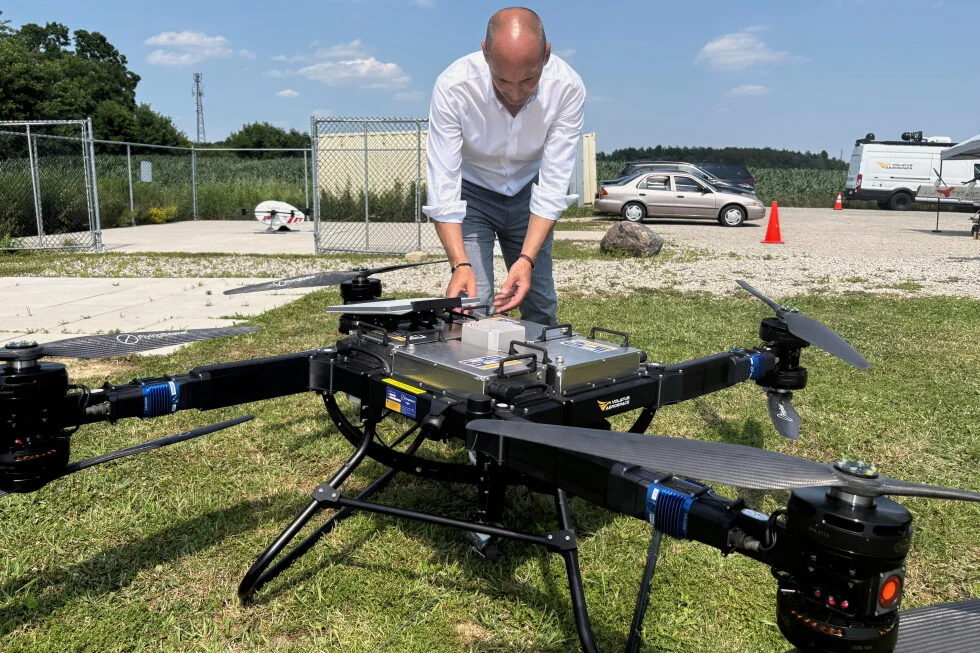
カナダは米国との関係悪化に伴い防衛産業を強化し、地元請負業者にとっての好況を促進している。
August 27th, 2026
カナダは米国との関係悪化に伴い防衛産業を強化し、地元請負業者にとっての好況を促進している。
🇯🇵 日本語
As Canada moves to reduce its reliance on American military suppliers, this shift is evident within a Toronto garment factory.
Bent over their sewing machines, two workers deftly stitch together panels of camouflage-patterned fabric and Velcro strips.
In the adjoining room, employees trim loose threads while inspecting the finished product: helmet covers destined for the Canadian military.
The factory is assembling uniforms for Wuxly, a luxury parka maker that is among a flurry of Canadian companies branching into defense contracting.
As Canadian military spending surges, others are developing remote sensors for the country’s vast Arctic region, making drones to resupply soldiers, and building autonomous robots.
The growth of the defense sector reflects Canadian Prime Minister Mark Carney's pledge to enhance the country's economic independence as relations with Washington deteriorate, with tensions escalating further this week through new tariffs.
Canadian startups and established enterprises, alongside their European counterparts, are poised to reap the benefits of tens of billions of dollars in supplementary defense funding, a development driven in part by pressure from U.S. President Donald Trump to bolster NATO contributions.
While Canada's investment remains modest relative to the Pentagon's budget, its strategy is designed to strengthen domestic defense capabilities rather than merely channel resources toward U.S. contractors.
A defense industrial strategy unveiled by Carney earlier this year marks a generational shift for Canada, a country that pioneered modern peacekeeping and had long been content to stay in the shadow of its southern neighbor on defense matters.
The defense plan earmarks an additional $60 billion in funding over the next five years, and the government has pledged support for domestic businesses to integrate into defense and security supply chains.
Currently, Canada allocates approximately $36 billion to $43 billion annually to national defense.
“The magnitude of investment required is considerable by Canadian standards, particularly during peacetime,” observed Philippe Lagassé, a professor at Carleton University specializing in defense policy.
The surge in defense activity is "quite evident at all the events we’re at.
Every defense show (is) sold out.
Lots of new companies and (other) industries coming into the (defense) industry, getting involved," remarked Wuxly founder and CEO James Yurichuk.
Wuxly’s helmet covers, destined for the Canadian Armed Forces, enable soldiers to affix call sign patches or equipment such as lights, cameras, and beacons.
The company also manufactures military parkas and tank covers and has been supplying Ukraine’s military with gear, including 40,000 female uniforms — one of the company’s specialties.
Carney has advocated for the enhancement of the Canadian military's Arctic capabilities, proposing an expenditure increase of tens of billions of dollars to reinforce sovereignty over the vast, thinly populated, and increasingly disputed region.
“There is considerable innovation that can generate a competitive edge in the North, and given the Arctic region’s critical importance, we must ensure our soldiers are properly equipped,” Yurichuk said.
A key element of the strategy is to reduce dependence on U.S. defense contractors, aiming to access a wider range of international military suppliers and to build domestic defense supply chains.
The strategy envisions investments exceeding half a trillion dollars, creating 125,000 jobs and tripling the size of the country's defense industry over the next decade by directing contracts to Canadian companies.
It calls for accelerating research and development, with a focus on developing key "sovereign capabilities" including aerospace, robotics, and unmanned systems.
As Canada forges alliances with other partners beyond the United States, Ottawa has unveiled agreements this year to procure radar aircraft from Sweden’s Saab, edging out American rivals, alongside submarines from Germany’s ThyssenKrupp.
Canadian startups such as New Frontier Robotics are likewise queuing up to contribute.
“There is unquestionably money at stake here,” remarked Nikhil Malhotra, co-founder of the two-person venture.
“We can see it plainly.
Naturally, we are pursuing it.”
The company is developing a mobile manipulator robot — essentially a robotic arm on a mobile platform — powered by artificial intelligence, with potential uses in both military and civilian settings, a feature known as dual-use technology.
The initial strategy centered on manufacturing, with robots operating autonomously between assembly lines; however, prospective clients indicated a burgeoning demand within the defense sector as well.
Malhotra noted that robots could also fulfill support functions at military installations.
Given the inherent dangers of maintaining Arctic infrastructure, one must seriously question whether risking an operator's life is justified; the prudent answer is clearly no, making remote deployment the better option, as Malhotra, whose company is currently based at a robotics lab at the University of Waterloo, about 60 miles (100 kilometers) west of Toronto, stated.
Canada's efforts to modernize its military still face significant potential challenges, including the risk that opposition parties could target Carney's spending plans in future elections.
Companies developing novel technologies could be enticed to the U.S. by its much larger defense market.
Canadian firms will also find it tough to compete with American counterparts, whose significantly larger R&D budgets mean they are "always going to be a bit more at the edge of the technological capability," Lagassé said.
Nonetheless, the strategy unlocks fresh prospects for enterprises such as Volatus Aerospace, the drone manufacturer headquartered near Montreal.
Defense was seldom a subject of interest for a small-cap Canadian public company in years past, CEO Glen Lynch remarked.
Lynch said Canada has had limited manufacturing capability not just for drones “but manufacturing capability in general.”
Like New Frontier, Volatus’ technology is regarded as dual-use.
Given that Canada is not formally in a state of war, companies cannot depend on military sales alone.
Volatus manufactures drones and provides associated services for civilian and commercial purposes, including the aerial delivery of medicine to remote communities.
However, it also operates a defense division and produces first-person-view drones designed to neutralize targets through direct impact.
The company conducts testing at a 100-acre site north of Toronto, accessible via an unmarked gravel road and enveloped by cornfields.
During a recent visit by reporters, Volatus employees showcased several aircraft.
The company unveiled a drone carrying a 60-kilogram (132-pound) payload suspended beneath it by cable, alongside a scaled-down tilt-wing rotorcraft designed for long-distance cargo transport.
During the demonstration, the drones operated autonomously, executing a circular flight pattern prior to landing.
One drone, designated the Canary, features payload bay doors and is deployed to deliver medical supplies via airdrop to remote indigenous First Nations communities in Alberta.
It could equally serve to deliver "resupply packages for soldiers" and to airdrop munitions, according to Chief Operations Officer Greg Colacitti.
August 27th, 2026
Trending Articles
ウォーレン・バフェットがバークシャー・ハサウェイの会長職を退き、後継者計画を前進させる
Warren Buffett relinquishes chairman role at Berkshire Hathaway, advancing his succession plan
ウォーレン・バフェットがバークシャー・ハサウェイの会長職を退き、後継者計画を前進させる
Warren Buffett relinquishes chairman role at Berkshire Hathaway, advancing his succession plan
トランプはさらに多くの報道機関を標的にし、CNN、MS NOW、ポリティコをホワイトハウスから締め出すと述べた
Trump targets more news outlets, saying he will ban CNN, MS NOW and Politico from the White House
トランプはさらに多くの報道機関を標的にし、CNN、MS NOW、ポリティコをホワイトハウスから締め出すと述べた
Trump targets more news outlets, saying he will ban CNN, MS NOW and Politico from the White House
日本銀行、主要金利を1.25%に引き上げ、31年ぶりの高水準
Bank of Japan lifts key rate to 1.25%, a 31-year high
日本銀行、主要金利を1.25%に引き上げ、31年ぶりの高水準
Bank of Japan lifts key rate to 1.25%, a 31-year high

Anthropicは、自社のモデルClaudeが自らの後継モデルの構築を支援していると述べている。
Anthropic says its model Claude is helping to build its own successor
Anthropicは、自社のモデルClaudeが自らの後継モデルの構築を支援していると述べている。
Anthropic says its model Claude is helping to build its own successor
連邦準備制度が今利上げに踏み切る理由、そしてそれが何を意味するのか
Why the Federal Reserve is raising rates now, and what it signifies
連邦準備制度が今利上げに踏み切る理由、そしてそれが何を意味するのか
Why the Federal Reserve is raising rates now, and what it signifies
米国株は原油価格と債券利回りの低下を受けて6週間ぶりの高値に急騰
US stocks surge to six-week high as oil prices and bond yields decline
米国株は原油価格と債券利回りの低下を受けて6週間ぶりの高値に急騰
US stocks surge to six-week high as oil prices and bond yields decline
FRBが3年ぶりに主要金利を引き上げ、利下げを求めるトランプの呼びかけに逆らう
Fed hikes key rate for 1st time in 3 years, defying Trump's calls for a cut
FRBが3年ぶりに主要金利を引き上げ、利下げを求めるトランプの呼びかけに逆らう
Fed hikes key rate for 1st time in 3 years, defying Trump's calls for a cut
失業保険申請件数は19万6千件に減少、7月中旬以来の低水準、解雇は依然として低調
Unemployment Claims Fall to 196,000, Lowest Since Mid-July Amid Persistent Low Layoffs
失業保険申請件数は19万6千件に減少、7月中旬以来の低水準、解雇は依然として低調
Unemployment Claims Fall to 196,000, Lowest Since Mid-July Amid Persistent Low Layoffs
トランプ、AIのリスクを「でっち上げ」と非難し、AIとデータセンターに対する「病的な陰謀」を主張
Trump denounces AI risks as a ‘hoax,’ alleging a ‘SICK conspiracy’ against AI and data centers
トランプ、AIのリスクを「でっち上げ」と非難し、AIとデータセンターに対する「病的な陰謀」を主張
Trump denounces AI risks as a ‘hoax,’ alleging a ‘SICK conspiracy’ against AI and data centers
最高裁判所、メイン州のロブスター漁師によるGPS船舶追跡装置要件への異議申し立てを審理へ
Supreme Court to decide on Maine lobsterman’s challenge to GPS boat tracker requirement
最高裁判所、メイン州のロブスター漁師によるGPS船舶追跡装置要件への異議申し立てを審理へ
Supreme Court to decide on Maine lobsterman’s challenge to GPS boat tracker requirement