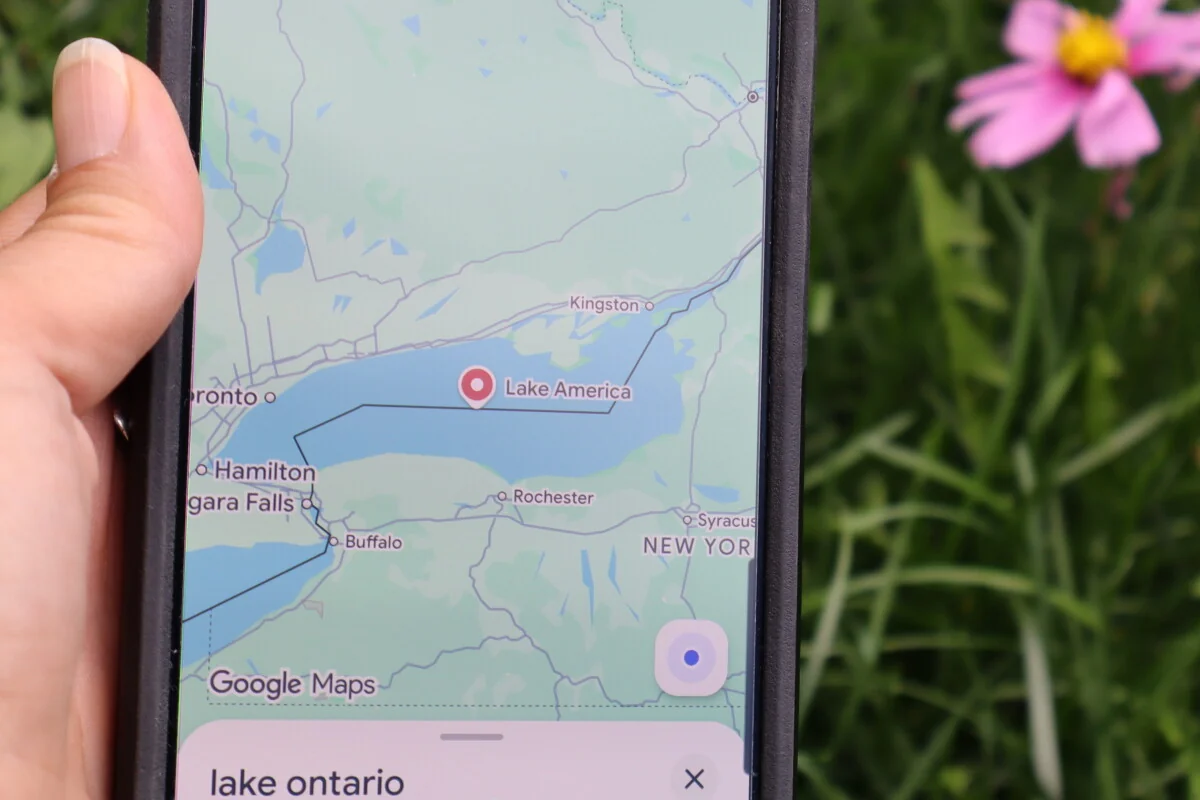
Ein Tech-Tipp: Die Gegenreaktion gegen „Lake America“ weckt Interesse an Google-Maps-Alternativen
November 18th, 2026
Ein Tech-Tipp: Die Gegenreaktion gegen „Lake America“ weckt Interesse an Google-Maps-Alternativen
🇩🇪 Deutsch
The mere fact that Google and Apple have now taken to calling it Lake America does not oblige everyone else to follow suit.
Upon President Donald Trump's issuance of a directive to rename Lake Ontario, the two U.S. tech giants, acquiescing with alacrity, promptly relabeled the body of water across their digital maps.
The move provoked a backlash among certain users, who were already disgruntled by the companies' decisions to rename the Gulf of Mexico the Gulf of America on their maps in the wake of a prior Trump edict.
The controversy and persistent anxieties surrounding digital privacy have stoked interest in map services unaffiliated with Big Tech companies—above all Google Maps, which, by most estimates, commands a dominant position with roughly 80% of the market.
What ensues is a succinct conspectus of several of the most widely adopted gratis alternatives to conventional cartographic applications:
MapQuest has persisted for three decades, only to be supplanted by Google's ascendancy; it now belongs to the California-based company System1.
Downloads of the MapQuest app surged in early September after Apple renamed Lake Ontario, catapulting it to the pinnacle of the free app charts in both the U.S. and Canada on Apple's App Store.
The MapQuest app furnishes real-time traffic updates and turn-by-turn route guidance, whilst additionally displaying nearby amenities such as gas stations and coffee shops.
Nevertheless, the application remains unavailable beyond the borders of the U.S. and Canada; notwithstanding this, individuals in other nations may still avail themselves of the MapQuest website.
The company is presently exploring the prospect of rendering MapQuest more broadly accessible, having received requests for the app from “people in multiple countries,” spokesperson Anne Brownlee said.
Another venerable titan of the mapping industry, TomTom helped popularize GPS route mapping with the 2004 release of its TomTom GO, which the Dutch company says was the world’s first all-in-one portable satellite navigation device.
TomTom persists in marketing physical devices; nonetheless, it also proffers a complimentary mapping application for Google and Android phones, engineered “exclusively for drivers” and replete with real-time traffic data together with information on road hazards.
The TomTom app's mobile interface is clean and rudimentary, devoid of advertisements and offering few supplementary features or settings.
However, its driver-centric orientation precludes alternative routing options such as walking or cycling.
HERE WeGo has been lauded by some as the closest non-Big Tech alternative to Google Maps; having originated as Nokia Maps, it is now owned by a consortium of German carmakers including Audi, BMW, and Mercedes-Benz.
The complimentary application, compatible with both iOS and Android platforms, furnishes a substantial array of functionalities on a par with those of Google Maps, encompassing route planning across a diversity of transport modalities — automobile, public transit, pedestrian, cycling and, in certain regions, taxi.
Much as with Google Maps, drivers are afforded the capacity to append multiple stops to their routes, and users may elect from an array of map views — terrain, traffic and satellite among them — yet Street View is conspicuously absent.
Where the mobile signal proves patchy or altogether absent, users may download country maps, thereby enabling offline navigation.
Offline maps are likewise obtainable via Google Maps; however, the area covered is restricted, and they lapse after a year.
Subsequent to the story's initial publication, a reader observed that the app designates the body of water as Lake America rather than Lake Ontario.
HERE Technologies, the app's proprietor, confirmed that it had amended the name to Lake America for users situated in the United States.
“Under our uniform global policy, HERE updates nomenclature in accordance with changes instituted by international and national standards bodies, such as the United States Board on Geographic Names,” spokesperson Jordan Stark said.
HERE WeGo is merely one among numerous comparatively obscure map applications headquartered within the European Union that espouse the bloc’s stringent privacy framework, known as GDPR.
In contradistinction to Google, they eschew the practice of indiscriminately hoovering up vast quantities of user data in order to peddle advertisements targeted at those very users.
HERE WeGo’s business model hinges upon licensing arrangements with enterprises such as trucking companies, whereas others purvey premium subscriptions alongside free-tier offerings.
Estonia's Organic Maps is entirely free of charge and predicated upon data drawn from the volunteer-operated OpenStreetMap database.
Netherlands-based OSMand is comparable, yet a subscription proves requisite for access to anything beyond merely basic functions.
Magic Earth, a Dutch route planner, asserts that it neither collects personal data nor tracks user movements.
Sygic, a Slovakian enterprise, is a GPS route-navigation application affording complimentary offline maps; nevertheless, procuring supplementary features—traffic updates, speed-camera alerts and a dashcam facility among them—necessitates the acquisition of a subscription.
Mapy.com, the brainchild of a Czech technology company, is an outdoor route planner whose hallmark is its meticulously detailed hiking and trail maps, downloadable for offline use.
Compelled to traverse the metropolis bereft of a car?
Citymapper is a complimentary journey-planning application that stands as a formidable rival to Google Maps in the matter of devising optimal routes across a city by way of public transportation.
Spanning 430 cities across the globe, the application proffers a spectrum of options encompassing bus, subway and ferry routes alongside taxi, rental bike and scooter alternatives.
This GPS navigation map is dedicated to furnishing drivers with route guidance, and it is celebrated for crowdsourcing real-time traffic intelligence—such as car accidents and police speed cameras—from fellow motorists.
Yet one ought not to be misled by the name: notwithstanding its own distinctive app and branding, Waze is in fact owned by Google, which acquired it in 2013.
Is there a tech topic you believe stands in need of elucidation?
Write to us at [email protected] with your suggestions for forthcoming editions of One Tech Tip.
November 18th, 2026
Trending Articles
Sie vermuten, Opfer eines Betrugs geworden zu sein? Lesen Sie dies
Suspect You've Been Scammed? Read This
Sie vermuten, Opfer eines Betrugs geworden zu sein? Lesen Sie dies
Suspect You've Been Scammed? Read This

Zentrale Erkenntnisse aus der AP- und FRONTLINE-Untersuchung zu Sextortion
Key Findings from the AP and FRONTLINE Sextortion Investigation
Zentrale Erkenntnisse aus der AP- und FRONTLINE-Untersuchung zu Sextortion
Key Findings from the AP and FRONTLINE Sextortion Investigation

Ein Tech-Tipp: Mit Apples Duo-Telefonstart – Gebote und Verbote bei Falt-Handys
One Tech Tip: With Apple’s Duo phone launch, folding-phone dos and don’ts
Ein Tech-Tipp: Mit Apples Duo-Telefonstart – Gebote und Verbote bei Falt-Handys
One Tech Tip: With Apple’s Duo phone launch, folding-phone dos and don’ts

Der Vorsitzende von Nvidia sagt, der Vorstand habe nicht die Absicht, Jensen Huang wieder als CEO einzusetzen.
Nvidia chairman says board has no intention of reinstating Jensen Huang as CEO
Der Vorsitzende von Nvidia sagt, der Vorstand habe nicht die Absicht, Jensen Huang wieder als CEO einzusetzen.
Nvidia chairman says board has no intention of reinstating Jensen Huang as CEO

Jensen Huang bricht sein Schweigen: Lesen Sie hier seine vollständige Erklärung
Jensen Huang Breaks His Silence: Read His Full Statement Here
Jensen Huang bricht sein Schweigen: Lesen Sie hier seine vollständige Erklärung
Jensen Huang Breaks His Silence: Read His Full Statement Here

Ist es akzeptabel, wenn KI deinem Freund schreibt? Wenn persönliches Messaging per Chatbot eine Grenze überschreitet
Is It Acceptable for AI to Text Your Boyfriend? When Chatbot Personal Messaging Crosses a Line
Ist es akzeptabel, wenn KI deinem Freund schreibt? Wenn persönliches Messaging per Chatbot eine Grenze überschreitet
Is It Acceptable for AI to Text Your Boyfriend? When Chatbot Personal Messaging Crosses a Line

In ihren Schlussplädoyers stellten die Staatsanwälte Huawei als Bösewicht dar; der Anwalt des Unternehmens widersprach.
In Closing Arguments, Prosecutors Cast Huawei as Villain; Its Lawyer Disagrees
In ihren Schlussplädoyers stellten die Staatsanwälte Huawei als Bösewicht dar; der Anwalt des Unternehmens widersprach.
In Closing Arguments, Prosecutors Cast Huawei as Villain; Its Lawyer Disagrees
Brillen und Hemdknöpfe sollen kontrolliert werden, um Betrug bei Südkoreas Hochschulaufnahmeprüfungen einzudämmen
Glasses and Shirt Buttons to Be Inspected to Curb Cheating in South Korea’s College Entrance Exams
Brillen und Hemdknöpfe sollen kontrolliert werden, um Betrug bei Südkoreas Hochschulaufnahmeprüfungen einzudämmen
Glasses and Shirt Buttons to Be Inspected to Curb Cheating in South Korea’s College Entrance Exams
FAA stoppt Router-Installationen im Zusammenhang mit Störungen des Luftverkehrs
FAA Halts Router Installations Linked to Air Travel Disruption
FAA stoppt Router-Installationen im Zusammenhang mit Störungen des Luftverkehrs
FAA Halts Router Installations Linked to Air Travel Disruption