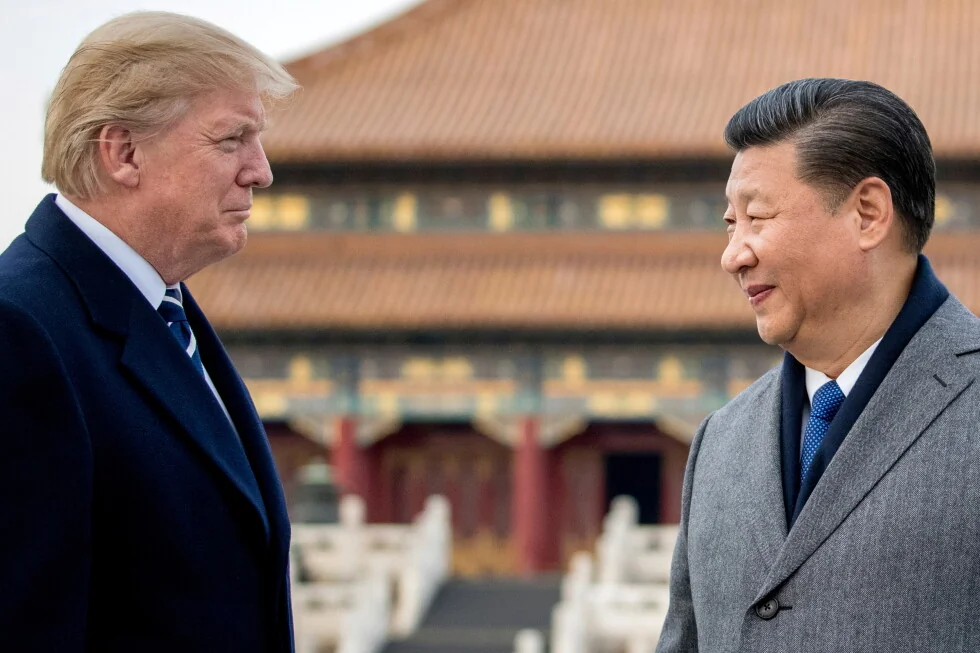
特朗普与习近平在寻求稳定的同时应对人工智能、贸易和伊朗问题上不断升级的紧张局势
September 22nd, 2026
特朗普与习近平在寻求稳定的同时应对人工智能、贸易和伊朗问题上不断升级的紧张局势
🇨🇳 中文
State visits typically take place when two countries have friendly relations, yet U.S. President Donald Trump is hosting Chinese leader Xi Jinping in Washington this week while their economic and technological competition is only worsening, especially in an artificial intelligence race.
Neither side expects any grand bargain, but the leaders are expected to play nice in their third meeting since Trump returned to the White House, aiming to steady fragile ties.
That is despite the world’s two largest economies seeking the upper hand on AI developments and trade, while pushing for leverage in persistent hot spots like Iran and Taiwan.
“The fact that they are meeting, and there’s dialogue occurring and building that relationship, is probably as important as outcomes from the meeting,” said Sen. Steve Daines, a Montana Republican who advises Trump on China and recently traveled there to lay groundwork for the summit.
Cui Tiankai, a former Chinese ambassador to the U.S., remarked at a recent forum in Beijing that there are “always problems, sometimes very big problems” between the two countries, but “we’ll make our best efforts to maintain overall stability.”
Xi's visit to Washington, which begins Wednesday, is his first in 10 years.
He and Trump are meeting after their countries stepped back from last year's intense trade war, in which they exchanged reciprocal sky-high tariffs that threatened the global economy.
China also cut off its world-leading supplies of critical minerals needed in products from electric cars to fighter jets.
The U.S. is not only trying to balance trade but also maintain its tech dominance to protect national security and global leadership.
China, which has amassed tremendous economic, technological and military power over the past several years to close gaps with the U.S., is seeking to solidify its place in the global order.
The stability both sides are pursuing is “for deeply competitive reasons,” said Evan Medeiros, a senior adviser at The Asia Group consultancy.
“This is essentially two geopolitical strongmen circling each other on the playground, trying to determine what their next move may be.”
Da Wei, director of the Center for International Security and Strategy at Tsinghua University in Beijing, said the countries appeared to be entering a "new normal" of "overall stability", despite blacklisting each other's companies and restricting the flow of high-tech products.
The leaders must now forge agreements that their governments are capable of implementing, he said, observing that “we need to move fast.”
This website is safeguarded by reCAPTCHA, and the Google Privacy Policy and Terms of Service are applicable.
The development of AI technology has become a key battleground, with neither side showing any interest in slowing down despite warnings from tech CEOs about the threats that rogue AI could pose to humanity.
“Whoever wins AI wins,” Trump has repeatedly said.
He asserted on social media Monday that the U.S. is ahead of China and that he was “not going to stifle Growth, of something that will be bigger than the Industrial Revolution, or the Internet, itself.”
China cannot afford to lose either.
In a rare, blunt essay, Chen Yixin, head of China’s Ministry of State Security, warned that AI poses a direct threat to Communist Party rule if foreign and hostile forces achieve superior capabilities.
The U.S. is already restricting exports of its most powerful AI chips to China and has accused Chinese developers of exploiting American AI models on an industrial scale to extract their capabilities.
Beijing says the practice, known as distillation, is widely used, including by American companies, and has criticized the U.S. for trying to monopolize the industry.
Beijing is equally displeased by U.S. efforts to build an alliance that excludes China, and is therefore seeking to establish new global AI guardrails by appealing to developing nations.
Nevertheless, the United States and China are taking a modest step toward cooperation on AI.
After meeting with Chinese Vice Premier He Lifeng in New York on Sunday, Treasury Secretary Scott Bessent said the U.S. has proposed a new “notification mechanism” for AI incidents that could affect national security.
"We believe that, as with any cross-border activity, moving from opacity toward greater transparency between the world's number one and number two AI powers is very important," Bessent said.
Although the U.S. and China have refrained from taking broad, punitive actions that would break their trade truce, they still blacklist individual companies and ban specific products.
"What we've seen is essentially both sides testing and probing to understand what can be done competitively, while still keeping that leader-level rapprochement on track," said Mira Rapp-Hooper, a visiting fellow at the Brookings Institution's Center for Asia Policy Studies.
The United States has recently targeted Chinese telecommunications and surveillance equipment, companies accused of using forced labor in the ethnic region of Xinjiang, as well as China's advanced robots and drones.
The Pentagon has also barred Alibaba, BYD, Baidu and other major Chinese businesses from receiving U.S. defense contracts.
Beijing responded by imposing export controls on drones and related technologies, as well as by blacklisting six U.S. companies for their support of the punitive measures tied to Xinjiang.
After the Supreme Court struck down Trump's tariffs on trade partners this year, the administration has been trying to impose them in other ways.
In July, the White House rolled out a 12.5% tariff on imports from 60 trading partners, including China, ostensibly because they had not done enough to prevent the import of goods produced by forced labor.
The U.S. is planning an additional 7.5% tariff on China, accusing it of producing far more goods than it can reasonably consume.
Analysts contend that the tariff levels are now deemed acceptable by both parties, yet any substantial escalation could reignite tensions.
The Trump administration, however, has launched a campaign to isolate Iran from its remaining economic partners, but Beijing has insisted on its right to trade with Tehran.
So far, the Trump administration has done little to punish China, partly to avoid jeopardizing the leaders’ summit.
But Washington is also losing leverage because China — Iran’s biggest oil buyer and its largest trading partner — has been building up a way to make payments outside the U.S.-led financial system, said Alicia Garcia Herrero, an Asia-Pacific economist at the French investment bank Natixis.
Taiwan, a self-governing island that Beijing claims as its own territory, remains one of the most difficult issues in U.S.-China relations.
After his May trip to Beijing, Trump put a large weapons package to Taiwan on hold, but the U.S. is required by a domestic law to provide it with enough hardware and technology for self-defense.
Analysts say Xi will most likely press Trump to further delay arms sales to sow doubts in Taiwan about Washington's commitment.
September 22nd, 2026
Trending Articles
华尔街逼近纪录高位,布伦特原油一度跌破每桶98美元
Wall Street Nears Record as Brent Crude Briefly Dips Below $98 a Barrel
华尔街逼近纪录高位,布伦特原油一度跌破每桶98美元
Wall Street Nears Record as Brent Crude Briefly Dips Below $98 a Barrel
韩国李在明对美联社表示,他倾向于以循序渐进的方式实现朝鲜无核化
South Korea's Lee tells AP he favors a step-by-step approach to North Korea's nuclear dismantlement
韩国李在明对美联社表示,他倾向于以循序渐进的方式实现朝鲜无核化
South Korea's Lee tells AP he favors a step-by-step approach to North Korea's nuclear dismantlement

俄罗斯与乌克兰在泽连斯基与特朗普会晤前互施致命打击
Russia and Ukraine exchange deadly strikes before Zelenskyy-Trump meeting
俄罗斯与乌克兰在泽连斯基与特朗普会晤前互施致命打击
Russia and Ukraine exchange deadly strikes before Zelenskyy-Trump meeting
沃伦·巴菲特卸任伯克希尔·哈撒韦董事长一职,推进其继任计划
Warren Buffett relinquishes chairman role at Berkshire Hathaway, advancing his succession plan
沃伦·巴菲特卸任伯克希尔·哈撒韦董事长一职,推进其继任计划
Warren Buffett relinquishes chairman role at Berkshire Hathaway, advancing his succession plan
特朗普针对更多新闻媒体,称将禁止CNN、MS NOW和Politico进入白宫
Trump targets more news outlets, saying he will ban CNN, MS NOW and Politico from the White House
特朗普针对更多新闻媒体,称将禁止CNN、MS NOW和Politico进入白宫
Trump targets more news outlets, saying he will ban CNN, MS NOW and Politico from the White House
日本银行将关键利率上调至1.25%,创31年来新高
Bank of Japan lifts key rate to 1.25%, a 31-year high
日本银行将关键利率上调至1.25%,创31年来新高
Bank of Japan lifts key rate to 1.25%, a 31-year high
Anthropic表示,其模型Claude正在帮助构建自己的继任者
Anthropic says its model Claude is helping to build its own successor
Anthropic表示,其模型Claude正在帮助构建自己的继任者
Anthropic says its model Claude is helping to build its own successor
美联储为何现在加息,以及这标志着什么
Why the Federal Reserve is raising rates now, and what it signifies
美联储为何现在加息,以及这标志着什么
Why the Federal Reserve is raising rates now, and what it signifies
美国股市飙升至六周高点,因油价和债券收益率下跌
US stocks surge to six-week high as oil prices and bond yields decline
美国股市飙升至六周高点,因油价和债券收益率下跌
US stocks surge to six-week high as oil prices and bond yields decline