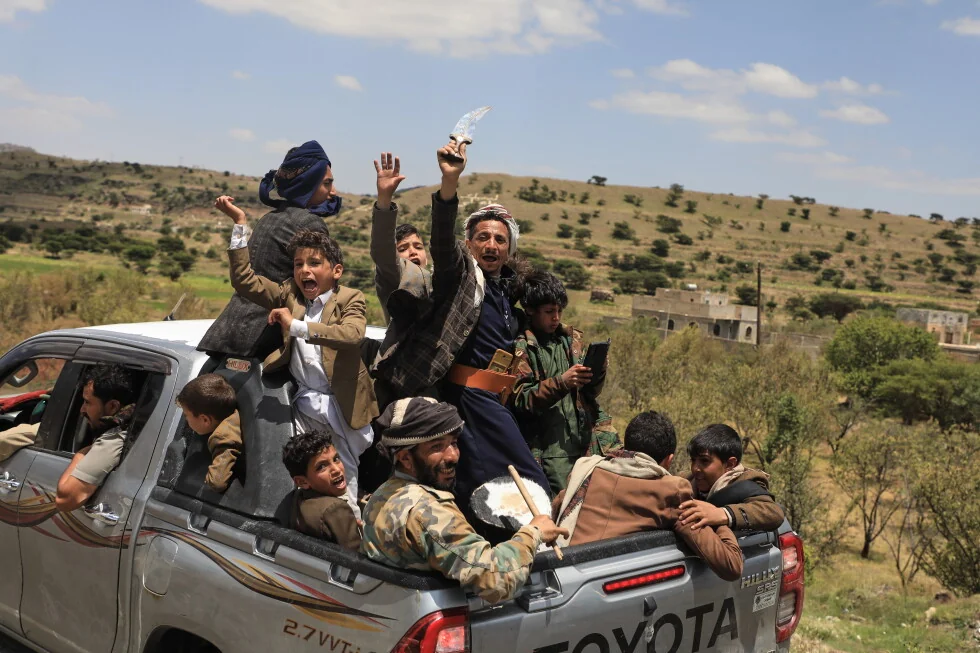
胡塞武装在更广泛的中东变局中夺取红海两座战略岛屿
September 14th, 2026
胡塞武装在更广泛的中东变局中夺取红海两座战略岛屿
🇨🇳 中文
Yemen’s Houthi rebels have seized the strategically important islands of Greater and Lesser Hanish in the southern Red Sea, thereby enhancing the Iran-backed rebels’ capacity to control a crucial maritime shipping route.
Meanwhile, according to two regional officials, repairs to a vital Saudi Arabian oil pipeline that was targeted in an attack last week could take three to five weeks, rendering it largely inoperative.
Herein lies an overview of the most recent developments in the Middle East.
Comprehensive coverage is accessible here.
Houthi officials said on Monday that the rebels had seized the two islands just as Saudi-backed government forces attempted to retake territory from the rebels' rapid advances around the Bab el-Mandeb Strait, a vital shipping route that serves as an alternative to the Strait of Hormuz.
In the opening days of the war, Iran effectively shut down the Strait of Hormuz — through which a fifth of the world’s traded oil and gas passes in peacetime.
Since then, the Saudis have resorted to the Bab el-Mandeb Strait, which leads out of the Red Sea, for their crude oil exports.
The Houthis' latest takeover, following their seizure of the Red Sea port of Mokha and a strategic island last week, places additional strain on Saudi shipments and, in turn, on global oil supplies and prices.
This could afford Iran additional leverage in its conflict with the United States.
Saudi Arabia depends on the East-West Pipeline to transport crude oil from Gulf ports to ports along its western, Red Sea coast, from where it can be loaded onto tankers for export.
Two officials, who were briefed on the matter, stated that repairing the damage resulting from an attack on Sept. 10 could take weeks, including at a major pumping facility.
The officials spoke on the condition of anonymity, as they were not authorized to brief the media.
One indicated that the line might function only partially while crews proceed with the repairs.
China, a major importer of Middle Eastern oil, called the Houthi attacks on Saudi energy infrastructure “unacceptable” and said it was “deeply concerned” about further escalation by the rebels.
— By Samy Magdy, reporting from Cairo
Esmail Baghaei, a spokesman for Iran's Foreign Ministry, said on Monday that Saudi Arabia had "demanded" that a meeting bringing Iran together with other regional countries to discuss the Strait of Hormuz be scrapped "for the time being."
Baghaei characterised the meeting, which was to be hosted by Oman, as a “proper opportunity” to restore security in the region.
The spokesman stated that an agreement between Iran and Oman concerning the Strait of Hormuz had been finalized and would be announced at a later time.
Saudi Arabia had submitted amendments to the agreement, citing concerns that it could have lasting implications for the Strait of Hormuz and negatively impact other Gulf Cooperation Council countries, according to a Gulf official familiar with the matter who wasn't authorized to comment publicly and spoke on condition of anonymity.
On Monday, Iran denounced Austria's refusal to issue visas to its nuclear chief and other delegation members for the International Atomic Energy Agency's general conference in Vienna, calling the decision "completely unjustified."
Baghaei stated that Tehran had summoned the Austrian chargé d’affaires, asserting that Austria, as the host country, was obligated to issue the visas.
Baghaei levelled accusations against Western countries of depriving Iran of an opportunity to defend itself, and attributed blame to the U.S. for exerting pressure on Austria to refuse the visas.
The refusal forms part of the U.N. sanctions imposed on Iran, reinstated last year, which encompass a travel ban on Iranian officials.
On Monday, U.S. Energy Secretary Chris Wright voiced criticism of Iran for its lack of cooperation with the U.N. nuclear watchdog.
Wright was especially critical of Tehran's refusal to allow U.N. inspectors into Iran's nuclear sites affected by the war.
He said Iran had "ample time to address its egregious negligence" regarding its obligations "but that time is up."
Speaking at the IAEA general conference in Vienna, Wright said that giving Iran more time “only delays overdue accountability.”
Wright said that the additional safeguards contained in a U.S.-Saudi nuclear accord include “absolutely rigorous” terms against proliferation.
He told the IAEA general conference that the U.N. nuclear agency “was part of it all along.”
The U.S.-Saudi accord, signed in July, could potentially give the kingdom the ability to enrich uranium for its civilian nuclear program.
Wright was responding to a media inquiry as to why the U.S. had requested that Iran sign an Additional Protocol while not making the same request of Saudi Arabia.
The Additional Protocol is an agreement between the IAEA and a country that grants agency inspectors expanded access to nuclear sites.
Nearly 94,000 individuals have been displaced from their homes in Yemen since hostilities between Iran-backed Houthi rebels and government forces intensified this month, the International Organization for Migration reported on Monday.
The most severely affected regions are Taiz and Lahj, where 48,000 individuals have been displaced, according to the U.N. agency, which further noted that over 2,000 people have crossed the sea into Djibouti.
In southwestern Yemen, approximately 200 schools have been repurposed as shelters to accommodate an influx of families, according to the International Rescue Committee, an aid organisation.
Fears are growing that Yemen is moving closer to a return to civil war, which killed 150,000 people before a 2022 ceasefire.
The World Health Organization said more than 500 people were killed in a weeklong period ending Saturday, a sharp increase.
According to hospital officials and the health ministry, Israeli strikes carried out across the Gaza Strip on Monday resulted in two fatalities and left several others wounded.
According to Shifa and Nasser hospitals, one individual was killed in Gaza City, whilst the other perished when a strike struck tents in Muwasi.
The strikes additionally inflicted casualties in Zawaida, situated in central Gaza, and in Khan Younis in the south of the territory, according to the health ministry.
The Israeli military acknowledged the strikes, stating that they had been directed at militants.
Although the most intense hostilities between Israel and Hamas have abated since a ceasefire in October, Israeli fire has nonetheless claimed the lives of more than 1,360 Palestinians in Gaza, according to health officials in the territory.
The B’Tselem human rights group said on Monday that Israel is carrying out a systematic and accelerated project aimed at “dismantling the foundations of Palestinian existence” in the occupied West Bank.
In a new report, the group said that Israeli actions against Palestinians in the West Bank, carried out by settlers and the military, are intended to undermine Palestinian collective life "while entrenching a permanent system of Jewish supremacy" across the territory.
Settler violence has escalated markedly under the ultranationalist government of Israeli Prime Minister Benjamin Netanyahu.
Rights groups contend that the military routinely turns a blind eye to such violence and that, when it does intervene, it frequently prioritizes the protection of settlers.
The B’Tselem report also says that Israeli actions rely heavily on open cooperation between state authorities and armed settlers who attack Palestinian communities, while the military either fails to prevent the violence or sometimes participates in it.
On Monday, the U.S. Treasury Department imposed full sanctions on VTB Bank — one of Russia's largest financial institutions — as part of its efforts to target Iran's remaining financial lifelines.
But the impact of the sanctions remains unclear, since the Biden administration had also imposed sweeping sanctions on the state-owned bank soon after Russia's invasion of Ukraine in 2022.
Under Trump, U.S. officials are now accusing the institution of helping the Islamic Republic evade sanctions by establishing correspondent relationships with sanctioned Iranian banks.
For years, VTB Bank has been expanding its global presence, including opening branches in China, India and Iran.
This report will be revised continuously over the course of the day as further developments come to light.
September 14th, 2026
Trending Articles
沃伦·巴菲特卸任伯克希尔·哈撒韦董事长一职,推进其继任计划
Warren Buffett relinquishes chairman role at Berkshire Hathaway, advancing his succession plan
沃伦·巴菲特卸任伯克希尔·哈撒韦董事长一职,推进其继任计划
Warren Buffett relinquishes chairman role at Berkshire Hathaway, advancing his succession plan
特朗普针对更多新闻媒体,称将禁止CNN、MS NOW和Politico进入白宫
Trump targets more news outlets, saying he will ban CNN, MS NOW and Politico from the White House
特朗普针对更多新闻媒体,称将禁止CNN、MS NOW和Politico进入白宫
Trump targets more news outlets, saying he will ban CNN, MS NOW and Politico from the White House
日本银行将关键利率上调至1.25%,创31年来新高
Bank of Japan lifts key rate to 1.25%, a 31-year high
日本银行将关键利率上调至1.25%,创31年来新高
Bank of Japan lifts key rate to 1.25%, a 31-year high
Anthropic表示,其模型Claude正在帮助构建自己的继任者
Anthropic says its model Claude is helping to build its own successor
Anthropic表示,其模型Claude正在帮助构建自己的继任者
Anthropic says its model Claude is helping to build its own successor
美联储为何现在加息,以及这标志着什么
Why the Federal Reserve is raising rates now, and what it signifies
美联储为何现在加息,以及这标志着什么
Why the Federal Reserve is raising rates now, and what it signifies

美国股市飙升至六周高点,因油价和债券收益率下跌
US stocks surge to six-week high as oil prices and bond yields decline
美国股市飙升至六周高点,因油价和债券收益率下跌
US stocks surge to six-week high as oil prices and bond yields decline
美联储三年来首次加息,无视特朗普的降息呼吁
Fed hikes key rate for 1st time in 3 years, defying Trump's calls for a cut
美联储三年来首次加息,无视特朗普的降息呼吁
Fed hikes key rate for 1st time in 3 years, defying Trump's calls for a cut
失业救济申请人数降至19.6万,为7月中旬以来最低,裁员人数持续处于低位
Unemployment Claims Fall to 196,000, Lowest Since Mid-July Amid Persistent Low Layoffs
失业救济申请人数降至19.6万,为7月中旬以来最低,裁员人数持续处于低位
Unemployment Claims Fall to 196,000, Lowest Since Mid-July Amid Persistent Low Layoffs
特朗普谴责人工智能风险是“骗局”,声称存在针对人工智能和数据中心的“病态阴谋”
Trump denounces AI risks as a ‘hoax,’ alleging a ‘SICK conspiracy’ against AI and data centers
特朗普谴责人工智能风险是“骗局”,声称存在针对人工智能和数据中心的“病态阴谋”
Trump denounces AI risks as a ‘hoax,’ alleging a ‘SICK conspiracy’ against AI and data centers

最高法院将就缅因州龙虾渔民对GPS船只追踪器要求的挑战作出裁决
Supreme Court to decide on Maine lobsterman’s challenge to GPS boat tracker requirement
最高法院将就缅因州龙虾渔民对GPS船只追踪器要求的挑战作出裁决
Supreme Court to decide on Maine lobsterman’s challenge to GPS boat tracker requirement