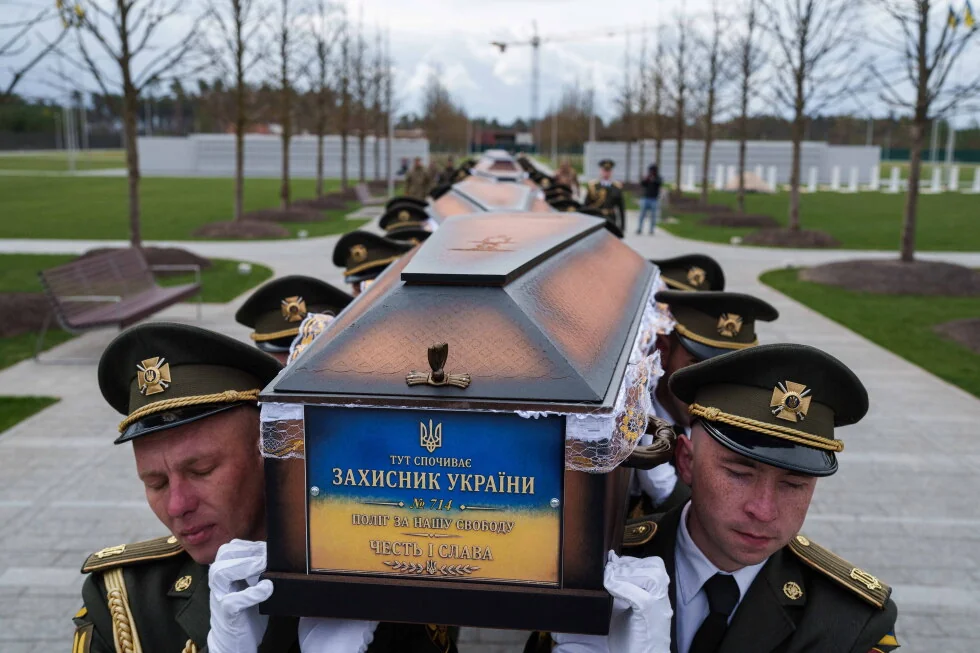
Within a military cemetery in Kyiv, a brother and sister, clutching carnations, weave their way through a dense forest of crosses.
在基辅的一座军人公墓内,一对兄妹手持康乃馨,穿行于林立的十字架之间。
Each cross in this section bears the same inscription: 'Unknown Defender of Ukraine,' beneath which a string of numbers is etched, along with a note indicating that identification procedures are ongoing.
该区域的每一座十字架上,均镌刻着相同的铭文:“乌克兰的无名保卫者”,其下方附有一串编号,并注明身份鉴定工作正在进行中。
Amidst this expanse of graves, one tombstone stands out with particular poignancy: beneath its epitaph, a photograph was later affixed.
在这片墓群之中,一座坟茔尤为引人注目:其铭文下方,后来被贴上了一帧照片。
The soldier in the photograph is none other than Ihor Yalynych—the last time he was seen alive was in the Kharkiv region in 2022.
照片中的士兵,正是伊霍尔·亚利内奇——他最后一次被人目睹尚在人世,是在2022年的哈尔科夫地区。
After four years of arduous searching, Stanislav and Oleksandra Yalynych have finally located their father.
历经四载苦苦寻觅,斯坦尼斯拉夫与奥列克桑德拉·亚利内奇,终于寻获了他们的父亲。
The identification of the deceased will be a protracted process of reckoning, arguably one of the most profound wounds left by the Russo-Ukrainian War.
对死者的身份鉴定将是一场旷日持久的清算过程,堪称俄乌战争所遗留的最为深重的创伤之一。
Some graves may forever remain lost to obscurity, leaving their loved ones with nothing but an interminable wait.
某些墓葬或许将永远湮没无闻,留给亲人的唯有无尽等待。
For much of the conflict, unidentified fallen soldiers could not be interred, their remains merely stored in refrigerated warehouses while the national military cemetery remained under construction.
在战争的大部分时期,身份不明的阵亡者无处安葬,其遗体只得暂存于冷藏库中,而国家军人公墓仍在营建。
Although the cemetery was not completed until January of the following year, the first unknown soldiers had already been laid to rest the preceding August.
即便公墓于次年一月方才竣工,首批无名士兵却已于前一年八月入土。
Today, over three hundred sets of remains lie beneath numbered crosses, while further graves continue to be excavated.
如今,三百余具遗骸静卧于编号十字架之下,而更多的墓穴仍在开掘之中。
"I was my father's close confidante, his 'little padded jacket,' and his death shattered me," says 21-year-old Oleksandra Yalynych.
“我曾是父亲贴身的‘小棉袄’,他的离世令我痛彻心扉,”二十一岁的奥列克桑德拉·亚利内奇如是说。
"For these four years, my sole yearning was to sit beside him and converse with him... Now, I am relieved that I have finally found him.
“这四年来,我唯一的念想便是能坐到他身旁,与他倾谈……如今,我庆幸终于寻到了他。
Henceforth, I have a place to mourn."
从此,我有了一个可以凭吊的归宿。”
Ihor Yalynych fell in battle in eastern Ukraine in April 2022.
伊霍尔·亚利内奇于2022年4月在乌克兰东部阵亡。
He had been serving since 2015, at a time when the armed conflict in eastern Ukraine had already erupted and Russia had unlawfully annexed Crimea.
他自2015年起服役,彼时乌克兰东部的武装冲突已然爆发,且俄罗斯已非法吞并克里米亚。
At the onset of Russia's full-scale invasion in 2022, he was serving in a brigade stationed in eastern Ukraine.
2022年俄罗斯发动全面入侵之际,他正服役于驻扎在乌克兰东部的一个旅。
He returned safely from his first mission and even sent photographs to his son; however, after the second mission, he vanished without a trace.
首次任务中他安然归来,还向儿子发送了照片,然而第二次任务后,他便杳无音讯。
After weeks of utter silence, Stanislav took to social media to announce his father's disappearance.
在音讯杳然数周之后,斯坦尼斯拉夫于社交媒体上发布其父失踪的消息。
An acquaintance had come across a photograph on a Russian Telegram channel—depicting nine soldiers in Ukrainian uniforms, executed and lying in a row—and recognized Ihor Yalynych among them.
一名相识者曾在俄罗斯的Telegram频道上目睹一张照片——九名身着乌克兰军装的士兵遭枪决,横尸成列——并从中辨认出伊霍尔·亚利内奇的身影。
Upon seeing the image, Stanislav realized that his father was also among them.
斯坦尼斯拉夫得见该影像后,遂知其父亦在其中。
Ihor's remains had been stranded in the Russian-occupied zone of the region and were only recovered after the area was liberated in September 2022.
伊霍尔的遗体曾滞留于该地区的俄占区,直至2022年9月该区域获得解放后才得以寻回。
His family was compelled to navigate an onerous bureaucratic process, including DNA identification, before they could reclaim the body—a procedure that dragged on for as long as four years.
其家属不得不历经繁复的官僚程序,包括脱氧核糖核酸鉴定,方能领回遗体,这一过程耗时长达四年之久。
"Had the police not lost the case files, the investigation could have proceeded far more expeditiously," Stanislav remarked.
“倘若警方未曾遗失案件卷宗,调查进程本可更为迅捷,”斯坦尼斯拉夫如是说。
According to him, the relevant documents had been transferred to the police authorities in Mykolaiv Oblast, his father's native region, yet they languished there for over two years without any action being taken.
据其所述,相关档案已被移送至其父故乡尼古拉耶夫州的警方机构,然而却遭搁置逾两年之久,未予处理。
Owing to the loss of the archives, Stanislav was only permitted to submit a DNA sample for comparison approximately half a year ago.
由于档案遗失,斯坦尼斯拉夫直至约半年前方获准提交DNA样本以进行比对。
Two months later, the comparison results were confirmed.
两个月后,比对结果得以确认。
At the funerals of fallen Ukrainian soldiers, the flag draped over the coffin, once folded, was supposed to be handed over to the family.
在乌克兰阵亡军人的葬礼上,覆盖灵柩的旗帜经折叠后本应交付家属。
However, the flag of the unknown soldier remained unclaimed, and was thus kept in state custody until his identity could be ascertained.
然而,无名士兵的旗帜无人认领,遂由国家代为保管,直至其身份得以确认。
Nataliia Kalmykova, Minister of Veterans Affairs, remarked: “Commemorating those who gave their lives for the nation is, above all, a necessity for the living — only thus can we grasp the price paid for independence — here, national independence — and for the right to freely choose our path and democratic freedoms.”
退伍军人事务部长娜塔莉亚·卡尔梅科娃指出:“纪念为国捐躯者,首先是为生者所必需——唯有如此,我们方能领悟为独立——在此即国家独立——以及为自主选择道路与民主权利所付出的代价。”
Kalmykova pointed out that the fact that so many bodies remain unidentified to this day can be traced in part to the conscription system in the early stages of the conflict.
卡尔梅科娃指出,如此众多遗体至今身份未明,其根源可部分追溯至冲突初期的征召制度。
At that time, soldiers enlisting were not required to provide DNA samples, resulting in a dearth of corresponding biometric databases; it was only later that such databases were established.
彼时入伍的士兵无需提供DNA样本,因而缺乏相应的生物信息数据库;直至后期,此类数据库方得以建立。
According to a senior officer not authorized to speak publicly, approximately half of Ukrainian military personnel have now submitted samples.
据一位未获授权公开发言的高级军官透露,目前约半数乌克兰军人已提交了样本。
In the absence of samples in the database, identification must rely on biological specimens provided by close relatives; however, due to a multitude of factors—such as residing in occupied territories, living abroad, estranged familial ties, complete unawareness of the identification process, or even the decease of the individuals concerned—the vast majority are unable to meet this requirement.
在数据库缺乏样本的情况下,身份鉴定必须依赖近亲提供生物样本,然而,由于诸多因素——如身处被占领土、旅居海外、亲属关系疏远、对鉴定事宜毫不知情,乃至当事人已然离世——绝大多数人无法满足这一要求。
Since the onset of the full-scale invasion, over forty thousand unidentified biological samples from human remains have been catalogued, as disclosed by Ruslan Abasov, Deputy Director of the Forensic Identification Centre at the National Scientific Research Institute of the Ministry of Internal Affairs.
自全面入侵行动启动以来,已登记逾四万份来源不明的遗体生物样本,内务部国家科学研究院法医鉴定中心副主任鲁斯兰·阿巴索夫如是披露。
The vast majority of these samples have been successfully subjected to genetic comparison and matching against a subset of the one hundred and seventy thousand reference samples collected from relatives.
其中绝大多数样本已成功与从亲属处采集的十七万份参照样本中的部分完成遗传学比对与匹配。
When unidentified remains are interred, a number is placed inside the coffin, the exterior of the coffin is likewise marked, and the same number is engraved upon the cross that designates the grave.
当身份不明的遗体被埋葬时,棺椁内会置入一枚编号,棺椁外部亦会予以标注,并在标记坟墓的十字架上镌刻该编号。
A register meticulously records the specific remains corresponding to each number, so that once a DNA match is achieved for a given number, the grave can be located accordingly.
登记册详录每一编号所对应的具体遗体,如此,一旦某编号的DNA比对成功,便可据此定位坟墓。
The remains are either transported directly from the battlefield or repatriated through Russian channels.
遗体或直接自战场转运,或经由俄方渠道遣返。
According to the Coordination Headquarters for the Treatment of Prisoners of War, since the onset of the invasion, Ukraine has received a total of 24,805 repatriated bodies.
据战俘待遇协调总部披露,自入侵行动启动以来,乌克兰已接收共计两万四千八百零五具遣返遗体。
One may find passports, military IDs, or driver's licenses in the pockets, yet DNA identification remains indispensable, for there is no way to ascertain that such documents were indeed discovered together with the remains.
口袋里或可觅得护照、军人证抑或驾照,然则DNA鉴定仍不可或缺,盖因无从确证此类证件确系与遗骸一并发现之物。
Forensic pathologist Maksym Patsiula notes that in certain instances, the remains of multiple deceased individuals are intermingled within a single bag, which substantially amplifies the complexity of extracting DNA samples.
法医马克西姆·帕齐乌拉指出,在某些情形下,多名死者的遗骸被混杂于同一袋中,这极大地增加了提取DNA样本的复杂性。
Moreover, the vast majority of the corpses are already in an advanced state of putrefaction.
此外,绝大多数尸体已处于高度腐烂的状态。
Its affiliated regional branch in Kyiv is required to process between 15 and 20 bodies daily, storing them under refrigerated conditions until their identities are confirmed or they are deemed fit for burial.
其所属的基辅地区分支机构每日需处理15至20具遗体,将其置于冷藏条件下保存,直至身份得以确认或具备下葬条件。
Compared to peacetime, its workload has surged to approximately five times the previous level.
相较于和平时期,其工作量已激增至约五倍。
"Even when the hostilities cease, we will still be confronted with a vast amount of follow-up work," Patsiula observed.
“即便战事终结,我们仍面临浩繁的后续工作,”帕齐乌拉指出。
"Identification is an arduous and protracted process that will not abruptly come to a halt simply because the fighting has subsided."
“身份鉴定是一项艰巨而旷日持久的进程,不会因战火平息而戛然而止。”
For the families of the deceased, the significance of identification extends far beyond merely obtaining a final conclusion.
对于遇难者家属而言,身份确认的意义远非仅仅获取一个最终结论。
Until the fact of death has been officially confirmed, relatives are unable to proceed with matters of inheritance, nor may they enter into new marital unions, and they are further precluded from claiming the pension and compensation to which the families of fallen soldiers are legally entitled.
在死亡事实尚未得到官方正式确认之前,亲属既无法着手处理遗产继承事宜,亦不得另行缔结婚姻关系,更无法申领阵亡军人家庭依法应得的抚恤补偿金。
Abbasov noted that in the Western Balkans, even though the flames of war have been extinguished for many years, the identification of human remains continues unabated.
阿巴索夫指出,在西巴尔干地区,即便战火已熄灭多年,遗骸的身份鉴定工作仍在进行。
He further emphasised that Ukraine's predicament is no exception.
他继而强调,乌克兰的境遇亦不例外。
"Now, it is no longer only our family who knows that my late father rests here," he said.
“如今,知晓先父安息于此的,已非仅我等家人,”他言道。
Since that photograph was displayed, strangers have occasionally paused to inquire about his life.
自那帧照片陈列以来,偶有陌路之人驻足探询其生平。
For Stanislav, this signifies that his father's sacrifice was not in vain, and that his memory will surely be immortalised.
于斯坦尼斯拉夫而言,这意味着父亲的牺牲并非徒劳,其记忆必将永垂不朽。